Time flies with great content! Renew in to keep enjoying all our premium content.
Power of local innovation in expanding healthcare among rural communities
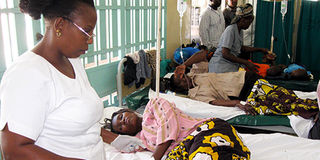
A nurse at the Coast Provincial General Hospital attends to a patient. Rising temperatures and extreme weather place additional strain on fragile healthcare systems.
The birth of my first child in 2018 revealed how unreliable electricity can undermine healthcare in rural Kenya. Frequent power outages disrupted vaccine storage, forcing families to travel long distances only to discover vaccines were unavailable.
While I could sometimes find alternatives, many mothers could not afford the extra transport costs or time away from caregiving.
My experience as a technical manager in a rural hospital had already exposed me to the challenges healthcare workers face in preserving vaccines and other temperature-sensitive medicines during blackouts.
Many clinics lack refrigeration, requiring health workers to transport vaccines over long distances, often in extreme heat that threatens their effectiveness. It became clear that this was not just an energy problem but a healthcare access challenge that disproportionately affects women and rural communities.
That realisation inspired us to establish Drop Access in 2021, a Kenyan company developing locally manufactured technologies for underserved and off-grid communities.
Our flagship innovation, VacciBox, is a portable solar-powered refrigerator that safely stores vaccines, blood, oxytocin and other temperature-sensitive medical supplies between 2°C and 8°C without relying on grid electricity. Its portability enables healthcare workers to take lifesaving services closer to remote communities.
Climate change is making these challenges even more urgent. Rising temperatures and extreme weather place additional strain on fragile healthcare systems, particularly in vulnerable settings such as Kakuma refugee camp, where reliable cooling is essential.
One lesson has shaped our journey: the best innovations come from the communities they are designed to serve. Healthcare workers and local residents continuously refined VacciBox, ensuring it addressed real-world needs rather than assumptions.
As governments seek cost-effective ways to strengthen healthcare systems, locally manufactured solutions offer a path to greater resilience. Africa has the talent and ingenuity to build technologies tailored to its own realities.
By investing in community-driven innovation and local manufacturing, the continent can expand healthcare access and ensure that quality care is no longer determined by geography or unreliable infrastructure.
Despite these barriers, momentum around African-led innovation continues to grow. Being selected as a finalist for the 2026 Zayed Sustainability Prize in the Health category became an especially meaningful moment after years of uncertainty and self-doubt.
Being recognised on such a global platform felt like validation that our work matters.
Beyond the visibility, the recognition also came with $100,000 in funding, providing critical support to help us continue scaling the technology and strengthening resilient healthcare access in underserved communities.
The Prize also strengthened our credibility and opened new opportunities.
As healthcare systems evolve, we have explored more flexible service models, including cooling-as-a-service systems that reduce the upfront cost burden for healthcare facilities that cannot afford expensive refrigeration infrastructure.