Time flies with great content! Renew in to keep enjoying all our premium content.
Prime
Innovating to unlock the livestock economy
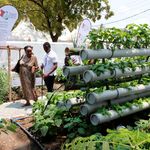
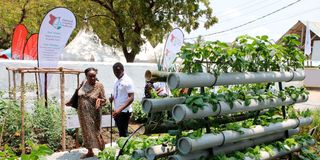
Kenyans Learn various ways of Establishing Smart Farming Units within their homesteads at the National Irrigation Authority Stand during the 2023 Agriculture Society of Kenya (ASK) Mombasa International Show in this photo taken on September 7, 2023.
A visit last week to the Rumuruti livestock market brought back memories of past debates with colleagues in the 10th Parliament. In the lead up to the Constitution of Kenya 2010, the marginalisation question loomed large, many seeing it as the primary driver of the political upheaval surrounding the 2007 General-Election. Devolution and the equalisation fund became the key constitutional remedies.
Some intellectuals posited that because the promised redistribution – the gains from focusing in high potential areas were to be used to develop the low potential ones - never happened, the unintended consequence of Sessional Paper No. 10 of 1965 was to make marginalisation official policy.
To buttress their arguments, my sparring partners compared the outcomes in the tea and livestock sectors.
While Kenya Tea Development Agency (KTDA) solved the aggregation problem, making it possible for smallholder farmers to own tea factories, there was no similar efforts in the livestock industry, with Kenya Meat Commission inherited from the colonialists struggling in most years.
Co-managed by the Livestock Marketing Association and the County government, the Rumuruti livestock sale yard operates once a week. Last Thursday, there were hundreds of buyers and sellers of livestock, allied products and services. I counted 31 small trucks, and 18 pickups, all waiting for customers who needed to transport their animals.
Afterwards, I reflected of the various organisations and initiatives in the sector. The government has the National Livestock Development and Promotion Service, while private sector has the Kenya Livestock Marketing Council, the Kenya Cattle Feeders Association, and Kenya Livestock Producers Association and the Kenya Meat and Livestock Exporters Council. Between government and private sector, more than a dozen programmes.
Most programmes have rather long names like Creating Shared Value in the Livestock Sector with Young People in Kenya’s ASAL (CASHA), and the De-Risking, Inclusion and Value Enhancement (DRIVE) of pastoral economies, by the State Department for Livestock, in partnership with FAO and World Bank, respectively.
The AU-IBAR associated Sustainable ASAL Fodder Economy (SAFE) Fund, is a specialised financing mechanism for fodder production. The Supporting Pastoralism and Agriculture in Recurrent and Protracted Crises (SPARC), is run by Cowater International, and ILRI.
The State Department has the national vaccine campaigns (against Foot-and-Mouth, Rift Valley Fever, and Peste des Petits Ruminants (PPR), and the Kenya Livestock Commercialization Project (KeLCoP). The latter programme aims to reach 110,000 households, providing access to improved sheep, and goat breeds.
A new Sh3 billion animal feeds plant in Athi River has dominated the press recently. It apparently will produce 240,000 metric tonnes annually.
Most initiatives focus on commercialisation, climate resilience, and value chain modernisation to increase productivity. Innovations in Kenya's livestock sector are largely focused on increasing productivity per animal through technology, improving feed security in Arid and Semi-Arid Lands (ASALs), and enhancing the value chain through digital tools and infrastructure.
They include the establishment of large-scale, private-sector-driven feedlots, the expansion of digital, data-driven farming, and new, sustainable, livestock-related financial products.
There are several digital-based innovation projects by both the public and private sectors. Anitrac and Mifugo 360 are government-led initiatives under the Drive programme to enhance livestock traceability and streamline vaccination, respectively.
iCow provides SMS-based services, and a digital marketplace (Soko). Flockr is a web and mobile app for modernising cattle production under feedlot conditions. Built by Craft Silicon and Ranch Experts, it also provides a digital marketplace for value chain participants.
In late 2025, the SPARC programme mapped the national livestock routes (migratory corridors, water points, and markets). These digitised routes are now integrated into the National Livestock Market Information System (NLMIS) to protect, and improve, the mobility of pastoralist herds. NLMIS is managed by the State Department for Livestock.
By some reports, beef exports generated approximately $99.6 million in 2024, a growth trend that the feedlot system aims to accelerate by meeting international quality standards.
The National Feedlot System is government’s long-term goal of establishing 450 feedlots across 21 ASAL counties. Three pilot sites - Chemogoch in Baringo, Kibiru in Meru, and Wajir West in Wajir are active. In addition, the Griftu Irrigation and Feedlot Project in Wajir, by the State Department for Irrigation is creating a 5,000-acre facility designed to accommodate 2,000 cattle.
Kenya's livestock sector seems poised for rapid modernisation driven, by digital innovations and new financing models. Unfortunately, the war in the Middle East is disrupting early gains such as exports to UAE.
@NdirituMuriithi, an economist, is partner at Ecocapp Capital, the advisory firm.
Unlock a world of exclusive content today!Unlock a world of exclusive content today!