Benchmarking and own-source revenue

osr

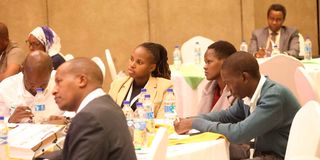
Delegates at Safari Park hotel in Nairobi on February 5, 2025 during Own Source Revenue (OSR) Growth Conference.

Photo credit: File | Nation Media Group

This year's Own-Source Revenue (OSR) Conference will be at Tamarind Tree, Nairobi on April 22 and 23. This annual event brings together county delegates and various experts to examine best practices in how counties raise revenues.

It is a benchmarking and peer learning opportunity. This year’s meeting focuses on physical planning, land administration and property taxes. And, for the first-time, recognition awards for top performers. Partners include the World Bank, Cooperative Bank, and CS Payments.
After a period of stagnation and consistent target misses, OSR has recently surged, driven by digital reforms, growing by 156 percent since 2013. Still, it only contributes about 12 percent of total county budgets. Collections have grown from Sh26.3 billion to Sh67.3 billion per year. Meanwhile, targets increased from Sh54.2 billion to Sh78.6 billion in the same period.

Last financial year, counties collected 77 percent of their targets, considerably better than 48.5 percent 10 years earlier, indicating both better revenue performance and forecasting. Performance in 2024/25, was particularly strong with a 63 percent increase from the previous year. This is due to system automation and human side reforms.

Nairobi and Mombasa reduced leakages and increased collections by over 30 percent.

Across the board, revenue from health facility services significantly bolstered totals, with the Facility Improvement Fund (FIF) hitting 118 percent of its target in 2024/25. Narok (with Sh2.98 billion in a single quarter), Nairobi, Mombasa and Nakuru are leading OSR generators by volume.

The 10 most improved counties surpassed their 2023/24 targets. These include Turkana (241 percent), Vihiga (136 percent), and Kirinyaga (118 percent).

Counties with lowest performance like Tana River, Marsabit, and Wajir consistently record the poor absolute figures, often due to smaller tax bases.

Despite growth, challenges persist. A large gap remains between current collections (Sh67.3 billion) and the documented potential of Sh240 billions.

Some counties still rely on outdated manual processes, leading to high revenue leakages. In a serious lapse, others have outdated valuation rolls meaning property taxes are based on old land values. Most businesses operate in mobile money enabled sectors – a great opportunity for innovative counties.

But benchmarking is widely misunderstood in Kenya, primarily because the term has been taken from its actual meaning and recast in the public eye as a synonym for wasteful government spending. While dismissed as joyrides for per diem purposes, benchmarking remains a vital management tool, used effectively in various sectors.

Professional benchmarking is a structured process that includes first identifying specific gaps in your own performance before looking elsewhere. Then you choose a best-in-class partner to specifically learn from. The magic of benchmarking lies in the discipline to adapt and implement findings locally - a step often missing in criticised government trips.

There are successful yet overlooked examples, where Kenyan institutions have used benchmarking to drive genuine improvement. Public universities successfully use development benchmarking to improve academic functions and continuous improvement systems. Huduma Kenya utilises benchmarking to maintain its efficiency and customer-focused service delivery models.

The Public-Private Partneship (PPP) Unit has identified best practices for attracting private investment in energy and water sectors.

Parliament performs self-assessments against international benchmarks for democratic legislatures to improve governance standards.

The misunderstandings are fueled by hurdles that hinder benchmarking. Doing it well requires skills. Second, the right match must be found to ensure findings can be translated into the local environment. It is most useful to benchmark with a better performer.

Finally, proper benchmarking requires disciplined planning, significant time, and most importantly, follow through. It is no use learning if you will not implement. And none of these should be sacrificed for short-term travel objectives.

For instance, investment promotion is about persuading investors that your location is better than the next – in other words, benchmarked against your competitor, you are a better destination! This is usually stated in terms of competitiveness. Investment conferences are used as platforms to project this. Kenya has just held one.

Perhaps because of it, comparing Kenya’s transformation to the Singapore story is back in social media again. The original debate was sparked by the President. I share his view that Kenya will reach the high-income category in this generation.

Data supports this conclusion. Per capita income has increased 6.3 times in the last 23 years. It stands to reason that at the same pace, the target is within reach.

That is why NMG’s Singapore Connect 2026 is such a brilliant idea. I look forward to robust debates! Thoughts become ideas, which become action, which brings about impact.

Ndiritu Muriithi is an economist and partner at Ecocapp Capital.  He is also the chairman of KRA and former governor of Laikipia County. Email: [email protected]

PAYE Tax Calculator

Note: The results are not exact but very close to the actual.