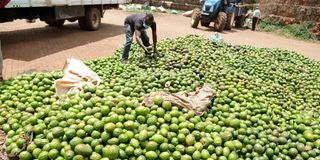
The Agriculture ministry has cautioned farmers to shun exploitative middlemen as the new export window for avocados gets underway.
"The government will crack down on the cartels exploiting farmers in rural areas, taking advantage of their ignorance and desperation to sell their perishable produce for low prices and thus incur losses," Agriculture Principal Secretary Paul Ronoh said.
"Some brokers dupe farmers into harvesting early, then disappear, only to reappear when the quality has dropped so they can offer rock-bottom prices," he said.
The Agriculture and Food Authority (AFA) reopened the 2025/2026 avocado export season on April 2, 2026, following improved fruit maturity across major production zones.
The regulator, however, introduced stricter regulations to ensure only mature, high-quality fruit reaches premium markets.
For example, all exporters are now required to undergo mandatory packhouse inspections, submit lists of registered suppliers, and adhere to traceability systems that link shipments to their origin and harvest timing.
Open trucks and pickups have also been barred from transporting the fruit, while those caught harvesting immature crops will have their permits revoked.
AFA’s move comes amid heightened scrutiny from key importers, including China and the European Union (EU), who have raised quality concerns tied to immature harvests.
Kenya, which is Africa’s largest exporter of avocados, ships more than 60 per cent of its annual output to Europe and the Middle East, with sea transport accounting for the bulk of consignments.
Kenya’s avocado output rose by 34 percent, from 632,953 tonnes in 2023 to 848,122 tonnes in 2024, reflecting both the expansion of farming into non-traditional areas and sustained global demand.
The country’s avocado exports in 2024 primarily went to the European Union, which remains the largest market, followed by the Middle East and China, where shipments have grown steadily since the market opened in 2022.
These destinations absorbed much of the record output, with Kiambu, Murang’a, Nakuru, and Kisii counties standing out as the top producers, fueling both domestic and export supply.
Avocados are the country’s largest export fruit, followed by pineapples, mangoes, raspberries, passion fruits, and lemons.
The value of Kenya's overall fruit exports increased by about 27 percent in 2024, driven mainly by soaring avocado shipments and steady contributions from bananas and mangoes.
Traders sold fruits worth Sh41 billion in the export market in 2024, according to data by AFA, marking a jump of Sh8.7 billion, compared to the Sh32.3 billion earned in 2023. Export volumes also increased significantly, from 188,101 tonnes in 2023 to 225,414 tonnes in 2024, with Hass avocado accounting for the lion’s share of the increase.