Uneasy US-Iran truce adds Nairobi bourse Sh101bn

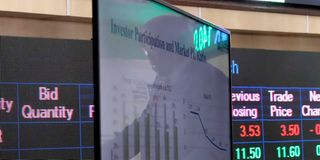
Screen showing market trends at Nairobi Securities Exchange. 

Photo credit: File | Nation Media Group

Kenya’s stock market has added Sh101.8 billion in investor wealth in the last two days after investor sentiment towards equities improved on news of a tentative ceasefire in the Iran war that has spooked global markets.

The Nairobi Securities Exchange (NSE) added Sh76.1 billion in market capitalisation—the measure of investor wealth—on Wednesday, before adding a further Sh25.7 billion on Thursday.
On Tuesday, US President Donald Trump announced the conditional two-week ceasefire if Iran agreed to reopen the Strait of Hormuz, a key gateway that carries up to a quarter of the globe’s daily oil and gas supplies. With the conditional agreement, the US pulled back from Mr Trump’s earlier threats to escalate Iran bombing.

The month-long conflict hit financial markets hard, triggering equities selloff as investors turned to holding dollars as a hedge, fearful of the negative impact of higher inflation a due to elevated fuel and food prices.

The NSE was also affected, with its top five blue chip stocks shedding more than Sh280 billion in market capitalisation in March due to the selling activity by foreign and large institutional investors. This was despite the banking stocks trading within their dividend periods after announcing record profits for the financial year ended December 2025.

These investors were also locking in the gains they had made in the recent bull run at the bourse, while increasing flexibility in case an inflation spike due to higher energy prices results in higher yields in the fixed income market.

Following the news of the pause in hostilities, the market has now reversed some of the losses, with top firms Safaricom, Equity Group, KCB Group and Co-operative Bank leading the charge.

Traders said that the two-day rally has largely been driven by local institutional investors, with foreigners having made net sales of Sh362 million on Wednesday.

Safaricom has added Sh42 billion in valuation over the last two trading sessions, to settle at a market cap of Sh1.18 trillion by close of trading on Thursday. The telco’s share is now trading at Sh29.45, up from Sh28.40 on Tuesday.

Equity’s market cap has risen by Sh12.3 billion to Sh276.4 billion in the period, followed by Co-operative Bank at Sh11.7 billion to Sh180.4 billion and KCB at Sh8.8 billion to Sh225.7 billion.

Alongside EABL, these four firms account for 60 percent of investor wealth at the bourse, with their share price movement influencing the overall performance of the market significantly on any trading day. Other firms with notable valuation gains are Absa Bank Kenya at Sh5.4 billion to Sh167.6 billion, and Kenya Airways at Sh4 billion to Sh38.1 billion.

Besides the NSE, the shilling has also showed a positive reaction to the Iran ceasefire. The local unit rose from Tuesday’s closing rate of Sh130.06 versus the dollar to trade at an average of Sh129.26 in the spot market by late Thursday afternoon. Last week marked the first time the shilling-dollar rate touched the 130 level since August 2024.

Traders said that although the shilling did not experience pronounced volatility after the start of the Iran war, it was pressured by an increase in demand for dollars by importers, who were hedging against possible increases in prices of overseas supplies should the conflict be prolonged.

In the Kenyan context, higher oil prices have presented the most immediate risk for the currency, given that fuel is Kenya’s largest import item.

There is also the secondary effect of higher fuel prices on the cost of other imported goods, which would widen Kenya’s current account deficit and put pressure on exchange rate.

Oil prices are however likely to come down should the US-Iran ceasefire result in the full reopening of the Strait of Hormuz, freeing shipments by key producers Saudi Arabia and the UAE, who also supply the Kenya’s petrol imports.

Global equities surged on Wednesday after the announcement, with US indices climbing to their pre-conflict levels, as oil benchmark prices fell below $100 from highs of up to $118 last week.

PAYE Tax Calculator

Note: The results are not exact but very close to the actual.