Partygoers take the fun to middle of Indian Ocean

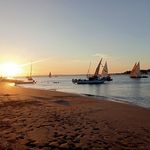
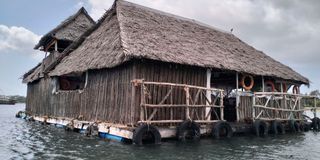
The Lamu Floating Bar, pictured on December 17, 2024, is a popular venue for floating birthday celebrations, engagements, weddings and other special events in the Lamu Archipelago.

Photo credit: Kalume Kazungu | Nation Media Group

It is 4pm and a fully packed wooden dhow sets out from the ancient stone town of Lamu into the Indian Ocean at Ras Kitau. As the dhow sails past Shella, a large banner unfurls from its mast: 'HAPPY BIRTHDAY'. On board, a group of friends breaks into song.

Such scenes have become increasingly common along Kenya’s Coast, particularly in Lamu, Malindi, Watamu and Kilifi, as Kenyans and foreign visitors hire traditional dhows to host parties in the middle of Indian Ocean.
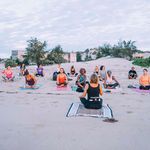
In Lamu, the parties mostly happen in Shella, Manda, Ras Kitau, Kipungani and Kiwayu islands.

Kristina Emil, a tourist from Norway, is among the growing number of foreigners drawn to the trend. A frequent visitor to Kenya’s Coast, she chose Lamu’s Ras Kitau to mark her birthday this year.

“I have done birthdays on yachts in Mombasa, boats and floating bars and restaurants in Kilifi. This year, my birthday was in Lamu’s Ras Kitau,” she tells BDLife.

“Celebrating aboard a traditional Swahili dhow, she adds, is a distinctly coastal experience. “You’re floating on the Indian Ocean, eating fresh seafood, dancing to coastal music, watching the sun set. It’s magical and unforgettable.”

Newest niche

Tourism operators say Kenya’s Indian Ocean coastline has long been associated with beach parties and resort nightlife. But middle-of-Indian Ocean celebrations, ranging from sunset cruises to private weddings and engagement parties, are emerging as the newest niche.

Fridah Njeri, chairperson of the Lamu Tourism Association (LTA), says middle-of-the-ocean parties are helping to boost tourist numbers, particularly among repeat visitors and those looking for experiences beyond traditional sand-and-beach.

Tourists board excursion dhows for a floating birthday celebration on the Indian Ocean off Ras Kitau, Lamu, on June 11, 2026.

Photo credit: Kalume Kazungu | Nation Media Group

Ms Njeri, who is also the proprietor of the Lamu Floating Bar and Restaurant, says sailing into the open water gives visitors a different experience.

“We should be actively promoting this as a new tourism niche,” she says. “It gives visitors a completely different way of experiencing the Coast.”

The cost

Hiring a dhow, decorating it and catering for guests can cost anywhere between Sh15,000 and over Sh150,000, depending on the size of the group and level of service.

“People are paying for sunset sailing for birthdays, engagements, weddings…any celebration, really,” Ms Njeri says.

Hassan Faraj, a coxswain who operates the Arya Excursion Dhow in Lamu and has been in the trade for seven years, says his rates range between Sh20,000 and Sh70,000 for a day excursion.
“It depends on the number of people,” he says. “For three guests, for instance, I charge about Sh20,000.”

In Kilifi, Maureen Obunga, the chairperson of the Kenya Association of Hotelkeepers and Caterers, says mid-ocean parties are a welcome innovation for the Coast’s tourism industry.
“These experiences breathe new life into destinations that visitors already know,” she says.

Ms Obunga, who is also general manager of Malindi Ocean Beach Resort and Spa, notes that while established beach towns such as Diani and Watamu remain popular, premium marine offerings—yacht charters in Mtwapa Creek, sunset dhow cruises in Kilifi, or island-hopping parties in Lamu—give travellers fresh reasons to return.

“It shifts the Coast from being a place where you simply look at the ocean,” she says, “to one where you actually live on it.”

New jobs at sea

Tour guides and beach operators say the trend is opening up new income streams. Mohamed Abubakar, a tour guide in the Lamu Archipelago, describes floating celebrations as a potential game-changer, particularly in culturally conservative destinations with limited nightlife.

Now 53, and with 22 years in tourism, Abubakar points to Lamu Old Town, a UNESCO-listed heritage site, as an example of where entertainment options are intentionally restricted to preserve tradition.

“Taking parties to the middle of the ocean offers a practical solution for the wide mix of tourists visiting the archipelago,” he says. “These visitors can party at sea,” Abubakar says, “without disrupting daily life or culture of the mainland.”

Tourists board excursion dhows for a floating birthday celebration on the Indian Ocean off Ras Kitau, Lamu, on June 11, 2026.

Photo credit: Kalume Kazungu | Nation Media Group

In Malindi, beach operator Ali Aboud says floating parties are fuelling a small but growing ecosystem of work. Traditional drummers, DJs, live musicians, decorators, photographers and boat crews are all drawn into what he calls a “micro-economy”.

“This creates a micro-economy,” Aboud says, “a single floating wedding or birthday party on a traditional dhow or yacht also triggers a chain of local spending, from captains and sailors to artisans, woodcarvers and mechanics who maintain the vessels.”

Cultural sensitivity

As floating parties gain popularity, Aisha Miraj, a tourism executive in Lamu, says cultural sensitivity must remain.

“We encourage visitors to enjoy the freedom at sea and the experiences,” she says, “but we also ask that they dress and behave modestly when moving through villages and town centres.”

The balance, Ms Miraj adds, lies in allowing tourism to grow without eroding the social fabric that makes Lamu distinctive in the first place.

Follow ourWhatsApp channel for the latest business and markets updates.

PAYE Tax Calculator

Note: The results are not exact but very close to the actual.