How Benedict turned half-acre Ngong home into sanctuary for birds, trees

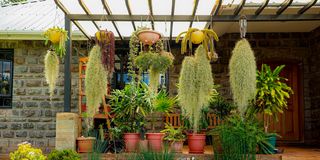
Hanging and potted plants at Benedict Odongo’s home in Ngong on March 22, 2026.

Photo credit: Lucy Wanjiru | Nation Media Group

A yellow-billed kite drinks unhurriedly from the concrete bird bath at the centre of Benedict Odongo’s garden. It pauses briefly, casts a territorial glance around its surroundings, then lifts off toward one of the trees that tower over the compound.

“That’s one of our resident birds,” 63-year-old Benedict says, pointing toward a nest tucked high in the branches. “I have a video recording of it fighting off a hawk at the water bath.”
Benedict’s garden shifts in a schedule of its own, filling up and emptying as different birds come and go. According to him, they are drawn largely by the steady presence of water.

“The smaller birds tend to come in early in the morning,” he observes. “Then the resident kites, the pigeons, and later in the afternoon, different varieties of birds come in, including a long-tailed one, likely the Speckled Mousebird, that enjoys eating the fruits of the poison arrow tree that’s growing right next to the bath.”

The birds, however, are only one part of the sanctuary Benedict has carefully cultivated.

A sitting area in the compound.

Photo credit: Lucy Wanjiru | Nation Media Group

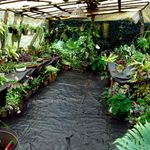
Three years ago, when he and his family moved into the property, much of the land was covered with wild shrubs and trees. Today, the half-acre plot has been reworked into a layered garden blending hard and soft-scape elements. He has concrete walkways that wind through the property and more than 100 plant species, most of which he knows by their scientific names.

A few of these plants, he has planted in concrete pots made from repurposed culverts.

But rather than follow one uniform design, Benedict, whose love for plants began in his parents’ farm, has divided the space into loose, functional zones.

One section remains largely natural, made up of trees he found growing there. Another section, ‘the man-made section’, hosts a mix of hardwood trees such as jacaranda, mahogany, Sudan Teak and African blackwood, alongside varying Yucca plant species, medicinal trees such as moringa, a patch of cycads and an esteemed rock garden that he has dedicated entirely to succulents.

“A friend once challenged me saying we don't eat trees, so I added a small portion with oranges, lemons, macadamia nuts and coffee,” he says, noting that the coffee was planted in honour of his late father who loved and grew it extensively. “I also tried cashew nuts but they didn’t take, I think it’s too cold for them.”

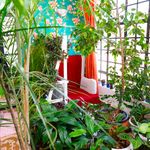
He has also set aside a small stretch for children to play or for hosting small gatherings with a compact seating area to the side that offers a full view of the garden. This, he says, is one of his favourite spots.

“I like to sit under the shade and listen to the birds while soaking in the fresh air,” he says.


Various succulents near the gate. 

Photo credit: Lucy Wanjiru | Nation Media Group

Potted succulents flank the path leading up to his house and dominate the shelves on his verandah, reflecting his love for the water-storing plants. In contrast, flowering plants are noticeably scarce.

“That was deliberate,” he says with a laugh. “I prefer succulents because they last longer and do not require as much care as flowering plants do.”

A vertical vegetable garden with more fruits, leafy vegetables and herbs adds another layer to the space, while a living fence of miniature bamboo, bougainvillea, eugenia and green duranta encloses the perimeter.

Another intentional feature in Benedict’s green space is the lawn, where he has planted four different grass types: Pemba green, Pemba variegated, Zimbabwe and mudriver, each selected for how it performs under specific conditions.

“I chose Zimbabwe for that stretch with lots of tree cover because it does well under the shade,” he says. “And then I wanted Pemba because it is drought-resistant and it also makes it difficult for weeds to grow wherever it establishes itself. I didn’t want to be constantly weeding, especially since bird droppings and the animal manure that I use as top dressing tend to contain some seeds.”

And while the mudriver grass demands more care than the others, Benedict says it compensates for it with rapid growth.

“It dries up quicker during the dry spells, but once the rain comes, it picks up a lot faster,” he says. “In the last three weeks, I’ve had to mow it twice already.”

Air plants in the compound.

Photo credit: Lucy Wanjiru | Nation Media Group

Demanding system

But behind the calm, curated space, is a system that demands consistent time and resources. Benedict harvests rainwater and supplements that with water from a community water project and a private supplier.

“Between these three sources, we never lack water,” he says.

During dry periods, he waters his garden two to three times a week. His routine maintenance also includes pruning the trees, mowing the grass and once in a while, applying pesticides, particularly on plants like neem and the citrus trees, which are susceptible to pests.

He has also hired a gardener to help him with the care and maintenance of his sanctuary, but he remains actively involved.

“I have also had to bring in some soil,” he adds. “Initially, my compound had two different soils, red soil and black cotton soil. To enrich the black cotton, I added some red soil.”

Benedict estimates the cost of maintaining the garden to well into its hundreds of thousands. This estimate also represents the cost of learning what works and what does not.

“I’ll give you two examples. When we first moved in, I bought around 25 Ashoka trees, each at Sh500. Only five made it, though they’ve been really struggling,” he says. “And then there’s a bismarck palm, which costs from Sh6,000 upwards. I have tried planting it three times without success, it’s only now, on the fourth attempt, that it has taken root.”

Painful though the losses have been, Benedict says that the returns are well worth it.

“I enjoy researching and selecting what species to plant next, as well as the propagation and transplanting,” he says. “But most of all, I get a lot of satisfaction just watching these plants grow. That’s why I prefer buying young plants rather than mature ones.”

Benedict Odongo’s compound at his home in Ngong.

Photo credit: Lucy Wanjiru | Nation Media Group

Estimated returns

He anticipates that this non-financial return will only increase in value in years to come.

“My garden is young,” he says. “Its real beauty will be seen in five to six years when some of these plants mature. For trees such as the African blackwood, it will take even longer. Those require around 50 years to fully mature, but they produce the most expensive kind of timber. So maybe my great-grandchildren will be the ones to benefit from those.”

Over time, Benedict has come to view the losses less as failures and more like lessons. One key lesson has been understanding the true cost of plants. Cheaper roadside options, he notes, often come with uncertainty, particularly for non-indigenous species that may struggle to adapt.

“More established nurseries might be pricier, but they tend to sell plants that have already acclimatised to local conditions,” he says. “At first you think that they are very expensive, but once you start losing plants, you really understand what you are paying for.”

Benedict Odongo at his home in Ngong on March 22, 2026.

Photo credit: Lucy Wanjiru | Nation Media Group

Other lessons

Other lessons, he adds, extend to life beyond the garden.

“It’s taught me patience,” he says easily. “I have come to understand that there are different factors that influence the growth of a thing and that there is a time for everything.”

He recalls one of his cycads that showed no change for a year.

“Just when I was about to give up on it, I saw a tiny leaf begin to sprout,” he says. “That’s when I realised that I just needed to be patient.”

Gardening has also taught him to anticipate and adapt to the unexpected.

“Just as a human could fall sick, unexpected events like hailstones, a lack of rain, pests or diseases could happen,” he says. “You have to work with the resources you have and find solutions. And sometimes, even when you do everything you can, the plant still dies. But it’s okay if you have to start over again.”

Even small details like spacing and soil composition, have left Benedict with a lasting perspective.

“It’s not supposed to be that way, but I intentionally planted some of my trees close together so that they compete for sunlight and grow tall and straight,” he says.

“I learned this the hard way. I wasn’t paying attention to one of my trees and it started to bend. I realised later that I should have been forcing it to go up, but that’s why they say that in gardening, there are no mistakes. Only lessons.”

Follow our WhatsApp channel for the latest business and markets updates.

PAYE Tax Calculator

Note: The results are not exact but very close to the actual.