Inside Palermo’s historic centre, where baroque architecture meets contemporary luxury, Sicily’s wine industry is positioning itself to reap from global tourism trends.
At the 22nd edition of Sicilia en Primeur, a major annual showcase organised by Sicilian producers, wineries, journalists and buyers gathered to taste new vintages. But alongside the wines, much of the conversation centred on how Sicily is trying to position itself within the global rise of experience-driven travel.
Held under the theme “Taste the Island. Live the Story,” the event brought together 56 wineries and more than 1,000 labels. Between tastings, industry participants discussed how wine tourism has become a growing part of business models across the island.
The shift reflects a wider change in travel habits. Visitors are increasingly looking for experiences that combine food, landscape, culture and storytelling, rather than structured sightseeing alone. Sicily, producers say, is well placed to respond to that demand.
A report presented at the conference by CESEO-Lumsa University found that 61.4 percent of Sicilian wineries recorded an increase in visitors in 2025, while nearly three-quarters said most of their guests were international, largely from Europe and the United States.
The study also suggested that wine tourism now accounts for around 10 percent of turnover for many wineries, excluding direct wine sales.
Mariangela Cambria, president of Assovini Sicilia, said wine in Sicily cannot easily be separated from the place. “Talking about wine in Sicily inevitably means talking about a journey,” she said. “One that goes beyond tasting and becomes a cultural experience connected to the region and its communities.” On the ground, that shift is visible in how wineries are designing visitor experiences.
Beyond production
At Fina Winery near Marsala in western Sicily, wine is closely tied to family history and a willingness to experiment with what the region can grow.
One of its signature wines, “Kikè”, is made primarily from Traminer grapes, a variety more commonly associated with northern Europe. Planted at a higher altitude near Erice, the vines benefit from cooler temperatures than those found along Sicily’s coast.
Federica Fina, who works with the family winery, said the wine reflects both curiosity and adaptation.
“It is unusual for Sicily, but it still carries the island’s character,” she said. “The Sauvignon Blanc balances the aromatics so it doesn’t become overwhelming.”
The wine is named after her childhood nickname, a detail that the estate also weaves into its storytelling when hosting visitors. Like many Sicilian producers, the winery is also beginning to look beyond its traditional European and American markets, with interest slowly building in newer regions.
Fina believes Sicilian wines could resonate with African food cultures because of their freshness and citrus-driven profiles, though distribution remains limited.
“It would pair beautifully with many dishes,” she said. “One friend once told me the wine feels like dancing in a glass.”
Wine as experience
On the slopes of Mount Etna, wineries are also reshaping how they present themselves to visitors, blending production with hospitality and, increasingly, wellness.
At Camporè Winery, a family estate managed by sisters Cristina and Roberta Madaudo, wine is framed less as a product and more as part of a broader way of life.
The winery offers tastings and guided visits, and is exploring a wellness concept that would bring together wine, food and spa experiences.
Cristina said the idea reflects how expectations are changing among visitors.
“For us, wine is not only something in a glass,” she said. “It is something you experience.”
She also pointed to changing attitudes toward alcohol, particularly among younger consumers in key export markets, where moderation and health awareness are shaping consumption patterns.
Cristina, who trained in medicine before joining the family business, said this has forced producers to rethink how wine is positioned.
“People are looking for authenticity and connection, not just consumption,” she said.
At Camporè, that philosophy extends to how guests are received. Visitors often meet members of the family directly rather than only hospitality staff, something the sisters believe adds a layer of familiarity that larger estates cannot always replicate.
Volcanic landscape
Further east, Mount Etna continues to define one of Sicily’s most distinctive wine regions. Here, vineyards sit between volcanic soil, mountain air and Mediterranean light, producing wines known for their acidity and mineral character.
At Tenute Bosco, a small producer working mainly with native grape varieties, owner Sofia Ponzini said the mountain shapes everything from taste to identity.
Locally, Etna is often referred to in feminine terms, a reflection of cultural ties to the landscape.
The wines are typically light in structure but precise in flavour, influenced by altitude and sharp changes in temperature. “These wines reflect the mountain,” Ponzini said. “You don’t separate geography from what is in the glass.”
Production is deliberately small, with some labels made in quantities of just over 1,000 bottles. That scarcity has helped Etna wines gain visibility in higher-end restaurants and specialist wine lists abroad.
Sustainability and scale
Alongside tourism and production trends, sustainability has become a central focus for many Sicilian wineries.
Data presented at Sicilia en Primeur showed that nearly 87 percent of participating estates now generate at least part of their energy from renewable sources. Many have also reduced packaging weight and moved away from single-use plastics. The adoption of digital tools, however, remains uneven.
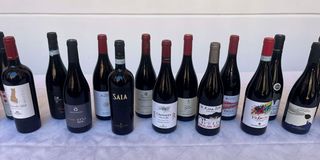
Wine bottles on display during the 22nd edition of Sicilia en Primeur in Palermo, Italy, on May 13, 2026.
Photo credit: Marion Sitawa | Nation Media Group
Around 30 percent of wineries currently use artificial intelligence (AI) in some form, mainly for marketing and visitor engagement. Edoardo Colombo, president of Turismi.AI, said technology is likely to play a growing role in how destinations manage tourism flows and personalise visitor experiences. “Digital tools are becoming part of how the industry communicates,” he said.
A shifting market
While Europe and the United States remain the main export markets, Sicilian producers are increasingly exploring opportunities elsewhere, including parts of Africa and Asia. Interest in Sicilian wines is also growing in urban markets where consumers are becoming more curious about origin, grape variety and food pairing.
In Kenya, for example, sommeliers say Sicilian wines are gaining attention for their versatility with food.
“Many of them work well with spice and flavour,” said Nairobi-based sommelier Victoria Muli-Munywoki. “You can taste the place, and that’s what people are looking for now.”
She highlighted varieties such as Nero d’Avola, Grillo, Catarratto and Carricante as particularly suited to local cuisine, especially dishes with bold seasoning.
“Rosé wines from Sicily also stand out,” she said. “They tend to have more structure and character than what people expect.” For producers, such markets represent both opportunity and challenge as they try to balance tradition with expansion. Among Sicily’s established names, including Planeta, Donnafugata and Tasca d’Almerita, distribution is already global, including select availability in East African markets.
“You can tell the terroir of the wines, depending on where they’re grown and produced. Case in mind, Etna wines, that minerality, you cannot not fail to fall in love with Etna wines,” she says
She singled out Nero d’Avola as one of the standout varietals, describing it as “a fantastic wine for pairing with African food, particularly the spicy Kenyan food.”
“Blue is not just a colour. It is a feeling. It communicates depth,” she said.
Sofia works primarily with native grape varieties such as Carricante, Catarratto, Minnella and Grecanico, that preserves the old mixed vineyards rather than separating grapes into monocultures.
Other wineries that participated in the Sicilia en Primeur tasting showcase included Donnafugata, Planeta, Tenute Bosco, Tenuta Navarra, Gambino, Casa Grazia, Cottanera, Benanti, Giovinco, Camporè, Caruso & Minini, Nicola Fiasconaro, Feudo Arancio, Vivera, Zisola, Tornatore, Santa Tresa and Pietradolce among others
The result is wines she describes as expressions of Etna’s authenticity.
“Etna wines are mountain wines. They have freshness, acidity and verticality,” Sofia said.
The term “verticality,” which is commonly used in wine language, refers to wines with freshness and structure that move sharply across the palate rather than feeling broad or heavy.
Her wines also reflect the unique geography of Etna, where vineyards sit between volcanic slopes, Mediterranean sunshine and cooling mountain air.
“We are in the middle of the Mediterranean, but also on a mountain,” she said.
The contrast creates wines with minerality, freshness and complexity that is sought after by global consumers looking for a distinctive terroir-driven wines.
Like many boutique Sicilian producers, Sofia produces limited quantities, sometimes as few as 1,200 bottles for premium selections.
The scarcity has helped elevate Etna wines into luxury categories featured in Michelin-starred restaurants and premium wine lists globally.
Sustainability as a luxury standard
Beyond wine itself, sustainability emerged as one of Sicily’s strongest selling points.
According to the CESEO-Lumsa report, nearly 87 percent of Sicilian wineries now generate renewable energy, while many have eliminated single-use plastics and adopted the lighter bottles to reduce environmental impact.
For the premium global consumers, sustainability is influencing their purchasing decisions.
Sicily is also embracing technology to strengthen their competitiveness.
Although only about 30 percent of their wineries currently use artificial intelligence tools, many producers are exploring AI-driven marketing, personalised visitor experiences and predictive tourism systems.
Edoardo Colombo, President of Turismi.AI, described Sicily as a potential “smart wine tourism destination” that is capable of combining heritage with digital innovation.
“Artificial intelligence can help transform Sicily’s already attractive tourism offering into a smarter and more personalised system,” he said during the conference.
Lessons for Kenya
Among the Sicilian grape varieties she believes Kenyan wine lovers should seek out are Nero d’Avola, Catarratto, Grillo and Carricante.
Victoria was also enthusiastic about Sicilian rosé wines, which she attributes have strong potential in the Kenyan market. “The signature of all the rosés was a touch of spice and minerality, and warmth in the glass.”
Beyond the wines themselves, she said the event delivered a complete immersion into Sicilian culture.
“We tasted and experienced the region at the same time.” Victoria adds that the experience was elevated by Sicily’s food culture, noting that many of the wines would pair well with Kenyan cuisine.
“Many of Sicily’s leading producers, including Planeta, Donnafugata, Pellegrino, Tasca d’Almerita and Mandrarossa, are already available in Kenya which provides the local consumers with an opportunity to experience the island’s celebrated wine heritage first hand,” Victoria says.