In 2016, Wilson Mwaniki bought a quarter-acre piece of land at the foot of Sleeping Warrior Mountain, roughly four kilometres from the Nairobi-Nakuru highway at Gilgil’s Kekopey centre. Reason? To build his dream home.
“I bought the two 50×100 plots at Sh650,000. At the time, I didn’t have enough money to break ground. Kekopey was ideal because I treasure my peace and being alone, and Nairobi was becoming noisier and more chaotic for me by the day,” says the 40-year-old.
A quieter place would also be ideal for the creative. “Quietude is a key component of the creative process,” he adds.
Mwaniki’s dream house, however, defies convention in a few ways.
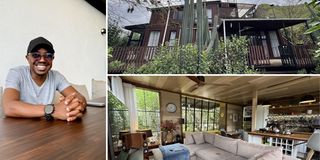
“My house is made of recycled material. Two high-cube 40-foot containers, which had been used and were about to be discarded, wood that I acquired from houses and homes that were being demolished, and generally any other material I could salvage from sites from as far as Nairobi.”
For Mwaniki, the dream was always a two-bedroom house far away from the city. After buying the land, it took him the next seven years to finish building and move to Kekopey.
He designed the house himself and would source the material and, at times, deliver it to the site himself. Mwaniki believed that, as the vision carrier of an unconventional house, few people would understand and execute his vision as he wanted. Through out the construction, he only entrusted a close friend who understood what he was building to manage the project.
“I had a project manager who is a friend who helped me intermittently, as commuting to Gilgil twice or thrice a week was not sustainable; besides, I also had my job to attend to,” points out Mwaniki.
Building debt-free
During the planning stage (between 2016 and 2020), he drew the whole financial plan and was clear that he was not going to fund the building with debt.
“I am very debt-averse. So, from the onset, I purposed to build debt-free. As a professional in the gig economy, I would get paid and push a section of the construction until my money ran out; then I would get paid again and repeat,” says Mwaniki.
He estimates the project cost him between Sh5 million to Sh8 million from start to finish and landscaping.
“It would have been a lot cheaper if I did it in one go. Staggering the project meant dealing with inflation and price changes for construction materials such as cement and sand. But building debt-free allowed me to build on my own terms. No pressure. It also allowed me to midwife the process, make mistakes, and correct them without looking at time as a factor, which is not possible when one builds with debt,” he says.
Mwaniki is, however, quick to clarify that he has nothing against debt.
“When I say I built debt-free, I don’t mean that I didn’t take debt. I would take soft loans that I would repay quickly. I just know had I borrowed money for the whole project, I would be under immense pressure (to repay), and maybe the outcomes wouldn’t be as good,” says Mwaniki.
High-cube shipping containers
Beyond the money issue, the project started on the same day the Covid-19 restrictions were announced in the country in 2020.
“I remember breaking ground moments before the president made the announcements and rushing back to Nairobi to avoid being locked in Gilgil,” he reminisces.
Wilson Mwaniki's Wild by Lera Cabins, located next to his home in Kekopey, Gilgil Town, Nakuru County, on March 23, 2026.
Photo credit: Pool
Using a high-cube shipping container gave enough headroom to avoid the space looking cramped. “The high-cube containers have a height of 9 feet 6 inches, which is a foot more than standard containers. With that, I had space for the ceiling and still enough space to stand comfortably in the cabin.”
Completely off-grid
Mwaniki’s house is completely off-grid. His system is built on deliberate planning across water, energy, and waste management, shaped by the realities of Kekopey’s semi-arid lake basin environment.
“Because underground water in the area is highly alkaline and unsuitable for consumption, I ruled out sinking a borehole early on. Instead, I designed the house with full guttering to maximise rainwater harvesting, ensuring that no rainfall is wasted. This feeds into storage tanks with a combined capacity of about 20,000 litres, enough to sustain the household for extended periods,” Mwaniki says.
In seasons with little or no rain, he supplements this supply with water delivered by bowsers from Gilgil town, a process he says he undertakes only about once a year, thanks to careful use and low occupancy—he lives alone in the house.
What about power supply?
“For power, I rely on a solar installation that generates close to 40 kilowatts of power daily, backed by lithium-ion battery storage of around 10 kilowatts, which I upgraded from an earlier, less efficient gel-battery system.”
This allows the home to operate with the same appliances and comfort levels as an urban residence. “I wasn’t going to trade comfort because I was moving away from the city. No. I still have running water as I did in the city, and appliances are in full use.”
He manages waste through two separate septic tanks — one serving the main house and another for guest cabins that he has built and shared facilities — with plans underway to integrate grey-water recycling, made easier by the home’s elevated, stilt-based foundation design.
The shipping containers are joined laterally to create a roomier living experience.
“Joining the containers side-by-side creates more space to live more naturally, as you would in a normal house. You can have normal-sized furniture and normal-sized appliances, which elevate your living experience. Living in a tiny house doesn’t necessarily mean forfeiting comfort,” Mwaniki says.
Design, he shares, is where the real work happens. “It helps you organise and build your house with the outlook and layout in mind. That way, you know exactly what fits where even before construction begins. For instance, I had all the dimensions for my kitchen appliances—microwave, oven, fridge, and gas stove—even before I started building. With these tiny houses, you have to maximise and be deliberate about usage while at it.”
Additionally, the lateral joinery helped him save on material.
“When you join the two containers, there’s material that you cut out on the sides to make one full rectangle. That was too much material to waste,” he explains.
Instead of discarding the cut steel, he repurposed it to construct a studio loft above the main structure. “That’s how I ended up with a two-bedroom house,” he says.
The final footprint measures about 44 by 16 feet, translating to roughly 1,024 square feet, making it smaller than a conventional two-bedroom home.
“With containers, you work within the eight-foot width and the fixed length — maybe 40 feet. If you go beyond that, you affect structural integrity,” he says. This constraint demanded intentional spatial planning and minimalism in both interior and exterior design.
The build process was anything but easy. “It was terrible,” he admits. “I was working full-time and trying to manage construction remotely. If I were told to rebuild it, I would not do it like that. There are things that I am not happy with. Over time, I will have to repair and redo them,” he admits.
Skilled labour
Finding skilled labour proved especially difficult. “Getting fundis here was quite an ordeal. Some of the fundis I had to bring from Nairobi or Nakuru, but locally I mostly found guys who could only do regular metal work — building the stone fence or doing general grounds work.”
Bedroom area of Wilson Mwaniki's home in Kekopey, Gilgil Town, Nakuru County, on March 23, 2026.
Photo credit: Pool
By the time he moved in the house in Apri 2023, some elements of the vision—like the landscaping he had envisioned—were still incomplete, but the pull and promise of quiet living outweighed the discomfort of an unfinished home.
“I didn’t wait for everything to be perfect. At some point, you just move in and grow with the house,” he says.
He had to recalibrate daily habits, from managing water and energy use to adjusting to the slower rhythms of rural life.
“You realise very quickly that this is not the city. You plan your days differently, you become more aware of resources, and you learn to live with what you have as you improve things step by step,” he says.
Living alone for long stretches, often with only his staff around, further deepened his relationship with solitude and the natural environment.
“The silence can be intense at first, but over time it becomes grounding.”
Moving in before full completion also reinforced his belief that a home is an evolving project rather than a finished product. “This house is still growing. Every time I fix something or add something, it becomes more aligned with how I want to live. Moving in was not the end of construction — it was the beginning of truly inhabiting the vision.”
A budding enterprise
The isolation was good for his creative ideation, and over time it also began to shape a different kind of vision—one that extended beyond his personal retreat into a budding enterprise.
Living at the foot of Sleeping Warrior Mountain exposed Mwaniki to a steady stream of curious visitors, friends, and fellow creatives who were drawn to the tranquillity of his surroundings.
“People would come here and say, ‘There is something about this place,’ and I realised the experience I was enjoying alone could actually be shared,” he says.
From hosting his friends and answering questions from hikers , Mwaniki began thinking about hospitality and land use.
He acquired an additional two 50x100 plots at a cost of Sh600,000 from a neighbouring parcel, creating the spatial foundation for a small hospitality venture. His plans now include five off-grid guest cabins and a modest restaurant, designed to complement the terrain rather than impose on it.
“I don’t want to urbanise the countryside. The whole point is to preserve the quiet that makes this place special.”
The cabins are envisioned as simple, immersive living spaces that allow guests to disconnect from urban noise, while the restaurant, when complete, will serve as both a functional amenity and a social anchor for hikers along the corridor.
“When you build something meaningful, you start to see how it can sustain itself and also create opportunities for others,” he says.
What has this home ownership journey taught the celebrated photographer? “Fundis have a mind of their own, and this is a real struggle for people building unconventionally. Everything in this process tests your patience, but nothing compares to the feeling of living in your dreams.”