Shibero Akatsa’s home in Kerarapon, an estate that is next to Nairobi’s Karen, does not look or feel like a house in an upmarket neighbourhood.
When you arrive at her house, which sits on a prime one-acre piece of land at the edge of Kariithi Close in Kerarapon, birdsongs, squirrels’ squeaks and rustling leaves welcome you.
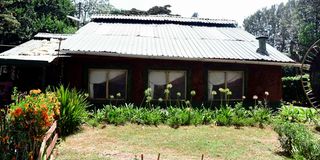
She has many trees, tens of potted succulent plants, and one or two bonsais. But what is striking is her three-bedroom house, built of mud and roofed with iron sheets.
Shibero’s green and yellow house goes against everything modern homes are meant to be. If she were to sell her one-acre land where that mud house sits, she would pocket upwards of Sh65 million. But Shibero is not selling the land, nor does she have plans to put up a palatial house like her neighbours.
“It doesn’t bother me,” she tells BDLife.
“This [my house] is where people begin to breathe again,” she says she, looking around her garden as if seeing it anew. “Sometimes they don’t even realise how tightly they’ve been holding themselves until they sit here.”
When she built the house, she did not look to the homes around her for reference. She wanted a house that would make her feel like she had returned home.
“This is how we used to live. This is how my people back in Western Kenya used to build houses. This house is me paying homage to my ancestry and earthing myself as a way to my healing,” says Shibero, who had lived and worked in the US for about a decade.
Not wanting to fit in did not begin with the mud house. Born Rose Shibero Akatsa 66 years ago, she later dropped her Christian name as an act of restoration.
“There came a time when I wanted my own name, my earth name, the name I was given,” she says.
Growing up in an era when parents were handed colonial books to choose Western names, Shibero questioned her English name.
“I went through a season of asking myself who I really was. Choosing Shibero,” she says, was her first act of healing and returning to herself.
Shibero Akatsa pictured at her home located in Karen on January 29, 2026.
Photo credit: Francis Nderitu | Nation Media Group
Then came the house.
Although the building materials are traditional, the home comes with a few modern trappings, but in the garden, lies a bathtub and a toilet seat that she has repurposed into planters, and an ironing board placed in her foyer, where she has placed a dozen succulent plants.
Shibero went to the US in 1981, enrolled at Oregon State University and later at the University of Oregon to study food and nutrition.
“But I couldn’t cope with the chemistry and biology. I realised this is not me. I am a creator; I am not for that kind of mainstream.” She transferred campuses and double-majored in performing arts, speech communication, and gender studies.
“My eyes were opened. I had never left Kenya before. The US was the first place I went, and I learnt so much.”
After a decade, she returned to Kenya. She worked at Price Waterhouse Coopers (PwC) for a year or so, before the predictability of corporate life started upsetting her.
“I just started getting restless. I needed more. And this is not to say that corporate life is unfulfilling. Some people work corporate environment for years, and they live happily; for me, I felt like that was not the kind of life I wanted to live,” she says.
One day, acting on her instincts and with nothing strategic, she packed one suitcase and left again for the United Kingdom. She had been visiting the British High Commission, scanning job listings, and when she applied for one and received an interview, she booked a ticket and was on the next flight to London. “I had complete tunnel vision, but somehow, I got through.”
In the UK, she pursued postgraduate studies in teaching performing arts before training as a clinical psychotherapist, specialising in transactional analysis.
Volunteering with Relate, one of the UK’s largest family and relationship counselling organisations, gave her a foundation for the work she would involve herself with later in life. “That’s where I really worked with couples and families who were breaking down. That work changes you.”
Her talk about healing and finding home may sound abstract until you listen keenly to her story. She married while living in the UK and for years Shibero and her husband entertained the idea of eventually settling back in Kenya. “My idea of home had never been abandoned; it was just deferred for some time. We regularly visited Kenya and would scout around for land.”
In the late 1990s, while still in the UK, she and her husband bought a one-acre piece of land in Karen.
“It was then largely undeveloped, bushy and quiet. It was just land.” They paid Sh4 million for it. Her brother, an architect, helped design a timber cabin, which was their first house in the compound. Even back then, Shibero did not desire to build a “modern” house. “The pull has always drawn me away from convention.”
The sitting home area at the home of Shibero Akatsa located in Karen on January 29, 2026.
Photo credit: Francis Nderitu | Nation Media Group
Garden of Eden
Shibero calls her home the Garden of Eden, and it is here that she says she found healing.
She would look outside through the window and imagine a new home in Kenya, from where they had the wooden cabin.
In the mid-2000s, she started her divorce process: “Divorce is difficult for families. We don’t talk about it.”
Her separation unfolded over four years, from 2006 to 2010. It was marked by prolonged uncertainty and emotional strain.
Shibero also experienced three miscarriages. “Every time that happened, I had to redo the garden,” she says, speaking of gardening as an escape.
The divorce process was costly, and by the time she was done, she only had a little money left to get by.
She remembered when she had her daughter back in the UK, the government used to send her some stipend, which by then had grown into a substantial amount. It is then that she made a decision to start building the mud house and eventually move from the log cabin, and maybe rent it out.
“I recognised that for complete inner healing to happen, I had to let go of the life I used to live.” She set aside about Sh400,000 to build the house.
“I had the artistic impression of what I wanted, and when I got men for the job, they were very curious. Some came with their ‘experience’ and would try to talk me out of my plan.”
The kitchen of Shibero Akatsa home located in Karen on January 29, 2026.
Photo credit: Francis Nderitu | Nation Media Group
By 2013, together with her daughter, they moved into the new house. “This house was the start of my healing. Not just for me, but also for my clients.”
Her clients would arrive for therapy sessions and find themselves sitting in the garden, surrounded by trees and birds, often before any formal conversation began. “You could see something change. For many people, it was the first time they had ever been still.”
‘The Garden of Eden,’ the name you see at her gate written on an upcycled piece of wood, was divinely given to her.
“I was simply asking God what to call the place. I was thinking about it from a very practical level,” she explains. “And God gave me the Garden of Eden.” The name stayed with her. It settled into place without any resistance.
To her, the name is both a reminder and a responsibility. “It keeps me accountable,” she adds. “It reminds me that this space is meant to bring peace. The sign at the gate, made from reused wood, is deliberate. I don’t believe in excess. I believe in meaning.”
Even before one steps fully into the compound, you get a feeling that the space is more than just a prime piece of real estate. It speaks of intention that is made visible through a series of deliberate actions. “Everything here is clearly thought out, intended to be here, and it is home when it is here.”
Shibero Akatsa’s bedroom.
Photo credit: Francis Nderitu | Nation Media Group
What she does for a living
Asked what she does for a living, she hesitates. “I think having one singular descriptor of what one does is limiting. It boxes you to one thing. I don’t like to think I am retired because my work does not end when you leave the conventional job ecosystem,” says the psychotherapist and life-long educator.
When she started doing therapy, particularly in divorce care, she says she realised that many of the tools she was using were Western. “I would sit with women and think, 'This is not landing.' It does not work for them or for me. It’s not that it’s wrong, it’s just not us.”
That realisation led her to write Ubuntu Dignified Divorce Care, a programme she says is founded on community, dignity and shared responsibility rather than isolation. Building her mud-iron-sheet-roofed home was the easy part; acceptance from neighbours and the community around, however, was the hardest part.
“First, they stopped talking to me when they learnt my divorce went through. I guess it is the curse of every divorced woman. Society is quick to apportion blame on women:
‘Then, there was the unconventional house I was putting up. It was, in their view, ‘un-Karen-like.’” Years later, her house stands, and she still jumps on the trampoline outside because that is what happiness looks like to her.
Unlock a world of exclusive content today!Unlock a world of exclusive content today!