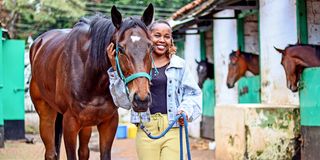
When we meet at Ngong Racecourse in Nairobi, Faith Nyokabi walks with a slight limp.
“My ankle has a metal rod and a screw to help it heal faster. I had surgery two months ago after a spooked horse threw me off,” she says.
In three months, she hopes to be cleared by her doctor to take part in her first race as a registered jockey — a milestone that feels both hard-earned and deeply personal.
Faith’s journey into horse racing is as unlikely as it is compelling. Growing up around Ngong Racecourse, she was terrified of horses. She had seen too many riders thrown off, nursing broken limbs and fractured collarbones. Yet one detail stayed with her: they always returned to the saddle.
Years later, she would become what she once feared: a jockey.
How it started
Her entry into the sport came during the Covid-19 pandemic, when her Tourism Management classes were suspended.
A chance opportunity arose at Xina Riding School in Kiambu, which had partnered with a stable at Ngong Racecourse and needed a receptionist. The job came with an unexpected requirement: she had to learn how to ride.
“One day, my trainer, Sam Kariuki, told me he would put me on a horse, and if I didn’t like it, he would never force me again,” she recalls.
Her first ride was on “Quickfoot”, a retired racehorse, a daunting introduction.
“I was a complete beginner, and retired racehorses are naturally high-energy and aggressive. I didn’t enjoy it at all.”
Sensing her discomfort, her trainer switched her to a calmer horse named “Lily”. The difference was immediate.
Lily became her anchor, the horse on which she learned to ride, and eventually, the one from which she took her first fall.
“Everyone tells you falling is part of the process. It’s like learning to ride a bicycle, except with horses, the stakes are higher. They spook easily, so you must always stay alert.”
Her first fall came when she attempted to push Lily into a faster trot.
“She thought I wanted a full gallop. I was unseated instantly. I just lay there for a few seconds, not because I was hurt, but because it all happened so fast.”
Riding quickly became routine. She would wake at 5am, ride for an hour and a half, groom and settle her horse, then head to school in Riruta.
“Most of my training was in the forest, and I fell countless times. I would still go to class bruised because my mother insisted I attend school no matter what.”
Later, she moved to Nakuru, where she trained under 70-year-old jockey John McGinn, riding an older, gentler horse named “Winter”.
“Older horses are ideal for beginners. They are calmer and more forgiving.”
Riding with cowboys
When Faith returned to Nairobi, the riding school that had introduced her to horses had shut down. The only available option was to train with racehorses.
Her new trainer, Tony, introduced her to a different world. Instead of riding alongside an instructor, she now rode with “cowboys”, seasoned riders, most of them jockeys.
“It was intimidating. Horse riding is male-dominated, and these riders spend most of their lives on horseback. Their energy was intense, almost like a rodeo.”
It was in this environment that she met riders like Fundi, then the youngest jockey in the country.
Riding with them toughened her.
“I was thrown off countless times and would walk home alone. Eventually, I got used to it. My mum would treat my injuries every evening and beg me to stop, but I wouldn’t.”
It was also during this period that the idea of racing began to take root. The turning point, however, came with tragedy.
A close friend, Millie, a fellow rider, died in a car accident. She had long dreamed of forming a girls’ riding club with Faith and another friend, horse therapist Amani Wanjiku.
“Millie wanted us to start racing because all the racers we knew were men. She believed we could compete in events like the Police Cup, which was originally meant for women but had become male-dominated due to their absence.”
Millie’s death reshaped Faith’s path. “I chose to become a jockey to honour her memory.”
Against the odds
Earning a jockey’s licence proved to be one of her toughest challenges.
“To reach a point where trainers trust you to gallop a horse is not easy. And being thrown off repeatedly — especially in front of others — can feel like a walk of shame.”
Back in Nakuru, she trained under Ndarwa, who focused on rebuilding her confidence, something that had been shaken by repeated falls.
Her asthma added another layer of difficulty. “Whenever I panicked, I would lose my breath, which made everything harder.”
Her horse, “Chippin”, helped steady her progress. “With Chippin, I mastered the four transitions, walk, trot, canter, and gallop. The gallop is the hardest because it mirrors race speed.”
Just as she was gaining momentum, Chippin was sold, forcing her to start over with a new horse, “Moreshowers”.
“It takes time to bond with a horse, to trust each other. But switching horses is also necessary — it makes you a better jockey.”
Dramatic female horses
Whereas she has ridden both male and female horses, Faith has a preference for the stallions, which she has ridden more than the mares.
“It isn’t fun riding young mares. I prefer male horses, which have their own drama, but female horses are more dramatic. They get spooked more easily and are likely to unsaddle you, and if they don’t want to be mounted on, you won’t mount them. Moreshowers was, however, different from the stereotype; she was a fast horse and won several races when I was riding her until she was taken from races because she got cancer. She is the horse that took me for my first gallop.”
“The thing about gallops is that horses always know when they are going back home, their speed intensifies in a gallop. I have had a history with horses that take off and refuse to come back home. I was scared to say the least, my stomach became queasy, and I felt like throwing up. It was fun; however, I let go of my fears and my thoughts and let the horse run. When I finished the gallop, I wanted to redo it. I had discovered my love for the adrenaline rush,” she says.
Her most recent horse, “Cranley” is the one that she still rides to date. It is the same horse that got her injured through a fall.
“Cranley” had got spooked and had taken off at full gallop with Faith on his back when another rider blocked their path to halt him.
“Cranley”’s stop was all too sudden, and he threw her off its back. She landed on her feet, to a searing pain in her ankle, which was fractured.
“I have fallen several times until I have lost count, but none of them felt like this one; it was extremely painful. This was on Christmas last year. I had just got my licence and was preparing for my first race.
The final test
To get permission to ride, a prospective jockey simply has to prove to a trainer that they can ride a horse. The rider is given different horses and monitored on how they are handling them, for Faith, she rode two horses, “Cranley” and “Insprook” every day for a year.
The last test involved jumping a starting stall in the presence of a rider (starting stalls or the starting gate, are metallic units, often holding 10-14 stalls, that are pulled into place by vehicles and are equipped with padded doors for safety used in horse racing to ensure a fair start for all competitors, primarily in flat racing).
This she handled with ease.
“The day I was doing my test, all the cowboys who I had ridden with were there, they tucked my horse for me, and teased me into a near panic, but later on I realised that this was their way of showing their support for me, they wanted me to prove them wrong. I passed my test, and I was supposed to start racing this year, were it not for my injury,” she says.
The first
Upon getting her licence, Faith became one of the first black Kenyan women racers in the sport.
“At the moment, I don’t know of any female black jockeys in Kenya. I know of another lady, but she is white and only came into the racing scene recently. Most girls who ride horses are not racers; they do it for the love of horses.”
In Kenya, the racing calendar starts in October and ends in July. Every month has a minimum of two races. With only two female racers, Faith is forced to race with the men under their rules with their weight class limits (maximum weight on a horse is 55kg) as per the rulebook.
Does the career pay?
Apart from the riding fee, jockeys also get a certain fee for participating in the races. A lot of the male jockeys she knows, she says, live off fully from working with horses.
“I know of people who have quit school for riding, and they are okay because most of them end up pursuing work rider jobs abroad. If you perfect your riding here, you stand a better chance of getting those jobs; their payment is way better. Most of them usually go to Denmark, Dubai or France. My dream is to end up in France. I have friends who are working there,” she says.