‘Fragments’: Thom Ogonga opens doors for emerging artists

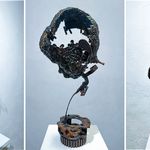
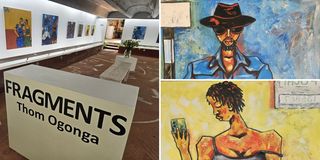
Fragments art pieces by Thom Ogonga, currently on display at One Off Art Gallery in Nairobi, May 2026.

Photo credit: Pool

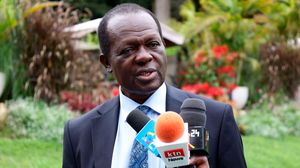
Thom Ogonga, one of Nairobi’s understated curators, is a brilliant visual artist who also connects hidden talent with galleries that might otherwise overlook them.

At the One-Off Art Gallery, his latest exhibition, Fragments, hangs alongside shows by Newton Eshivachi and Paul Njihia—protégés he has carefully ushered into the spotlight.
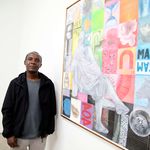
For Thom, this isn’t just curation; it is gratitude and calling. He treats the painstaking work of combing through thousands of pieces, guiding artists for months and persuading galleries to take risks as part of his duty to an industry that shaped him.

Thom’s mother was an art teacher and his sisters are visual artists. He believes this exposure taught him as much as he could have learnt in art school: “I had a soft landing in the arts. I worked with very established artists who helped me learn the ropes and over time, it was a gentle introduction despite all the challenges and frustrations that every artist experiences at the beginning of their career."

While Thom is an established artist, his work as a curator rarely receives the accolades it deserves, largely because of the quiet manner in which he goes about it. He identifies artists, sells them to galleries and ensures their work is shown. This process involves poring through thousands of works and spending hundreds of hours with artists just to find one who fits his profile.

“To me, an artist has to be exceptional; they must know what they want to achieve. I usually step in to guide their practice using different materials, which can take up to nine months. I help these artists articulate their work and create cohesive art statements.

"The art scene is very cut-throat, and most of these artists wouldn’t get to exhibit their work in galleries by themselves, not because they aren’t good artists, but because galleries are sometimes selfish. They are private entities with their own artists, so they rarely look for new ones. I enjoy introducing artists to the mainstream, and I am happy that galleries trust my judgement when it comes to choosing artists to show,” he says.

All the top galleries in Nairobi have exclusive artists signed to them, so they are usually fully booked throughout the year. Introducing new artists requires persuasion because most galleries would rather exhibit work by their established artists than take a risk with newcomers. Thom steps in as the bridge to this quagmire.

“I approach the exhibitions I curate as project proposals, selling these artists to different galleries, which is tough but necessary. When it comes to curation, I am a mercenary; I am not attached to spaces. I curate shows anywhere I find, and this helps me when I interact with galleries.

"I like putting on avant-garde shows that are tidy and minimal but memorable. I think every established artist should hold a younger artist’s hand, take them to places and introduce them to these spaces. It is easier for us, having done this for a while, but it isn’t for the newcomers.”

One of his greatest mentors was the late Patrick Mukabi, who passed away last month after a battle with diabetes. Mukabi or Panye as he was popularly known, was a prolific visual artist whose work was exhibited in more than 20 countries. He is perhaps best remembered for his portraits of ample-bosomed women hanging in Java House cafes and his portrayal of women in workplaces.

“ Mukabi’s absence will be felt very soon because he rented studios purely to host and teach young artists about painting. Many artists who have practised for over a decade are still afraid to rent studios independently because safety in numbers is important, which is why most of them are in safe spaces like Kuona and GoDown.

"If you were to rent a studio in Westlands, you would likely be competing with banks and other institutions, and the rent would be expensive.”

For Thom, an artist needs more than just setting up a show in a top gallery. In his opinion, an artist needs to look beyond the exhibition and money, and focus more on cultivating a relationship with these spaces.

“If a gallery knows you exist, that is a bonus. That is something a lot of artists have never understood. It isn’t just about holding an exhibition in a gallery; it is about building a relationship with the gallery. I tell every artist that they should make sure that every gallery knows they exist. If artists who have been in the scene for over 20 years still have to introduce themselves to galleries, I feel like they are doing themselves a disservice. My goal is to introduce these artists to important spaces,” he says.

In recent years, artists have become more independent in terms of how they sell and exhibit their work, with some moving away from established galleries to exhibit and sell their work independently. While Thom welcomes the evolution of the art space, he feels that its glaring lack of professionalism needs to be addressed.

“Everyone has the freedom to do what they want. Having interacted with the industry both locally and internationally, however, I have different views. In Kenya, we have long enjoyed the gimmick of being self-taught and naïve, which loosely translates as producing art without context. Spaces like Ngecha had brilliant artists, but they were stereotyped as reckless, which is why our parents would never allow us to be artists."

In Fragments, Thom unsettles the familiar. His work dwells in what endures—rupture as condition, fragmentation as formation. It is a language of solitude and memory, one that challenges neat resolution but insists on visibility.

He explains that living through rupture does not mean returning to a prior state but inhabiting a reconfigured one where fragmentation is an ongoing process of formation. His figures, which capture moments of solitude from different perspectives, offer not resolution but a language that allows the complexities of loss, memory and becoming to remain visible and open.

Follow ourWhatsApp channel for the latest business and markets updates.

PAYE Tax Calculator

Note: The results are not exact but very close to the actual.