What it means is that the shows must go on until the last available paint brush dries up. This is the biggest honour that the art scene in Kenya can give to a man of the caliber of Patrick Mukabi who passed on April 23, 2026 because in his lifetime, art was his very essence of life.
He embraced it and taught it in all its forms to everyone that showed even the slightest interest. He was born into this world to be nothing else but a progenitor of art, the conduit through which all who would come to have an interaction with him would later come to the realisation that in his world, art was life and freedom in all its strokes and forms, shadows, lights and hues of colour.
Peterson Kamwathi perhaps best understands this, the mention of Kamwathi’s name is enough to perk up ears even in casual conversations within Kenya's art scene.
“Patrick Mukabi (Panye) inspired this generation,” says the 44-year-old.
To Kamwathi, Patrick was a friend and a mentor who enabled him to see art beyond the paint and pencil.
His latest show, Tabula Rasa, currently at the Nairobi Contemporary Art Institute, is perhaps the most expansive of his projects going beyond frame and paper to encompass the entire walls of the gallery with drawings of human figures in different forms of motion.
Kamwathi’s muse has constantly been a crowd on a drawing plane and his latest show doesn’t veer far from the narrative.
Tabula Rasa, by extension, builds into Kamwathi’s long time fascination with groupings. His drawings at the show capitalise on this with the same detailed exactness in terms of execution; crowds of people huddled in quiet stances or in falling motions.
‘Consta (Nations), 2023-2025’ by Peterson Kamwathi.
Photo credit: Bonface Bogita | Nation Media Group
“The optics of a group are a spectacle. When you see people gathered or forms of grouping, you cannot help but be drawn to it. It takes you away from the physical world. Groupings give you recognition and spectacle. When you look at, for example, a protest, it is hard to ignore it. Groups give rise to collective consensus but with the ability to allow people to go back to their worlds,” says the veteran artist.
Framed artwork by Peterson Kamwathi at the Nairobi Contemporary Art Institute.
Photo credit: Bonface Bogita | Nation Media Group
Before he developed a thing for crowds, Kamwathi was fascinated by queues, drawn to the linear points of interaction and the sequencing of these points of organisation.
Queues spoke to him as a system of structure with their limitations of demands for access and pressure imposed. For the bigger picture, they became representative of the transitions in between political systems where they were the thin membrane between ideologies, political choices amongst other things.
For Kamwathi, queues and groupings are inadvertently symbolic of being mediums capable of influencing change.
Tabula Rasa is Kamwathi’s first institutional solo exhibition in Nairobi. The works made between 2022 and 2026 are a collective of drawings, prints, sculptures, video installations, and site-specific wall drawings.
Through a thorough self-reflective practice that looks and uses images as fragments of larger narratives, Kamwathi assembles figures, monuments, maps and ordinary objects from multiple places and moments, treating each as a bearer of unstable meaning.
His works leave gaps for indulging perspective because he considers his role as an artist as that of a cartographer, the path in which one takes from looking at his works is ephemerally a matter of individual choice.
Despite having curated groupings in his previous shows, what is different with Tabula Rasa is that previously he looked at groups as a single form multiplied and his argument was that within the context of a group, the individual lay erased, there was nothing to zoom into.
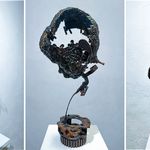
‘Objects: Monuments, 2023-2025’. Tabula Rasa, by extension builds into Peterson Kamwathi’s longtime fascination with groupings.
Photo credit: Bonface Bogita | Nation Media Group
This was more or less like a commentary on what happens with social media, the digital age and democracy with the connotation that the majority ruled. His latest show however punched holes into this narrative because of the realisation that individuals were the main components of a grouping and their individuality was etched within the main narrative of a crowd.
Tabula Rasa is a mental surgery into the anatomy of a gathering, looking at the psychological elements powering the narratives revolving around masses.
What it does is pockmark Kamwathi’s ability to dig into narratives that transcend the mere physical aspect of drawing or sculpturing. It sets him apart as a refined thinker, a philosopher and an intellect of the craft whose works will outlive memory.