Baraka Shamia weaves protest and symbolism in ‘You Will Not Certainly Die’

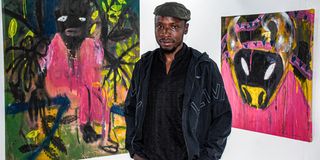
Baraka Shamia at his ‘You Will Not Certainly Die’ exhibition, One Off Contemporary Art Gallery, April 1, 2026.

Photo credit: Billy Ogada | Nation Media Group

Baraka Shamia’s first solo exhibition at the One Off Art Gallery is remembered as much for its darkness as for its defiance. It was not merely an exploration of morbid themes, but a bold artistic protest against the oppression of villagers in Ileho, Kakamega County, by KWS forest rangers.

Through sharp wit, layered symbolism and brooding canvases, Shamia translated the harassment and tension into dark tones and restless patterns, walking a fine line between anguish and artistic expression.
If the work was misunderstood, it seemed a small price to pay. For Shamia, it was less about reception and more about resistance an artist, armed only with brush and canvas, standing up to systems far more powerful and better resourced. The noose, once tightly drawn, has loosened.

Yet his signature remains. The mordant aesthetic that defines Shamia’s work still threads through the collection, but now it is interwoven with a new kind of balance.

He continues to inhabit territories many Kenyan visual artists shy away from—those shadowy, uncomfortable spaces where beauty and unease coexist. To some, his work teeters between genius and madness. There is no middle ground with Shamia; you either lean into his world or recoil from it.

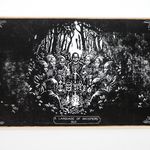
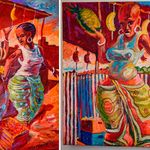
“Untitled III,” acrylic on canvas by Baraka Shamia, displayed at the ‘You Will Not Certainly Die’ exhibition, One Off Contemporary Art Gallery, April 1, 2026.

Photo credit: Billy Ogada | Nation Media Group

Titled You Will Not Certainly Die, the exhibition initially suggests influences from his bullfighting heritage, with its recurring imagery of oxen. But the inspiration runs deeper.

Shamia turns instead to biblical narratives, drawing from spiritual inquiry and personal reflection. What emerges is a body of work rooted in scripture, symbolism and an ongoing search for meaning.

This show builds on his earlier exhibition, Retribution, whose opening left him emotionally drained. That body of work was steeped in themes of death—almost overwhelmingly so.

It reflected the loss of community and heritage, and the quiet violence inflicted on ordinary villagers grazing cattle in Kakamega Forest. In many ways, Retribution was activist art, confronting injustice while carrying the emotional toll of its subject matter.

“Retribution was sad because it was talking about death,” Shamia recalls. “After the show, I was in low spirits. And when I’m low, I find myself reading stories that are not tied to current realities—those ones tend to instil fear.”

It was during this period that he turned to the Bible, revisiting books he had long postponed reading. “When I was younger and thinking about politics, my father advised me to read Kings and Samuel before getting into that world. I kept putting it off. It was only after my first exhibition that I finally did.”

That encounter reshaped his artistic language. In this exhibition, his portraits weave together themes of creation, the Tree of Life, and the relationship between God, man and nature. But Shamia does not see the Tree of Life as an object. To him, it is a companion—an extension of love. It represents loyalty, reverence and a quiet mystique, much like the intimacy between creator and creation.

There is, at times, a wandering quality in how Shamia describes his inspiration—almost abstract, even elusive. Yet his paintings are strikingly precise. Each piece feels like part of a larger puzzle, fitting together with careful intention. His use of dark tones remains deliberate and commanding, while brighter hues—rare in his earlier work—are now introduced with measured confidence.

The result is what can only be described as controlled chaos. There is a certain gothic elegance to the exhibition, where sombreness takes centre stage without overwhelming the viewer. Even in its darkness, the work carries a strange clarity. It demands patience, rewarding those willing to look closely.

“Cedar of Lebanon,” acrylic on canvas by Baraka Shamia, displayed at the ‘You Will Not Certainly Die’ exhibition, One Off Contemporary Art Gallery, April 1, 2026.

Photo credit: Billy Ogada | Nation Media Group

Shamia’s latest pieces feel, in some ways, like a beautiful distraction. Smudges of deep red, scattered petals, leaves and watchful silhouettes emerge across the canvases. Beneath it all, the Tree of Life persists as a quiet but constant presence.

The oxen, meanwhile, take on new meaning. Inspired by the winged creatures in the Book of Ezekiel, they symbolise loyalty, obedience and reward. Their titles—reminiscent of state honours—suggest aspiration, even hope.

“There are things you think are distracting you from your purpose,” Shamia says, “but you don’t realise they are part of it.”

He pauses, then adds: “The plan belongs to a higher being. You are just playing your part.”

For Shamia, this exhibition is less about answers and more about transmission.

“I see myself as a messenger,” he says. “I push myself to extract even the smallest fragments of the message—whether it speaks of retribution, anguish or pain—so that somewhere in it, there is a semblance of hope.”

At the show, prices of Shamia’s portraits range from Sh120, 000 to Sh420,000. The show runs for a month.

Follow ourWhatsApp channel for the latest business and markets updates.

PAYE Tax Calculator

Note: The results are not exact but very close to the actual.