Time flies with great content! Renew in to keep enjoying all our premium content.
Prime
Mukabi’s ‘Mali Safi’: Honouring the giant who gives too much
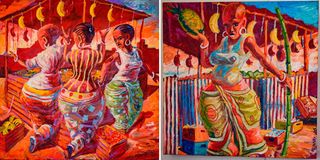
Morning Glory (I) and Mama Kibanda (I), acrylic on canvas by Patrick Mukabi, displayed during the Mali Safi exhibition at Banana Hill Art Gallery on April 1, 2026.
The Banana Hill Art Gallery carries the weight of age and experience. Its walls are lined with works that shine like diamonds in the rough. Its current exhibition, Mali Safi, is no exception. But, it is also deeply personal.
The show is a celebration of the brilliance of Patrick Mukabi, one of Kenya’s most influential visual artists. But it is also shaped by something more urgent – his health.
Mukabi, more popularly known as “Panye,” is not just an artist. He is, to many, a mentor, a teacher, and perhaps even the mentor of your favourite artist. If you have walked through a Java House in Nairobi and admired the artwork on the walls, chances are you have already encountered his work.
In Kenya’s visual art scene, Mukabi stands as a towering figure. Of the hundreds of artists I have interviewed in the past few years, only a few have not been mentored by Panye. He is the closest thing to Don Corleone, the Godfather.
A master of form and feeling
Panye’s work is instantly recognisable. His paintings often depict women—market scenes, daily labour, quiet moments—rendered with a striking balance of simplicity and depth.
Open soko, acrylic on canvas by Patrick Mukabi, displayed during the Mali Safi exhibition at Banana Hill Art Gallery on April 1, 2026.
Photo credit: Billy Ogada | Nation Media Group
He captures movement with the ease of a master, rendering curves and form with what appears to be effortless precision. His treatment of light, especially the way he evokes sunlight without directly depicting it, reveals a refined artistic intuition. His style is direct, almost unpretentious. Yet within that simplicity lies a quiet power.
Mali Safi showcases this mastery. The brushstrokes are deliberate, the compositions balanced, and the subjects—often women engaged in everyday life—are portrayed with dignity and sensuality. There is a reverence in how he paints the human form, elevating it into something almost sacred.
A show born out of urgency
However, the exhibition carries a weight beyond art.
Mukabi is currently hospitalised at Kenyatta National Hospital, battling a severe case of diabetes. His condition has worsened in recent months, leading to a leg amputation. He remains under intensive care, heavily reliant on medication to manage pain.
Mali Safi was showcased with his approval while he was in hospital. Some of the works were moved from Ardhi Art Gallery, while others were loaned by private collectors. In total, the exhibition brings together more than 17 pieces.
Today is my day, acrylic on canvas by Patrick Mukabi, displayed during the Mali Safi exhibition at Banana Hill Art Gallery on April 1, 2026.
Photo credit: Billy Ogada | Nation Media Group
More than a showcase, it is a fundraiser to help cover his mounting medical bills.
The exhibition is curated by Njeri Tani, who also acts as Mukabi’s unofficial agent. She says one of the challenges she has faced while working with him is his tendency to undervalue his own work.
“Panye isn’t money-minded,” she explains. “He would often give away his paintings at very low prices to people who appreciated them. That mindset is common among older artists.”
Panye’s generosity extends beyond his artwork. At his studio in Dust Depo, he opened his doors to emerging artists, offering them free space to create and sell their work. Many artists passed through his mentorship, benefiting from his openness in an industry that rarely offers such support.
“In many ways, he was a launchpad,” Njeri says. “That kind of selflessness is rare.”
Despite his generosity, his work has not always been properly valued.
“I always tell him that day and night exist for a reason. You cannot be the same all the time,” Njeri says. “There is a tendency for people to take advantage when you are too generous. It is part of human nature.”
She adds that this reality often leads to artists underpricing their work, especially when dealing directly with buyers.
This is part of what she sought to address by representing him professionally.
Art with a purpose
The works on display at Mali Safi are priced between Sh32,512 and Sh123,500, with proceeds going toward Mukabi’s treatment.
The exhibition itself becomes more than a cultural experience, it is an act of solidarity.
Mukabi’s situation also reflects broader challenges within Kenya’s visual arts scene.
Green shops Great Harvest, acrylic on canvas by Patrick Mukabi, displayed during the Mali Safi exhibition at Banana Hill Art Gallery on April 1, 2026.
Photo credit: Billy Ogada | Nation Media Group
Many artists work in isolation, often without consistent financial support or institutional backing. Their livelihoods depend on an audience that, in many cases, has yet to fully appreciate the value of visual art.
The challenges extend beyond the market. There are systemic gaps, including limited policy support, minimal investment in arts education, and a lack of structured pathways for artists to thrive.
As a result, many artists give their all to their craft, only to return home unrecognised and undercompensated.
For all he has given—to his students, to the art community, and to the country—Mukabi’s story is not just one of artistic excellence. It is also one of quiet sacrifice.
Mali Safi stands as both a tribute and a call to recognise not only the beauty of the work, but the humanity of the man behind it.