To walk through The Skin of Memory is to immerse oneself in precolonial prophecy. From visions of the coming of the white man, to the railway lines, to the imposition of foreign education systems, Abdul Rop's exhibition brings to life Kenya’s history through a striking series of grayscale prints.
He draws from the history of the Nandi resistance against British colonial rule. As a descendant of the Nandi people of Kenya’s Rift Valley, Abdul approaches this history as both personal inheritance and as a lens to examine colonialism’s lasting mark on communities, land and identity.
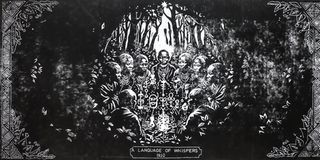
In this body of work, he returns to woodcut printing, an ancient technique that produces stark black-and-white imagery. The medium lends itself to his storytelling, with bold visuals accompanied by succinct captions that deepen the narrative arc. Interestingly, Abdul only began pursuing art full-time art after completing a sociology degree at Egerton University.
The Harvest of Strange Fruit (1930), ink on canvas by Abdul Rop, displayed at The African Arts Trust, Nairobi on March 25, 2026.
Photo credit: Billy Ogada | Nation Media Group
“I found myself at that point where many young Kenyans find themselves after clearing campus. You study but you cannot get a job in that field. Talent is usually the saviour you can use to build a career, and that is what I did.”
Before he moved to Nairobi, Abdul was just a visual artist who experimented with different styles. There was no specialty to his craft. Under the tutelage of Thom Ogonga at Brush Tu Collective, he carved his place in woodcut prints. Now, he has established himself as one of the growing forces in this ancient craft.
“I am always out in the field and I felt like I was more of a tree maker than just a normal painter, so I decided to pursue woodcut prints more.” he says.
The Skin of Memory reintroduces figures and narratives familiar from Kenyan history, now reimagined on gallery walls. For many millennials, the exhibition feels like stepping into a Geography, History and Civics classroom, only this time, the lessons are visual, dynamic and deeply reflective.
“Most of the history we learn is oral. I felt that images would tell the stories better because they could condense a lot of information within them. It took me some time to figure out that I needed to talk about stories from my childhood. I wanted to depict historical narratives and give them the weight they deserved. I realised many of my peers did not understand their history. The more our generation grows the more the memory gap of our history grows. I felt that artists have a role in preventing this from happening.”
The Skin of Memory explores the inheritance of historical trauma, how the experiences of past generations continue to shape the present, often subconsciously. Moving almost like a visual timeline, the works trace how colonial systems including education, agriculture and religion were deployed to control African societies.
In Education as Erasure, Abdul presents a powerful meditation on loss. A solitary figure hunches over a blackboard, suspended between two worlds. Around him, symbols—books and spears—signal the tension between imposed knowledge systems and indigenous ways of knowing.
Education as Erasure, ink on canvas by Abdul Rop, displayed at The African Arts Trust, Nairobi on March 25, 2026.
Photo credit: Billy Ogada | Nation Media Group
The piece reflects on how colonial education reshaped not just language, but memory itself, displacing relationships to land, culture, and identity. It reads as both mourning and resistance, a silent protest against enforced forgetting.
In The Silenced Prophecy, Abdul revisits the assassination of Koitalel Arap Samoei, the Nandi leader who famously foretold the coming of the “steel snake”—the railway. His killing marked a turning point in the resistance and symbolised the fracturing of a people’s autonomy. Through this work, Abdul invites viewers to reflect: Would we have acted differently if we had access to the foresight of our ancestors?
The Skin of Memory exhibition at The African Arts Trust is powerful artistry. In years to come, it will be remembered as one of the masterful pieces in the modern age when artists, in their quest to create, paused long enough to remind us of where we came from.