Before we get into the review, go watch this movie. It is currently streaming on Rafutv and Madfun. It's affordable and accessible, so no excuses.
I love the premise of this film, it’s so interesting that the creators decided to go back to the 90s. Based on the content I come across on social media, sometimes I think Gen Zs don’t understand the 90s! They think the 90s were the Stone Age.
I assume they think we had no phones, like we were using smoke signals to communicate and the only form of commerce was barter trade. I highly doubt that they even think we even had clothes back then; they probably think we were out here wearing leaves! I love that this era is the backdrop for Cards on the Table, which also happens to be a Kenyan Christmas movie.
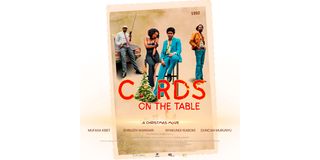
Directed by Victor Gatonye and produced by Shirleen Wangari through Blackwell Films, Cards on the Table is a 2025 heist-dramedy that takes us back to Nairobi on Christmas Eve, 1992.
It stars Wangari as Beth and Nyakundi Isaboke as Jackso, two former lovers who decide to reconnect by robbing the gate collections of a major holiday event.
Let’s start from the top, the title card and the end credits.
The typography and placement of the title card perfectly captured the movie’s tone.
The end credits were equally well-handled, featuring behind-the-scenes, random clips and black-and-white photos of the actors having fun. It’s a small thing, but I haven’t seen it done that way locally.
The Look
Visually, the film looks glossy. It’s sharp and high resolution, the lighting is colourful with vibrant hues, which is exactly what you want for a Christmas movie. However, I found this worked both for and against the film.
On one hand, it’s beautiful to look at. On the other, the “clean” digital look occasionally pulls you out of the 1992 setting. In my mind, the 90s should feel a bit more desaturated and muted colour-wise. But if the director’s and cinematographers’ visual language was focused on a polished aesthetic for a period story, they definitely achieved it.
The cinematographer and director did a good job with the framing of some scenes to avoid the familiar modern touches in a lot of the locations.
The production design team also did a decent job. You can tell there was a real effort to recreate the era through costumes and props. Beth’s outfit in the police station is classy, but there are other moments where you see pieces that look like they were pulled straight from a 1990s wardrobe with the Inspector and Jackso.
The props, the old-school TVs, the stereo system, physical maps on the walls, the chairs, all feel authentic. I specifically looked for the portrait of former President Daniel arap Moi in the background, and when it finally popped up in the second act, I knew they had done their homework.
Structure
One of the strongest elements of the film is its structure, particularly in the first and third acts. It avoids a standard linear, A-to-Z format, which kept me engaged from the jump.
There’s a decision in the third act where the movie essentially turns into a music video. A specific song comes on, I thought it was laid back yet bold to close out a movie like that.
Gripes
The core of this movie isn’t really the crime; it’s a “situationship” story. Beth and Jackso have too much unresolved romantic baggage and a total lack of communication.
While the chemistry between Shirleen Wangari and Nyakundi Isaboke and the writing is great, the film struggles with its pacing in the second act.
Once the story shifts to the Inspector’s (played by Ken Mufasa Kibet) office, the momentum slows down significantly.
With scenes that rely heavily on exposition to explain the characters’ backgrounds, unlike the first act when we would cut back and see what was going on, I thought a tighter edit would have helped that second act. Quicker cuts and less “telling” would have helped keep the energy of the first act alive.
I also felt the Inspector’s character was a missed opportunity. The resolution of why whatever happens in the end happens felt a bit underwhelming for two people who are supposed to be “smart” criminals.
I kept waiting for the Inspector to have a more personal arc. There’s a mention of his wife; I kept thinking a breakup scenario would have made him a much more complex character, or just a “Christmas Grinch” who arrested them simply because he was having a miserable holiday.
Then maybe the couple could have used their own relationship experience to help “mend” the Inspector’s marriage, and his decision to do whatever he does would have felt more earned.
The sound and the script
Technically, the sound design could have used more “dirt”. The dialogue is very clean, but in the scenes where they are locked in a room, it feels too sterile.
There’s a lack of ambiance or “room tone”, the buzzing of a fan, muffled voices from outside, or even distant music would have gone a long way in making the world feel lived-in. Without that background noise, you can sometimes hear the “post-production” nature of the audio.
The script is decent, but the heist itself could have been way more fleshed out.
While the “why” of the robbery is clear, the “how” and the “who” they were robbing felt a bit vague. I thought the target could have been intentionally framed, marked, singled out to make it easier for the audience to follow along. Or just a quick planning session to get the audience involved.
I also wished the script would have done something with the language, like classic sheng’ the one mastered by Kenyan Gen X and older millennials.
Finally, the dialogue, while it works really well, could have benefited from a “punch-up”.
There are some funny moments, like the Inspector and Beth moment, but there were many missed opportunities for smarter, sharper comedic beats, like some reveal involving the Waiyaki way. I wish the production had brought in a stand-up comedian during the table reads to just add one or two comedic punches.
Despite my critiques, Cards on the Table is an easy and enjoyable watch. It’s a character study on how silence can destroy a relationship, wrapped in a glossy old school holiday setting. It’s a film that focuses on the heart and soul of its characters rather than just the mechanics of a crime.