‘Bloody Bonds’: Love, tribalism and corruption collide in church

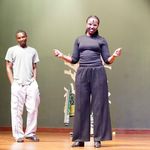
(From left) Molyn Kinuthia (Vanessa Siti), Eucharia Manyasia (Emma Siti), Faith Musyoka (Florence Mabula) and playwright Mark Munyao rehearse a scene from Bloody Bonds ahead of its staging at AIC Milimani on May 15, 2026.

Photo credit: Pool

The play begins, as so many tragedies do, with love. Two young people – David Mabula, a Sukuma by tribe, and Vanessa Siti, a Nyamwezi – fall in love and want a future together. What stands between them are their fathers, two men of God who have built entire careers preaching unity in public while perfecting the art of ethnic hatred in private.

Their fate is among the key subplots in 'Bloody Bonds' that will be staged at the Africa Inland Church (AIC) Milimani in Nairobi today (Friday, May 15) from 6pm. The play, scripted by Mark Munyao and directed by Eustace Muli, follows last year’s highly acclaimed staging of ‘She Said No’.
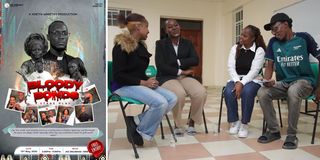
Bloody Bonds’ interrogates the violence concealed within bloodlines. The common proverb that blood is thicker than water is both the play’s starting point and its central accusation: that invoking kinship has become a license for cruelty, a shield behind which tribalism, abuse, and corruption shelter from scrutiny.

“We always say that blood is thicker than water,” Mr Muli, the director, tells the BDLife. “But what happens when we use that phrase to promote vices? When we practise cruelty against other people in the name of protecting ‘our people’ and no longer uphold the virtues the Bible teaches us?”

The play follows two religious households whose public righteousness is a near-perfect mask for private rot.

Pastor Edward Mabula and Pastor William Siti are influential, respected, and pulpit-ready. Behind closed doors, they are tribalists, manipulators, and abusers who will use bribery and spiritual intimidation to seize control of their church as its senior pastor retires.

Their wives, Florence and Emma, absorb the cost: one in sustained domestic violence clothed in religious language; the other in infidelity and deliberate neglect.

Their children inherit the wreckage. David teeters on the edge of becoming his father. His sister, Olivia, in one of the play’s most uncomfortable psychological portraits, defends the very abuse that is destroying their family.

The playwrights set the drama in Tanzania, among the Sukuma and Nyamwezi peoples.

The decision, the creative team said, was strategic. They reasoned that by stepping across the border, they would communicate that what the play depicts is not a Kenyan issue but a regional, even continental, condition; that is, the corruption of religious institutions by tribalism and patriarchy wherever communities place clergy beyond accountability.

“They based it in Tanzania both to show that it is a universal experience and to bring diversity to the whole situation,” says Molyn Kinuthia, a law student at Riara University who plays Vanessa Siti.

“It has opened our eyes to see that this is actually a universal experience,” she adds.

Mr Muli says ‘Bloody Bonds’ invites people in church circles to introspect.

“For a very long time, religion has been viewed as the source of the moral compass; the one that unites people and guides them to live in love,” he notes. “But there has been a twist in recent years. Religion is increasingly becoming a source of disunity. There are fights in churches, cases of bribery. We want to expose these truths and start the discussion.”

The production has been months in the making. Work on the script began in late 2025. Auditions followed, rehearsals began in January.

Mr Muli says the rehearsals have been happening every Sunday after youth fellowship, 5pm to 7pm, stretching to 9pm as the staging approaches.

For the cast, the material has demanded more than memorisation.

Jim Mwendwa, who plays David Mabula, is a professional actor, comedian, and content creator. He tells the BDLife that his role has pushed him beyond any previous assignment. In the play, he has to depict tribalism and gender-based violence, vices he is not too familiar with.

“I have never experienced it personally. I come from a very loving family, and my dad and mum are the best,” Jim says. “So, playing this role has stretched me. I had to research stories beyond my own setting to understand what it is like to grow up in such an environment: how do these individuals survive? How do they react to what is around them?”

He adds: “I will not lie; every time I come from the rehearsals, my heart is always heavy, but I tell myself that ‘fasihi ni kioo cha jamii’ (literature is the mirror of society) and these stories have to be told because they are happening in the churches and in the world at large.”

Asked about what the audience should expect, Jim says: “Viewers should expect to see what happens behind the curtains of religion: major emotional rollercoasters all through, a thorn in the flesh for many.”

Mollyne, who says she is making her debut on a production of this scale, is a gifted actress. In 2023, when she was in Form Three, she was crowned the best female actor in Uasin Gishu County.

She described the rehearsals as unlike anything she has encountered before. Besides Mr Muli, there have been professionals involved, including Mercy Mutindi, currently starring in the NTV television drama, ‘Noma’.

“I feel like this is something that happens in an everyday house setting,” Mollyne says of the play. “Maybe after seeing this, viewers will realise they are not the only ones in this type of predicament. Maybe it will help them go through a situation they are already going through at home, whether that is tribalism, corruption, or not being allowed to love someone because of class or tribe.”

Mollyne, who joined the church recently, says she was aware of the success of ‘She Said No’ last year and hoped that this year’s production will be better.

In last year’s play, she says, there was a character whose performance was so convincing that people in the congregation began to dislike the actor personally.

Being one of the two main characters, she says there is a heavy responsibility thrust on her shoulders.

“I’m pretty excited about it. But I also feel overwhelmed because that means the play is kind of in my hands. So, I have to execute the character with utmost care. I have to depict her perfectly and to bring out every single emotion of hers,” she says.

Mr Muli says that besides the acting, there will be some music.

“We also have a musical enhancement, so the music team has also been doing the same, and we thank God for the far that we have come, and we are looking forward to staging the play,” he says.

He reiterates his message that the play’s ultimate purpose is to start a conversation.

“We want to ensure that we start the big question and have a change of this trend that is quite unfortunate,” he tells BDLife. “Religion has become a source of tribalism, and tribalism is not only evidenced in politics. There is a lot of tribalism even in our churches.”

“When the compass shifts and instead of going north it starts going south, do we let it continue in the name of ‘our people’ or should we have a discussion that redirects the ship to the right compass?” Mr Muli poses.

Follow ourWhatsApp channel for the latest business and markets updates.

PAYE Tax Calculator

Note: The results are not exact but very close to the actual.