Time flies with great content! Renew in to keep enjoying all our premium content.
Prime
Tough Finance Bill lessons from 2024 and plan to fund Sh4.8trn budget
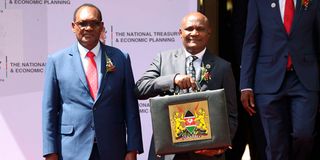
National Treasury Principal Secretary Chris Kiptoo (left) with the docket’s Cabinet Secretary John Mbadi together displays the Budget briefcase ahead of unveiling the government spending plan for the financial year 2025/2026 in Parliament on June 12, 2025.
The National Treasury has refrained from introducing higher taxes to fund this year’s Sh4.845 trillion budget, as lessons from the controversial Finance Bill 2024, which triggered deadly protests, continue to influence the government’s revenue-raising measures.
For the second year running, Treasury Cabinet Secretary John Mbadi is banking on aggressive tax enforcement and other administrative measures to raise total revenue by Sh232 billion to Sh3.67 trillion in the 2026/27 budget.
The measures include stricter validation of expenses on the Kenya Revenue Authority (KRA) Electronic Tax Invoice Management System (eTIMS), integrating the KRA’s systems with eCitizen and other digital payment platforms, and inspections to net more taxpayers from the informal sector.
The Finance Bill 2026 has gone after hard-to-tax segments, including non-resident landlords who will now pay a 30 percent withholding tax on rental income from immovable property in Kenya.
The government has also made changes to the Income Tax Act, introducing withholding taxes on interchange and merchant service fees on card-based payment transactions.
Treasury has also introduced an amendment seeking to establish a floor of 60 percent of a company’s undistributed income that may be treated as a deemed dividend, which would then be subjected to a withholding tax.
Currently, there are no thresholds on the proportion of undistributed income that the KRA could deem as dividends.
Explaining this year’s Finance Bill, which is targeting Sh120 billion in new revenue, Mr Mbadi said that the limited room for higher tax rates will see the focus is on expanding the tax net and ensuring equity and fairness in the tax regime.
“We are alive to the fact that the options of raising more taxes are limited because Kenyans have complained loudly before of high taxation. We are also aware that we have limited options in borrowing money to finance our budget, which continues to increase, especially as a result of debt service cost,” said Mr Mbadi in a briefing on May 25.
“We have gone back to the basics of taxation, which ensures equity, fairness and simplicity. Therefore, the proposals in this Bill are going to enhance simplicity to help us in tax administration.”
Previously, Finance Bills relied on measures such as higher excise duty on products such as alcohol, cigarettes, confectionery, imported goods, motorcycles and mobile phone airtime to drive higher revenue.
The 2024 Bill that sought additional revenue of Sh360 billion introduced unpopular amendments including VAT on bread, and an annual motor vehicle tax set at 2.5 percent of the value of a vehicle, capped at Sh100,000.
The changes were later discarded after President William Ruto declined to sign the Bill in the aftermath of the protests, although some of the Bill’s clauses were reintroduced later in the year through a Tax Laws Amendment Bill.
Having taken heed of the protests a year earlier, the Finance Bill 2025 went after the government’s tax expenditure (foregone taxes) by shifting a raft of manufacturing inputs from VAT zero-rated status to exempt status. This bill had a more modest new revenue target of Sh30 billion.
Manufacturers are able to claim VAT refunds from the government on inputs used to produce zero-rated products. On exempt goods, they are unable to do so, and therefore this cost is usually passed on to the final consumer.
Products targeted under the VAT change included locally assembled mobile phones, animal feed, raw materials for pharmaceutical products, solar and lithium batteries and electric bicycles.
Beyond the taxation measures, the government has in the last two years sought to expand its options for financing development projects amid a widening deficit and a stubborn inability to implement fiscal consolidation through spending cuts.
The 2026/2027 budget has a deficit of Sh1.174 trillion, which is equivalent to 5.6 percent of GDP. This deficit will be funded through domestic borrowing of Sh1.06 trillion, and external borrowing of Sh116.2 billion.
With the development vote in the budget set at Sh749 billion, or 15.5 percent of the total expenditure for the year, the State has been forced to turn to alternative financing options for its multi-billion-shilling capital projects and settle pending bills.
These include public-private partnerships (PPPs), securitisation of levies and sale of public assets.
“The 2026 Budget Policy Statement marks a clear strategic shift in how Kenya approaches development financing, moving away from a model heavily reliant on public resources toward one centred on mobilising private capital at scale,” according to tax experts at PwC Kenya in a pre-budget bulletin.
“The shift reflects both necessity and policy evolution: public resources alone are no longer sufficient to meet Kenya’s growing development needs.”
In the 2026/2027 budget, the State has a target of mobilising Sh80 billion through PPPs in sectors such as roads, irrigation and power transmission.
It is also eyeing a Sh120 billion roads bond backed by future collections from the Road Maintenance Levy Fund (RMLF), earmarked for clearing pending bills in the sector and putting up new roads.
The State is also mulling a Sh100 billion bond that will securitise future inflows from the Affordable Housing Levy.
The proceeds are expected to address a funding gap of Sh118 billion in the Kenya Kwanza administration’s goal of building one million affordable houses by June 2027.
The budget is also likely to be boosted by the proceeds of the government’s Sh244.5 billion sale of a 15 percent stake in Safaricom to South Africa’s Vodacom Group.
The proceeds from the sale of public assets will be allocated to the recently established infrastructure fund, which aims to crowd private capital into public projects.