The Treasury is betting on a last-minute dash to raise Sh106.3 billion from the sale of a stake in Kenya Pipeline Company (KPC) before the deadline on Thursday as the initial public offering (IPO) struggles to meet targets.
Multiple top stockbrokers and investment banks reckon they have struggled to sell the State oil pipeline company, especially among high-net worth investors who have expressed interest, but have failed to make payments for the shares.
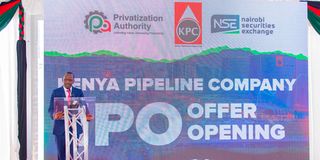
The four remaining days ahead of closure of the sale are crucial for the success of what would be East Africa's biggest IPO in local-currency terms.
Four of the top brokers who sought anonymity for fear of State reprisals said about 10 percent or nearly Sh11 billion of the offer had been sold as the close of business on Thursday amid a split on views over the valuation of KPC.
The government priced the KPC IPO at Sh9 per share for the offer that opened on January 19 and ran until Thursday, with the shares scheduled to begin trading on the Nairobi bourse on March 9.
Treasury Cabinet Secretary John Mbadi expects a huge chunk of investors to purchase the shares in the next four days, terming the last-minute dash normal.
Certain segments of investors, he said, had recorded significant demand for the offer, without giving numbers.
“You know how Kenyans behave, even when the IEBC [Independent Electoral and Boundaries Commission] is registering voters, they all come at the last minute. Let’s wait for the final week, I am sure we will have enough investors,” he said.
“Ugandan investors want more shares from us and are annoyed we are only offering 20 percent under the East African pool.”
KPC’s IPO must receive valid applications from not less than 250 applicants representing 50 percent of the offer shares.
This means that the IPO must raise at least Sh53.1 billion for the offer to proceed.
Of the total stake on offer, 15 percent is reserved for oil marketing companies, five percent for employees and the remainder for local retail, local institutional, East African and foreign investors, with each category receiving 20 percent.
“In cases of undersubscription, valid applications in the affected category be allocated in full, with remaining shares reallocated in the order of local retail, local institutional, East African investors, international investors and oil marketing companies (OMCs),” the KPC investor memorandum says.
“In cases of oversubscription, Kenyan investors will be given priority.”
The sale of a 65 percent stake in KPC is part of the Treasury's plan to divest from State companies.
The government is also reducing its stake in telecoms operator Safaricom, with the sale of a 15 percent stake to South Africa’s Vodacom for Sh204 billion.
Burdened by high national debt, limited room to raise taxes and annual loan repayments that consume 40 percent of government revenues, the State has sought new funding models.
The KPC IPO will be the region's biggest, surpassing the 2008 Safaricom offering, which raised just over Sh50 billion.
In dollar terms, the Safaricom IPO may still rank as the largest, given the weakening of the Kenyan shilling over the past 17 years.
The KPC IPO comes amid a sharp rally at the Nairobi Securities Exchange (NSE), with stocks last week posting the biggest ever one-week gain.
The lead advisor to the transaction, Faida Investment Bank, and co-sponsoring broker, Francis Drummond, remained optimistic that the offer will be a success.
Francis Drummond said it expected institutional investors to ‘act on their decisions’ within the closing days.
“Institutional clients have expressed strong interest, and we anticipate that within the next five days, the institutions will act on their decisions,” Francis Drummond told this publication on Friday.
KPC’s IPO, the first in 11-years since Stanlib Fahari i-Reit listing in 2015 had been tipped to generate as much interest as Safaricom’s offer in March 2008.
The sluggish sale of the offer comes amid lack of consensus among investment banks over the valuation of KPC.
Faida Investment Bank and Dyer & Blair valued the company at Sh9 a share while NCBA Investment Bank and Standard Investment Bank (SIB) quoted a lesser Sh6.35 and Sh8.05 a share respectively.
KPC’s expected reduction in its dividend payout ratio and future capital expenditure commitments (Capex), including laying a new pipeline between Mombasa and Nairobi, have led to investor scrutiny of the offer.
The share sale offer document shows the firm will reduce its average dividend payout from 94.5 percent of profits to 50 percent.
Wesley Manambo, a senior research associate at SIB, has issued a buy recommendation to investors with a long horizon on KPC, arguing that there is less attraction for short-term oriented investors to skip the offer.
“We did give strategic long-term investors with at least a seven-year investment horizon with a buy recommendation. For investors keen on the ability of the company to generate cash and perform relative to peers, then the offer seems to be fully valued,” Mr Manambo told the Business Daily.
“For investors keen on dividends, then the opportunity cost seems higher relative to other propositions in the market. For them, they might look to avoid the offer.”
Faida Investment Bank noted momentum in the book build ahead of the closure period, supported by enhancements made to the e-IPO platform by KPC and the start of shares trading on the M-Pesa platform, including bids for the IPO.
“We are seeing encouraging growth in applications especially following the enhancements made to the e-IPO platform. As we approach the offer’s close, we encourage Kenyan retail investors to take advantage of the remaining window to participate,” Faida told the Business Daily in a statement.
“Applications are steadily flowing in, with particularly strong interest from institutional investors. This level of participation reflects confidence in KPC’s fundamentals, its strategic national importance, and its track record of consistent performance.”