The government splashed over Sh1 billion World Bank funding for the National Youth Opportunities Towards Advancement (Nyota) project on consultancies and administrative fees in its first year, new disclosures show.
The Micro and Small Enterprises Authority (MSEA) revealed the spending in a report for the year ending June 2025, amid details that over a million youth applied to benefit from the project’s first phase.
The details come at a time when Nyota --which seeks to offer financing and business training to the youth-- has gained popularity as President William Ruto leads exercises to distribute cash to beneficiaries in public fora.
In the annual report for the 2024/25 fiscal year, MSEA says it spent all the funding it got towards the Nyota project on “administrative activities and consultancy services.”
“During the 2024/25 financial year, the authority received a total of Sh1.032 billion for Nyota and was able to absorb 100 percent of the amount on administrative activities and consultancy services,” MSEA said.
The spending on consultancies and office operations was 84.4 percent of all the funding received from the World Bank towards Nyota during the year, documents show.
Part of the spending on office operations included purchase of computers and laptops, MSEA said.
This, however, was as the Auditor-General revealed that the government had not started actual project activities by the end of June 2025, more than a year after it officially started.
Nyota is a Sh33 billion project with 90 percent funding from the World Bank and the government topping up 10 percent of the funding, aiming to uplift economic standards of 800,000 Kenyan youth.
Out of the Sh29.5 billion funding from the World Bank, Sh25.8 billion is a loan that the government will have to repay with interest.
The project targets Kenyans aged 18 to 29 to provide them with start-up loans of between Sh20,000, Sh50,000 and Sh200,000 for businesses, provide them with entrepreneurial skills and link them with financing opportunities and markets.
The World Bank released a total of Sh1.223 billion to the government towards the Nyota project during the year ending June 2025, including the Sh1.032 billion that went to MSEA.
“The project is aimed at unlocking the economic potential of youth across Kenya by enhancing employability, entrepreneurship, and self-reliance, especially among vulnerable and underserved youth groups,” MSEA, the agency implementing Nyota on behalf of the government, says.
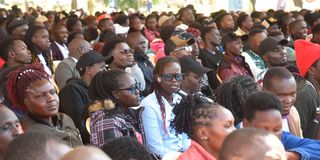
Millions of Kenyans trapped in unemployment have been upbeat on the economic prospects the project presents, with MSEA revealing that over a million youths applied for its first phase.
The number is 50 times the 20,000 beneficiaries targeted for the first phase, underlining the depth of hardships in an economy littered with millions of unemployed youth.
The number of applicants also represents about one in every five Kenyans and MSEA had to undertake eligibility screening that included subjecting applicants to aptitude tests as a basis for selection into business development training, mentorship and start-up capital support.
Nyota is expected to benefit 800,000 youths by December 2028 and borrows from a previous World Bank programme, the Kenya Youth Employment and Opportunities Project (KYEOP), which ended in 2024.
This includes 600,000 youth who are expected to receive digital training on Access to Government Procurement Opportunities (Agpo) and other targeted socioeconomic programmes.
Last year, the World Bank said it had employed block chain technology to track movement of funds financed through Nyota, after a portion of beneficiaries of the KYEOP project vanished despite receiving billions of shillings to operate businesses.
“Furthermore, impact evaluations and tracer studies will be conducted to gather robust evidence on effective interventions and necessary adjustments,” the World Bank said.
The multilateral lender took the precaution following an audit indicating that some KYEOP beneficiaries could not be traced or refused to indicate their locations when reached out to by auditors.
“KYEOP audit helped an informed design of the Nyota project, in particular for including enhanced monitoring systems as well as the use of digital tools for tracking the performance and outcomes,” the lender said.