Time flies with great content! Renew in to keep enjoying all our premium content.
Prime
How Kenyans lost millions in online investment scheme
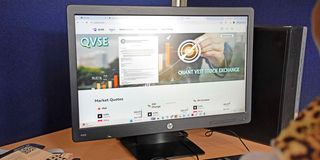
A user tries to log in to the Quant Vest Stock Exchange (QVSE) App on September 14, 2026. The Capital Markets Authority (CMA) has blacklisted and warned the public against investing in QVSE, classifying it among illegal, unlicensed funds.
Things started falling apart when Edwin Mutuma woke up on September 7 to a notification on his QVSE mobile app telling him that his and fellow investors’ accounts had been frozen.
Just weeks earlier, the Laikipia-based hotelier had been watching his money grow on the online investment platform, convinced he had found a quick way to make money trading US stocks.
A friend who had been in the scheme since last year introduced Mr Mutuma to QVSE, or Quant Vest Stock Exchange, in August and claimed to have made more than Sh400,000 within months.
All Mr Mutuma needed to do, he was told, was deposit $500 (about Sh65,000) into his QVSE account and trade stocks from American tech giants such as Tesla and Apple.
He was also asked to download Binance, the cryptocurrency exchange, where he could convert his gains into stablecoins before eventually cashing out to his M-Pesa wallet.
For communication, investors were directed to Bonchat, a Hong Kong-based messaging application similar to WhatsApp, where a person who identified himself as ‘Carl Grindan’ ran the groups and privately contacted members.
“All of it seemed interesting,” Mr Mutuma told the BDLife. “I used my savings to raise the initial amount. I put alerts on the trading times at 4:30pm and 8:30pm when Carl would send us a code, and we would trade and watch our money grow.”
Suspicions, broken friendships
Justus, a Kitui-based teacher who declined to give his second name, heard about QVSE in May through a family member.
“I was suspicious at first, but seeing how strongly they believed in it, I asked to be given three months to observe how things would turn out,” he says.
A month later, the family member offered Justus a Sh65,000 loan, saying it was money he had earned from the investment scheme. “I agreed.”
Regina, another teacher who asked not to be identified beyond her first name, says she needs time to process what happened before disclosing more publicly. She had put nearly Sh200,000 into the scheme, some of it borrowed.
“It has broken friendships because we all need answers from the friends and colleagues who introduced us to it, yet they have gone silent on us,” she says.
Copy trading
QVSE relies on what is known as copy trading, where an investor automatically mirrors the trades of another, usually more experienced, trader.
The method allows beginners to participate in financial markets without deep knowledge of chart reading or hours of research, but losses are mirrored just as gains.
In Kenya, the scheme targeted mid-level professionals such as teachers and people in the service industry, as well as small-scale traders and boda boda operators.
Carl, whom investors fondly referred to as ‘Prof Carl’, would send trading signals at specific times. Investors had five minutes to execute each signal before it expired.
Those who put in $500 (Sh65,000) were told they could earn $6 (Sh777) per trade, while those who deposited $1,000 (Sh129,480) were promised $12 (Sh1,553). With two trading sessions a day, Mr Mutuma could make $12 (Sh1,553) a day.
When investors withdrew their money, ‘Prof Carl’ took a 20 percent cut.
Several people interviewed by the Business Daily said ‘Prof Carl’ sent messages and photos purporting to show homes built and TVs bought by QVSE members who had made money from the scheme, reinforcing the impression that the investment was legitimate and profitable.
Accounts frozen
‘Prof Carl’ would also entice investors with the promise of additional earnings.
In late August, he announced what he described as a humanitarian campaign on the trading platform. Some investors said they received automatic deposits of $90 (Sh11,648) a day for 10 days.
Days later, Justus withdrew about Sh47,000. The transaction went through, briefly allaying his concerns and reinforcing his confidence in the scheme. “Once you see money coming out, you stop questioning a lot of things,” Justus says.
On September 5, ‘Prof Carl’ froze the accounts of all investors, accusing them of running multiple accounts to increase the amount they could trade. Each account required a unique phone number and national ID number; investors were accused of using friends’ and family members’ details to create accounts.
“Following the latest review by the QVSE Market Surveillance Division, severe violations involving single users operating multiple accounts have been detected within Global Investment Group,” read a notification he sent to users.
The warning cited the US Patriot Act and FINRA Rule 3310, a 2001 rule requiring financial institutions, including broker-dealers, to establish anti-money laundering programmes.
It claimed the rules required financial institutions to verify the ultimate beneficial owner of accounts.
“Privately borrowing, buying, or selling accounts for third-party operation will directly result in account freezing and permanent bans by the brokerage in accordance with the law.”
‘Prof Carl’ then told investors they would have to ‘activate’ their accounts by depositing an amount similar to their original principal. “It started dawning on me that this is a sketchy scheme,” Mr Mutuma says, laughing at himself.
From then on, he stopped sending trading codes. Investors could no longer withdraw their principal or profits.
“That’s the point; I knew something wasn't right. If the money is mine already, why should I pay again just to get it? By the time Carl froze my account, I had $870.39 (Sh112,654),” Justus says. “Seeing it there but not being able to touch it is frustrating.” Mr Mutuma had $2,100 (about Sh271,740) showing on his account.
“I had never withdrawn any amount since I joined, which makes me sad. I wanted to wait for it to grow and grow; now all of it is stuck there,” says the hotel manager.
He spoke of investors who had as much as Sh6 million in the scheme—money they had set aside in the hope of funding major projects. An administrator of a WhatsApp group for Kenyan investors claimed the team had 12,005 members. If every member had paid the reported minimum contribution of Sh65,000, that would amount to Sh780 million.
The Business Daily could not independently verify the membership figure, the amount paid by individual members or the total amount raised.
Red flags
Looking back, investors say there were early warning signs.
“The Bonchat platform was restricted; you cannot screenshot anything on the app, and ‘Prof Carl’ was the only person who could post in the group, and comments from any member had to be approved by him,” Mr Mutuma says.
“I once tried to screenshot chats. He flagged me and messaged me to warn me about it. Complaints like errors on my account were also not welcome, and he got agitated if you continued complaining.” Justus noticed a similar mood.
“‘Prof Carl’ was often defensive and had an attitude when difficult questions were raised in personal messages,” he says.
“At one point, he locked my account simply because I had not responded to his message for a week,” he says, adding that the messages were condescending.
Investors say ‘Prof Carl’ would tell them to withdraw all their cash and leave the scheme if they continued raising questions.
“There was constant pressure to recruit new members. If the investment capital was genuinely generating profits, why such a persistent push to bring in other people?”Poses Justus.
The teacher also noticed frequent use of flattering language such as ‘friend’ and ‘family’ by strangers, which he suspected was intended to create trust and a sense of belonging among recruits.
Kenya probe
Last month, Kenya’s Parliament raised concerns over QVSE’s operations, particularly its regulatory status, investor protection measures and the legality of its activities in Kenya.
The National Assembly Speaker directed the Finance and National Planning Committee to investigate the platform and report its findings within two weeks. The findings have not been made public.
QVSE has also attracted regulatory attention outside Kenya. In July, Ghana’s Securities and Exchange Commission flagged it among entities promoting and offering unlicensed investment products in the country.
But QVSE is not the first online investment scheme to leave Kenyans counting their losses. In April 2025, users of cryptocurrency and forex trading platform CBEX lost fortunes after their accounts were emptied.
The platform had attracted Kenyans, Nigerians and Egyptians with promises of AI-powered profits, referral bonuses and easy withdrawals, including returns of up to 30 percent in 30 days.
When contacted by the Business Daily on September 9, the CMA said QVSE was not licensed in Kenya. A spokesperson said copy trading was not officially recognised and was therefore unregulated.
On September 12, the CMA issued a statement flagging QVSE and GIG among 15 entities operating illegally in Kenya and directed affected investors to file reports with the Directorate of Criminal Investigations (DCI).
“These entities are the subject of active investigations by the DCI in collaboration with the CMA and other law enforcement agencies,” the regulator said. “The Authority strongly cautions the public against dealing with entities and persons disguising their fraudulent activities as investment opportunities.”
Hours later, ‘Prof Carl’ took to Bonchat to rubbish the CMA’s “emergency notice” and assure followers that they should continue putting money into the scheme.
“The content is merely performative and lacks real substance; it is simply a way for them to signal to the public that they are taking action, rather than being based on anything tangible,” read a message sent to the investors’ group.
The verification process involved investors depositing more money equal to their principal. They were told it was the only way they could withdraw their entire holdings after the accounts were frozen.
Members suffering
However, some investors who put in additional cash say withdrawals have yet to be effected.
“To be sincere, I can’t tolerate seeing the problem other members are facing. They deposited their money for self-verification, yet they have not received the money back. Why is this happening, Professor? You are aware that 99 percent of members who deposited have not received their money. You gave a deadline of 72hrs and now members are suffering like that; others took money for business. Tell members what is happening. No member who has withdrawn today, yet you say members should verify their account; where will the trust come from?” One Kenyan lamented.
“Please initiate my withdrawal. I am getting sick,” another wrote.
“I now accept QVSE is completely over and now only AI is managing us,” another said.
Bonchat messages show ‘Prof Carl’ pushed the deadline by a week, the day the CMA issued its statement, giving investors more time to put in more money.
“Let the next 168 hours prove everything. Please rest assured that I am always with you—I have never left, and I will never disappear! … Now, only GIG stands with you,” he says.