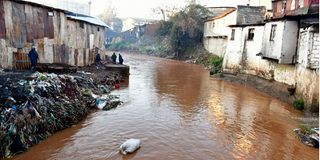
The Environment and Land Court has rejected an application by more than 30 property owners seeking to stop the government from reclaiming riparian land along the Nairobi River, paving the way for the demolition of structures on the corridor.
The court ruled that the property owners failed to prove that the government’s actions under the Nairobi Rivers clean-up initiative violated their rights or amounted to unlawful demolitions.
The dispute arose after the Cabinet Secretary for Interior announced on May 24, 2024, that structures erected on riparian reserves bordering the Nairobi River would be demolished.
The announcement, made through a press release, followed deadly floods that struck Nairobi between March and May 2024, submerging homes and businesses and highlighting the dangers of riverbank encroachment.
The directive was coordinated by the Nairobi Regeneration Committee, with multi-agency teams comprising officers from Nema and the Water Resources Authority.
The property owners, whose buildings stand along Kombo Munyiri Road in Gikomba, argued in court that they had legally developed their land in the 1990s after obtaining government approvals.
They contended that State officials had marked their permanent structures for demolition without issuing written notices or granting them a hearing.
Additionally, they accused the government, including the Interior Ministry and Nema, of retrospectively applying the Environmental Management and Coordination Regulations of 2009.
They further claimed violations of their rights to property, fair administrative action and a fair hearing.
However, the court dismissed these arguments, stating that land ownership rights are not absolute and that the petitioners failed to demonstrate actual or imminent violations.
"The press release in question did not order the cancellation of the petitioners’ titles," the court stated. "As rightly submitted by the respondents, the right to own land is not absolute, particularly when regulating developments for the benefit of both the owner and the environment—upholding the right to a clean and healthy environment."
On the right to fair administrative action under Article 47, the court found that the government’s statement specifically targeted encroachers on riparian reserves.
Since the owners denied that their buildings were on riparian land, the court ruled that they could not demand explanations meant for confirmed violators.
The court also noted that the Water Resources Authority had only identified and marked high flood levels and the maximum 30-metre riparian boundary following heavy rains, with no demolition orders issued against the petitioners.
"The petitioners did not provide any evidence of actual demolitions carried out solely due to these markings," the court observed, adding that the markings remained a "threatened violation", unsubstantiated as imminent.
Riparian land protections
On claims that the Cabinet Secretary had overstepped parliamentary authority, the court held that existing law empowers the minister to issue regulations for managing riverbanks and environmentally sensitive areas. It therefore found no breach of Article 94(5).
The court also rejected arguments that the 2009 regulations were applied retroactively, noting that riparian land protections existed even before the Environmental Management and Coordination Act, including under the repealed Physical Planning Act and Survey Regulations, which mandated reservations along water bodies.
Emphasising that property rights are not absolute, the court affirmed that State regulation of land use, especially in ecologically sensitive areas, is constitutional to ensure public safety and environmental health.
The Nairobi Rivers clean-up initiative, launched in 2023 and intensified after the 2024 floods, aims to restore the Nairobi, Ngong and Mathare rivers by removing illegal structures, clearing waste and reclaiming riparian buffers to mitigate flood risks and pollution.
The ruling allows authorities to proceed with mapping and enforcing riparian boundaries along the Nairobi River, even as disputes over urban riverbank developments continue.