Chinese firm gets Sh37.6bn deal for city sewer, roads

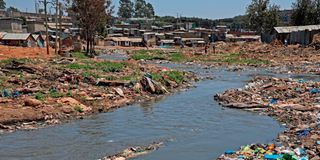
The current state of Nairobi River in this photo taken on September 15, 2024.

Photo credit: File | Nation Media Group

A Chinese firm has secured a Sh37.6 billion deal to restore Nairobi's water basin in a futuristic plan that will see it build a new sewer line, pedestrian walkways and cycle lanes along one of the city's main rivers.

China Energy Engineering Group (CEEC) will be the project contractor for the master plan to rehabilitate the Nairobi River in yet another attempt to restore the capital to its past glory as "the green city under the sun", according to a Social Environmental Impact Assessment (ESIA) report published in June.
The report, which is awaiting approval of the National Environment Management Authority (Nema), notes that a multi-agency team of several State corporations, led by the Ministry of Defence, will build a new trunk sewer, expand an existing sewer treatment plant at Kariobangi, and build bridges, pedestrian walkways and cycle lanes along the Nairobi River.

Dubbed the Nairobi River Regeneration project, it also entails rehabilitation of the Dandora dumpsite and dredging and widening of the river channel at a total cost of Sh37.6 billion. The document does not reveal the source of financing.

“The overall goal of the project is to enhance the health and quality of life for residents of Nairobi and to promote a cleaner urban environment by providing comprehensive sewerage services, including the collection and treatment of wastewater,” says the ESIA report.

“The construction of new trunk sewers, expansion of the reticulation system, and increased capacity of wastewater treatment plants will significantly reduce pollution levels in the Nairobi Rivers, lower the incidence of waterborne diseases and mortality rates, and ultimately boost the population’s productivity.”

At the heart of the civil works is a new reinforced-concrete trunk sewer to replace an overwhelmed line and capture sewage that currently spills into the river.

Sewerage systems have been developed in only limited areas in Kenya. Households not connected to the sewer network dispose of wastewater through septic tanks, soak pits, open drains or into surface water bodies, said the World Bank in a previous report.

The proposed sewer trunk will run in three main sections — Naivasha Road to Museum Hill, Dagoretti/Chiromo via Kirichwa Kubwa, and Museum Hill to Dandora Falls — with manholes for inspection and future expansion.

The ESIA report says the line is sized to carry up to 310,000,000 litres per day and is designed to reach neighbourhoods from Westlands and Lavington to Kangemi, Kawangware and Kikuyu that have historically relied on undersized or informal systems. The sewer trunk will cost around Sh6.05 billion.

The project will also entail the construction and rehabilitation of 27 bridges, non-motorised access roads, drainage systems, and street lighting for Sh5.36 billion, with the hope of improving urban mobility and safety at a total cost of Sh5.36 billion.

The Ministry of Defence will coordinate multiple agencies to expand treatment capacity at Kariobangi, dredge and widen key river sections and stabilise banks. It will provide the surrounding neighbourhoods with safe foot and cycle paths, parks and lighting.

The report puts the overall price tag at Sh37.6 billion.

The 2019 Kenya Population and Housing Census shows that just 24.6 percent of households are connected to a main sewer, meaning most Kenyans depend on on-site sanitation like septic tanks or pit latrines—systems that, when poorly sited or maintained, can leak into waterways.

That national shortfall is echoed in Nairobi, where rapid growth and infrastructure gaps have left the rivers exposed to constant contamination.

Closing that gap—starting with a backbone trunk and reliable treatment—explains the project’s emphasis on hard infrastructure rather than clean-ups.

About Sh6.05 billion will be set aside for the new trunk sewer and Sh5.36 billion for non-motorised transport (NMT) works, including walkways, segregated cycle lanes, and revamping of 27 bridges, drainage and street lighting, says the filings.

About Sh6.42 billion will be directed to flood control and stormwater works, especially in informal settlements that are adjacent to the riverbanks.

The remaining funds cover the Kariobangi expansion, river training, riparian landscaping and amenities, and the first phase of Dandora remediation.

This is not the first river basin restoration plan. Former Environment minister John Michuki’s early-2000s blitz, which included a mix of riparian enforcement, clean-ups and tree planting, briefly turned the tide and bequeathed the city the green strip now known as Michuki Memorial Park, later revived by the Kenya Wildlife Service and City Hall.

In February 2023, President William Ruto launched the Nairobi Rivers Commission and has since publicly pledged to restore the river to the point where fish can live in it again—an evocative benchmark for water quality and ecosystem health.

London’s River Thames was once a national disgrace—so foul during the 1858 “Great Stink” that Parliament fled its chambers.

The fix was infrastructure at scale: Sir Joseph Bazalgette’s 19th-century intercepting sewers captured foul flows before they reached the river, paired with new embankments and outfall works.

In the 21st century, London doubled down with the 25-kilometre “Tideway” super-sewer to intercept combined sewer overflows. The arc—from public outcry to massive sewer investment and sustained regulation—is the usable template for Nairobi.

PAYE Tax Calculator

Note: The results are not exact but very close to the actual.