MPs seek to inspect Sh80bn securitised revenues

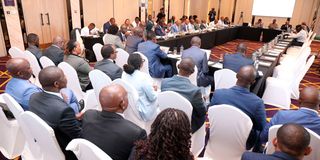
A joint sitting of the Departmental Committee on Finance and National Planning and the Select Committee on Public Debt and Privatisation after the Cabinet Secretary for the National Treasury and Economic Planning, Hon John Mbadi, appeared before the committees to deliberate on the proposed partial divestiture of the Government of Kenya’s shareholding in Safaricom PLC at Glee Hotel, Nairobi on January 13, 2026.

Photo credit: Bonface Bogita | Nation Media Group

The National Assembly wants powers to inspect the securitisation of government revenue streams in the funding of key projects including the extension of the Standard Gauge Railway (SGR) and the payment of supplier pending bills.

Securitisation refers to ringfencing of specific revenue streams to pay lenders funding various government projects, with the money acting as collateral.
The Public Debt and Privatisation Committee has warned that the reliance on alternative funding approaches may create additional debt risks while hiding shortfalls in the availability of mainstream financing like external debt.

The committee has recommended Parliament’s oversight on the commitments which are currently estimated at Sh80.48 billion per year.

Kenya has securitised Sh12 out of every Sh25 per litre collected from the road maintenance levy fund (RMLF) for the payment of road sector pending bills and further plans to set aside 90 percent of the railway development levy to extend the SGR from Naivasha.

“The committee recommends that all securitisation and commitment of public money be subjected to transparent disclosure and parliamentary oversight, including publication of the fiscal implications of these commitments to the future debt sustainability,” the committee said in a report on its consideration of the Medium-Term Debt Management Strategy.

“The committee observed that declining concessional financing, alongside increased reliance on alternative approaches such as PPPs and securitisation, may mask underlying external financing constraints while creating additional contingent and fiscal risks that require transparent disclosure and integration into fiscal risk management.”

The National Treasury revealed in June last year that the Cabinet had cleared the Kenya Roads Board (KRB) to allocate Sh12 of the Sh25 per litre Road Maintenance Levy Fund (RMLF) to compensate investors who buy two multi-billion shillings bonds.

KRB is set to issue a Sh175 billion roads bond whose proceeds will refinance a bridge facility from commercial banks including the Trade and Development Bank (TDB), KCB Bank Kenya, Absa Bank Kenya and UBA Kenya Bank.

The four commercial banks issued facilities to the government helping it clear arrears owed to road contractors.

The road agency has mulled issuing a second Sh125 billion bond, where investors will be compensated using Sh5 per litre collected from the road maintenance levy fund, to cater for future arrears in the roads sector.

Motorists pay Sh25 into the RMLF for every litre of petrol or diesel bought with the government apportioning Sh12 from the collections for securitisation.

The securitised collections are estimated at Sh47 billion per year using average monthly consumption data for petrol and diesel which amounts to 193.2 million litres and 133.4 million litres respectively between September 2024 and September 2025 as per data from the Kenya National Bureau of Statistics (KNBS).

The government has set its sight on securitisation and public-private partnerships (PPPs) to fund infrastructure projects against fiscal constraints where revenues and traditionally borrowed funds are gobbled up by debt service and recurrent expenditures.

The public wage bill is currently estimated at around Sh1 trillion in every financial year while debt service costs run to the same levels per cycle leaving fewer resources for multi-billion shillings infrastructure projects.

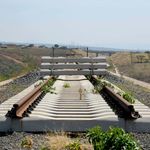
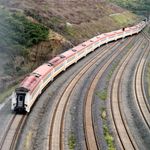
Kenya plans to take up to 90 percent of annual revenues from the Railway Development Levy (RDLF) to secure additional financing for railway projects.

This would amount to about Sh33.48 billion annually using data for the fiscal year to June 2025.

The Miscellaneous Fees and Levies (Amendment) Bill, 2025, seeks to amend the Miscellaneous Fees and Levies Act to expand how proceeds from the RDLF can be used.

Kenya is set to extend the SGR to Malaba from Naivasha without Chinese financing but has sought negotiations to drop a clause that required RDL proceeds to be used to repay the loans for the Mombasa-Naivasha line.

“What we intend to do is use the railway development levy to raise funds and have an engagement with Exim Bank on this because there is a provision in the agreement that ties the railway development levy to this loan,” John Mbadi, the National Treasury Cabinet Secretary said.

The road maintenance levy fund was primarily used to fund road maintenance and development before securitisation while the railway development levy primary use is the operation and maintenance of the SGR.

Follow our WhatsApp channel for the latest business and markets updates.

PAYE Tax Calculator

Note: The results are not exact but very close to the actual.