Kenya to swap Eurobond for food in Sh129bn deal

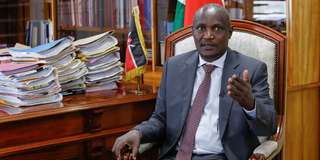
Treasury Cabinet Secretary John Mbadi gestures during an interview with Reuters where he says Kenya has started talks with IMF for a new program, in Nairobi, Kenya, February 5, 2025.

Photo credit: Reuters

The Treasury will use proceeds from a Sh129 billion ($1 billion) debt-for-food security swap to make early repayments on outstanding Eurobonds to ease Kenya’s heavy debt burden.

The Public Debt Management Office (PDMO), a directorate of the Treasury, says it will use proceeds from the debt swap to retire early costly sovereign bonds that are maturing from 2031.
The plan is expected to work similarly to the debt-for-nature swaps carried out by several countries in recent years that offered lower interest rates in exchange for nature protection.

A debt-for-food swap would likely allow Kenya to replace costly existing debt with lower-cost financing on condition that the country channels the savings towards programmes to boost food security.

Kenya has identified the early repayment of costly Eurobonds as part of the debt-for-food security swap, with five of the seven sovereign bonds maturing between 2031 and 2048 as its target.

“The targeted transaction in liability management this year is that we are working on a debt for food security swap, which we expect to conclude by the end of this financial year,” said Raphael Owino, the director-general at the PDMO.

“We are getting a guarantee from the US-DFC [United States International Development Finance Corporation], which will enable us to issue an instrument in the financial market at a fairly good rate, and then we can use that to take out either a Eurobond or some other expensive commercial borrowing.”

Kenya has Eurobonds worth Sh872.2 billion, including two that will mature in 2027 and 2028 and are not part of the swap. The outstanding amount of the two bonds is Sh72.4 billion.

The Eurobonds will cost taxpayers Sh84.73 billion in interest payments for the year ending June, up from Sh73.89 billion a year earlier.

Under a debt-for-food swap, the guarantor- the US-DFC will help Kenya raise a new instrument in the international capital markets at a cheaper rate.

Kenya will use proceeds from the lower-cost financing to retire an existing expensive debt like a previously taken Eurobond and channel the interest savings on projects that will boost the country’s food security.

The Eurobonds pay an interest or return of between 6.08 percent and 8.8 percent. The new debt targeted under the swap deal could come with interest rates of below 3.0 percent, analysts says.

In early December 2025, President William Ruto confirmed that the US-DFC had agreed to proceed with the debt-for-food security swap and expected the arrangement to significantly ease Kenya’s repayment burden by replacing expensive existing loans with cheaper financing.

“We appreciate DFC for agreeing to proceed with the $1 billion debt-for-food security swap to allow us to replace costly existing debt with lower-cost financing,” President Ruto posted on social media.

The DFC is the United States’ flagship development agency.

Debt-for-food security swaps represent a new way the Treasury is seeking to ease the effects of Kenya’s mounting public debt.

The country has been working to cut its overall debt, which stands at close to 70 percent of its GDP, and make repayments more manageable.

The government has revamped its debt maturing management.

Annual debt repayments eat nearly half of taxes, leaving little cash for projects that are critical for revving up economic growth and easing the growing youth unemployment.

The external debt, which includes the Eurobond, costs taxpayers Sh597 billion in repayments for the year to June, compared to Sh773 billion a year earlier.

The Treasury reckons the early buybacks are useful in boosting investor confidence.

The public debt office says it will not identify the Eurobond targeted for early refinancing at this point to avoid spooking market yields.

“If you identify the instrument early, traded yields will likely be volatile. We will lock in closer to the transaction,” Mr Owino added.

“We may target a range of instruments rather than focusing on one, depending on what is happening in the market at a particular time, which should give us an indication of the specific instrument to go for.”

Kenya is exploring buying back maturing local bonds using proceeds from the corresponding sale of longer-dated bonds to manage huge maturities and ease the strain on public finances.

It has previously experienced the adverse consequences of confronting a large bullet debt repayment.

The shilling weakened against the dollar through a series of record lows in the months leading to February 2024, as markets worried about the government’s ability to pay off a $2 billion Eurobond that was maturing in June of that year.

The government managed to issue a new Eurobond to pay off that bond, easing concern and helping the shilling rebound.

The Treasury issued two Eurobonds last year and used the proceeds to make partial repayments of similar bonds maturing in 2027 and 2028.

Kenya’s next significant Eurobond will mature in 2031 and is a Sh193.5 billion facility.

“The reforms include the review of the debt and borrowing policy to bring on board new developments in debt management such as derivatives, liability management operations and associated instruments such as swaps, forwards and options,” the Treasury said.

Debt swap agreements with a focus on social or environmental benefits are becoming an increasingly popular financing tool in poorer parts of the world.

Ecuador, Belize and Gabon are among countries that have undertaken debt-for-nature deals in recent years.

Follow our WhatsApp channel for the latest business and markets updates.

PAYE Tax Calculator

Note: The results are not exact but very close to the actual.