Treasury expands borrowing options amid rising debt pain

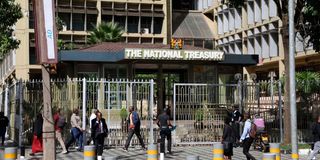
The National Treasury building in Nairobi on April 16, 2025.

Photo credit: Dennis Onsongo | Nation Media Group

As Kenya’s debt service costs and budget deficit grow, the Treasury has been forced to become more creative in the choice of instruments it deploys to raise new debt and keep existing creditors happy.

In prior years, the government relied on a narrow staple of Treasury bills and bonds, concessional loans from multilateral and bilateral lenders, Eurobonds, and syndicated loans to raise new debt.
Amid rising budget deficits and repayment bills, however, it has recently added a wider variety of debt instruments, such as a Samurai bond from Japan, securitisation of statutory levies, climate- and food- for-debt swaps and bond buybacks.

The country will also see a return to privatisation of State-owned enterprises to raise new funds for the Exchequer, with an initial public offering of Kenya Pipeline Company (KPC) already in the works. In the current fiscal year, the Treasury is targeting Sh149 billion from the privatisation plan.

Kenya’s debt service expenses have climbed in recent years to become the single largest line in the budget, leaving little cash for critical public investments such as education, health, and infrastructure.

Spending on debt repayments is projected at Sh1.9 trillion this fiscal year, more than 44 percent of the Sh4.29 trillion budget.

Although domestic debt accounts for 69.16 percent of estimated total debt service costs, the biggest headache is coming from foreign loan expenses, which make up less than a third (30.84 percent) of the burden, or Sh586.46 billion.

At the same time, the Treasury will be looking for Sh901 billion in new borrowing from domestic and external lenders to fill its budget deficit for this year.

In its 2025/2026 annual borrowing plan, the Treasury said that it would prioritise non-market-based measures when managing external debt —including debt swap arrangements — to restructure existing obligations without creating new debt, thereby alleviating medium-term fiscal pressures.

“Moving forward, the government will sustain a diversified liability management strategy, leveraging buybacks, switches, and debt exchanges, while reinforcing external debt sustainability through export growth and foreign reserve accumulation,” said the Treasury in the borrowing plan.

“External issuance will adhere to a transparent and predictable schedule, ensuring investors can make informed decisions. Instruments may include sovereign bonds, Samurai bonds, sustainability-linked bonds, diaspora bonds, and other innovative debt instruments aligned with market demand and Kenya’s development priorities.”

In February 2024, the government bought back a $1.5 billion (Sh194 billion) portion of a $2 billion (Sh258.5 billion), 10-year Eurobond that was due to mature in June 2024 after investor jitters over its ability to repay the debt pulled the shilling to an all-time low of Sh161 versus the dollar.

In March this year, the Treasury made another partial buyback worth $579.6 million (Sh74.9 billion) on a $900 million (Sh116.3 billion) Eurobond that was due to fully mature in May 2027. It is planning a similar refinancing move on a $1 billion (Sh129.3 billion) Eurobond that matures in February 2028.

Last month, Treasury Cabinet Secretary John Mbadi disclosed that Kenya was in talks with China to convert the Sh500 billion standard gauge railway loan from dollars to Chinese renminbi (RMB).

This swap, he said, will effectively halve the interest rate on the debt from 6.3 percent to three percent when the reference rate is changed from the US Federal Reserve’s Secured Overnight Financing Rate (SOFR) to a fixed Chinese currency rate.

The government is also pursuing a Sh129 billion saving on its external debt service costs through a World Food Programme (WFP) brokered debt-for-food swap, which will see participating creditors forgo their dues in exchange for Kenya investing the funds in food security programmes.

In 2024, Kenya executed a similar debt-for-climate swap with Germany, which forgave a debt of €60 million (Sh9.1 billion) on condition that the funds be invested in the 300MW Bogoria-Silale geothermal project.

On new loans, Kenya inked a deal last month with Japan for $169.4 million (Sh21.9 billion) Samurai loans to be directed towards the local vehicle assembly and energy sectors. The annual borrowing plan also outlines plans for Sh65 billion worth of sustainability bonds, while the government is also likely to draw down a second tranche from a $1.5 billion loan facility from the United Arab Emirates (UAE).

On the domestic front, the Treasury’s borrowing plan shows that it intends to combine the issuance of reopened, long-term bonds with buybacks and switch bonds to manage maturity risk and smooth the redemption profile of domestic debt.

Under the switch bond plan, the Treasury is targeting six papers with a total outstanding value of Sh555.5 billion for refinancing between September 2025 and June 2026.

The bonds, which mature between May 2026 and September 2027, will be swapped with papers that have maturities of between 10 and 25 years.

In February 2025, the government made its first domestic bond buyback with a partial repurchase of Sh50 billion on three papers that were due to mature in April and May, easing the headache of heavy maturities in the two months.

PAYE Tax Calculator

Note: The results are not exact but very close to the actual.