Treasury plans Sh129bn debt for food swap in March

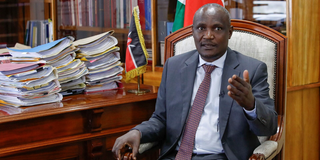
Treasury Cabinet Secretary John Mbadi gestures during an interview with Reuters in Nairobi, Kenya on February 5, 2025.

Photo credit: Reuters

Kenya will in March issue a pioneering Sh129 billion debt for food swap deal with the World Food Programme (WFP) as the country seeks fresh solutions to ease the mounting debt burden.

The WFP-sponsored debt for food swaps will see Kenya identify a bilateral or multilateral creditor who is willing to forego part or all of their due payments in exchange for a commitment from the country to invest the freed-up resources towards food security initiatives such as school feeding programmes and agriculture development.
Kenya targets to cut its debt by Sh129 billion in what could cut annual interest payments.

This is part of the government’s liability management plan for the current fiscal year which also includes a domestic switch bond issuance and potential refinancing of a $1 billion Eurobond that matures in 2028.

This marks the second time in as many years that Kenya is eyeing a debt swap to reduce external debt service obligations on the exchequer. 

Last year, the country entered into a debt-for-climate swap with Germany, which forgave a debt of €60 million (Sh9.1 billion) on condition that the funds be invested in the 300MW Bogoria-Silale geothermal project.

“In managing external debt, the government will prioritise non-market-based measures, including debt swap arrangements, which restructure existing obligations without creating new debt, thereby alleviating medium-term fiscal pressures,” said the Treasury in its 2025/2026 annual borrowing plan.

“In 2024, Germany supported a €60 million debt swap initiative. Building on this success, the government will continue to engaging development partners to explore additional swaps, including a proposed $1 billion (Sh129.23 billion) Debt-for-Food Swap with the World Food Programme (WFP).”

In addition to the food and climate debt swaps, Kenya has also been considering a debt-for-medicine swap with the Global Fund—which is a partnership to combat tuberculosis, malaria and HIV/Aids.

Like the other two swaps, a debt for medicine swap sees the creditor forego a repayment if the debtor puts the dues towards Global Fund-supported programmes, with the foregone amount also counting as the creditor’s contribution to the fund.

It is not clear which WFP donor countries, which are also Kenya’s creditors, will be part of the deal being stitched together between the Rome-based UN agency and Nairobi.

Major bilateral lenders, also the biggest donors to the WFP, include France, which Kenya owed $784.39 million (Sh101.97 billion) at the end of June 2025, Germany ($433.55 million or about Sh56.36 billion), and Italy ($345.92 million or about Sh44.97 billion).

European Commission, another donor to WFP, is also a major multilateral lender to Kenya with $230.71 million outstanding as of the end of June.

WFP has sponsored debt-for-food swaps for two African countries in the past. In 2017, Mozambique entered into such an agreement with Russia for a $40 million (Sh5.2 billion) worth of obligations, while Egypt entered into two separate swap agreements with Italy in 2009 and Germany in 2020, each for $15 million (Sh1.94 billion) in foregone repayments.

Proceeds from the Egyptian swaps were ring-fenced for nutritional rations targeting school-going children in the Fayoum, Menia, and Beni Suef regions over a five-year period, which lapsed in 2014, and for the provision of nutritional needs for 136,000 low-income households.

Mozambique’s proceeds were ring-fenced for a five-year-long school nutrition programme targeting 150,000 students.

For the Treasury, a successful debt swap will free up a significant portion of the Sh586.46 billion earmarked for external principal (Sh340.19 billion) and interest (Sh246.27 billion) payments for the current fiscal year.

On the domestic end, debt service obligations are pegged at Sh1.157 trillion, comprising interest payments of Sh851.42 billion and principal dues of Sh306.16 billion.

The high debt service obligations at a time when the fiscal deficit has been widening due to lagging revenue collection has thus forced the government to explore other options to reduce its financing costs.

Last month, Treasury Cabinet Secretary John Mbadi said that Kenya was negotiating with China to convert the dollar-denominated loans contracted a decade ago for the construction fop the standard gauge railway (SGR) to yuan (renminbi), which will halve the interest payable on the credit.

Kenya spends about Sh130 billion annually on servicing its debt to China, the bulks of which is tied to the SGR financing.

The currency swap, according to Mr Mbadi, will effectively reduce the applicable interest rate on the approximately Sh500 billion debt to about three percent from 6.37 percent under the current dollar denominated terms.

The fall in the interest rate will be realised from a change to the fixed renminbi reference rate of three percent, from the current peg of the US SOFR (Secured Overnight Financing Rate), plus a premium of two percent.

Other recent liability management efforts have seen Kenya refinance its Eurobonds that are maturing or are near maturity with new issuances of longer tenor.

PAYE Tax Calculator

Note: The results are not exact but very close to the actual.