Time flies with great content! Renew in to keep enjoying all our premium content.
Prime
Fertiliser imports slide for second year running
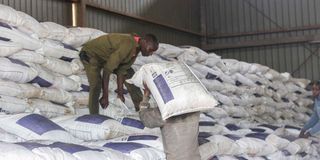
Workers arrange bags of subsidised urea fertiliser for top dressing at the National Cereals and Produce Board (NCPB) depot in Elburgon, Nakuru County on April 21, 2025.
Kenya’s fertiliser imports have dropped for the second straight year, signalling a cooling of the government’s subsidy programme that drove record shipments in 2023 and stood at the heart of President William Ruto’s food security agenda.
Data by the Kenya National Bureau of Statistics (KNBS) shows that the country imported 443,701 tonnes of fertiliser between January and June 2025, valued at nearly Sh25.63 billion, down from 445,857 tonnes worth Sh27.71 billion in the same period of 2024.
The latest fertiliser import volumes extend a decline from the 2023 peak when 629,566 tonnes worth Sh44.8 billion was shipped in, representing a 29.52 percent fall in volume and a 42.83 percent decline in value over two years.
The fertiliser subsidy was among Dr Ruto’s first major interventions on taking office in September 2022, when the country faced record maize flour prices, following the worst drought in four decades and global supply chain disruptions from Russia’s invasion of Ukraine.
To cushion farmers from elevated costs, President Ruto’s government rolled out a massive subsidy that cut the retail price of a 50-kilogramme bag from about Sh6,500 to Sh3,500, before falling further to Sh2,500.
The programme triggered a 234.24 percent surge in imports in the first half of 2023 from 188,358 tonnes in the same period of 2022, as the government — through the National Cereals and Produce Board (NCPB) — purchased fertiliser in bulk to boost agricultural output and stabilise prices.
That, together with favourable weather, helped grow the production of staple maize by 38.80 percent to 47.6 million 90-kilogramme bags in 2023.
A slowdown in fertiliser imports amid erratic weather, including devastating floods in May 2024, hurt production last year, with maize output falling by 6.1 percent in 2024 to 44.7 million 90-kilogramme bags.
Production was far below the government’s target of 74 million bags, set under President Ruto’s food security plan, anchored on fertiliser use.
The shortfall has forced millers and traders to nearly double (96.08 percent jump) maize imports to 266,283 tonnes in the first half of 2025 from 135,800 tonnes a year earlier, KNBS data shows.
Despite the setbacks, Dr Ruto insists Kenya remains on track toward food self-sufficiency, crediting subsidies on farm inputs.
“Our overarching goal remains to make farming profitable, stabilise farmer incomes and secure national food security,” he said during Labour Day celebrations on May 1 in Nairobi. “The reduction of fertiliser prices has led to a 40 percent surge in maize production and boosted farmers’ earnings.”
The marginal decline in half-year import volumes between 2024 and 2025 — about 2,157 tonnes — alongside a Sh2.08 billion drop in import value, suggests that fertiliser prices on the global market have continued to soften.
The government uses the e-voucher system, where farmers redeem digital coupons for subsidised fertiliser via registered agro-dealers. But the 2025 Budget Policy Statement (BPS) noted that some farmers failed to use their vouchers due to literacy challenges, prompting plans to recruit volunteer extension officers to help improve uptake.
During public budgetary hearings late last year, participants urged the government to involve more agro-dealers and private distributors to ensure timely delivery and better logistics.
Similar sentiments have been echoed through the Central Bank of Kenya’s agriculture surveys, whose findings have suggested that while fertiliser availability has improved, delays and long distances to collection points remain major hurdles for smallholders.
“This will be addressed by recruiting volunteer extension officers to assist farmers and ensure 100 percent uptake of the programme,” the Treasury wrote in the 2025 BPS.
Findings by the Comesa Competition Commission have, however, raised red flags in the fertiliser market structure. The watchdog for the 21-nation trading bloc wrote in a 2024 report on fertiliser markets in East and Southern Africa, based on 2022 data, that Kenya’s largest fertiliser suppliers were using their market dominance to maintain high prices despite falling global costs.
“The large companies appear to share shiploads and prepare cost build-ups using common benchmarks,” the report stated, adding that prices “have not reduced in line with international trends.”
The report suggested the dominance by the two leading suppliers— Yara and ETG —has been reinforced by being the only firms contracted to supply bulk volumes under the government subsidy scheme, with entry barriers for new players.