Lower food, fuel import bills narrow trade deficit to Sh1.6trn

Food truck

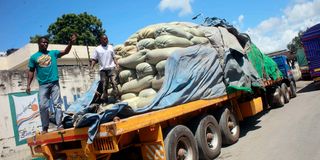
Trucks loaded with imported maize from Tanzania waiting to offload outside Mombasa Maize millers in Mombasa. The slowdown in the value of imports was largely driven by the reduced value of food and beverages.

Photo credit: File | Nation

The gap in the monetary value of Kenya’s imports and exports narrowed for the second year running in 2024, new official data shows, on falling expenditure on food and fuel orders from abroad.

The amount—popularly known as the trade deficit—fell marginally to Sh1.591 trillion from Sh1.595 trillion the previous year, marking a 0.26 percent change, according to data newly published by the Kenya National Bureau of Statistics.
This came when the country’s import bill slowed for the fourth year in a row, growing a modest 3.81 percent to Sh2.70 trillion from Sh2.60 trillion the year before.

The slowdown in the value of imports was largely driven by the reduced value of food and beverages as well as fuel bought from foreign countries despite a rebound in shipments of machinery and transportation equipment.

The value of food and beverages contracted 17.35 percent to nearly Sh283.27 billion, reflecting improved domestic production helped by President William Ruto's administration’s subsidy programme. 

“To ensure food security in the country and reduce the cost of living, the Government has continued to roll out fertilizer and seeds subsidies to farmers across the country enabling them to increase the key food value chains and revamp underperforming/collapsed export crops,” the Treasury wrote in the 2025 Budget Policy Statement earlier this month. “Since February 2024, the Government has distributed subsidised fertiliser to 6.45 million registered farmers in 45 counties, under the Fertiliser Subsidy Programme, as well as animal feed and certified seeds, enabling them to increase their yields. Additionally, maize production doubled to 61 million bags of maize in 2023 compared to the 30 million bags that were harvested in 2022”

Fuel imports, on the other hand, dropped 6.21 percent to Sh618 billion on falling global prices amid stability in the shilling amongst major international currencies, including the US dollar.

Expenditure on food import in 2023 surpassed that for machinery as traders turned to foreign markets to bridge the deficit in stocks following poor harvests the year before because of a prolonged drought and bottlenecks in global supply chains which raised cost of farm inputs such as fertilizer.

The provisional KNBS data shows expenditure on machinery and related equipment recovered last year to grow 16.72 percent to Sh353.79 billion, reflecting improved performance in sectors such as agriculture and some segments of manufacturing.

The biggest growth came from orders for transportation equipment such as motor vehicles whose value jumped 38 percent to Sh238.62 billion.

The growth in import bill, nonetheless, was slower than earnings from exports for the third year in a row, narrowing the trade deficit in that period.

Kenya earned nearly Sh1.11 trillion from exports, the KNBS numbers – sourced from the Kenya Revenue Authority – show, a bump of 10.28 percent over Sh1.0 trillion a year earlier.

Kenya has over the years struggled to sustainably narrow the goods trade deficit partly due to reliance on traditional farm produce exports such as tea, horticulture, and coffee which are largely sold raw, fetching relatively lower earnings.

Most Kenyan traders also largely export raw and semi-processed goods because of higher taxes slapped on processed products in destination markets such as the 27-member European Union and the UK, fearing that value addition will make products less competitive in the global markets.

The value of tea exports is estimated to have remained largely flat, growing a measly 0.21 percent to Sh188.96 billion, while coffee rose 9.83 percent to Sh40.41 billion, according to provisional data by the Central Bank of Kenya.

Earnings from horticultural exports such as cut flowers, vegetables, and fruits, on the other hand, grew 10.12 percent to Sh158.29 billion.

PAYE Tax Calculator

Note: The results are not exact but very close to the actual.