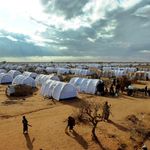
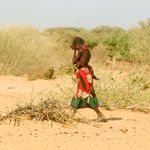
Kenya’s refugee and asylum-seeker population hit a record 857,065, with Eritreans and Burundians recording some of the fastest growth over the past decade as the country increasingly becomes a destination for people fleeing conflict, political instability and economic hardship.
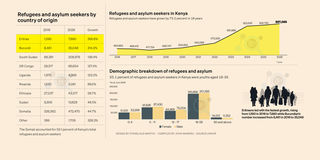
The number of refugees and asylum seekers reached 857,065 in June 2026, up 73.2 percent from 494,863 in 2016, according to data compiled from the United Nations High Commissioner for Refugees.
The growth has been particularly pronounced among some of the smaller refugee communities.
Eritreans led with the fastest growth, rising from 1,590 in 2016 to 7,880, representing a 395.6 percent.
Burundian’s had the second-fastest growth. Their number increased from 8,461 in 2016 to 35,048, a 314.2 percent increase over the decade.
The increase in the Burundian population comes at a particularly sensitive time for the community, with hundreds of Burundians seeking to leave Kenya following a government crackdown on foreigners operating small-scale businesses.
Hundreds of Burundians gathered outside their embassy in Nairobi this week, seeking travel documents to return home after President William Ruto ordered a crackdown on foreigners operating businesses.
Some Burundians arrived at the embassy carrying suitcases and other possessions, with some saying they had received threats and feared they were no longer safe in Kenya.
The reports came after the President directed authorities to shut down small businesses operated by foreign traders, although the government later clarified that the enforcement was aimed at foreigners operating without the required permits.
The episode highlights a difficult economic balancing act for Kenya.
Foreign traders form part of the country's wider informal and small-business economy, providing goods and services to consumers while also competing with Kenyan traders for customers and market space.
The government's position is that foreigners should not use visitor or other immigration status to enter Kenya and then compete with citizens in small-scale businesses.
But the sudden uncertainty also illustrates how closely migration and livelihoods have become intertwined.
For businesses, the immediate issue is therefore bigger than the departure of individual traders. It raises questions about how Kenya manages the intersection of immigration enforcement, refugee protection, informal employment and regional trade.
Kenya's refugee population has not simply grown in numbers; its composition has also changed significantly.
Somalis remain by far the largest group, rising from 326,562 in 2016 to 472,470 in June 2026. They accounted for 55.1 percent of the country's refugees and asylum seekers.
South Sudanese increased from 88,391 to 208,978 over the same period, while refugees from the Democratic Republic of Congo rose from 29,317 to 66,654.