Time flies with great content! Renew in to keep enjoying all our premium content.
Prime
Dimmed hopes as Mbadi backtracks on promise to reduce workers’ PAYE
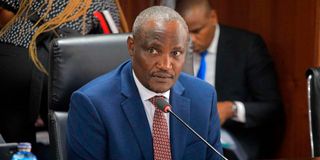
Treasury Cabinet Secretary John Mbadi addressing members of the National Assembly's Departmental Committee on Finance and National Planning at Bunge Tower, Nairobi, on November 18, 2025.
Treasury Cabinet Secretary John Mbadi has backpedalled from an earlier promise to include income tax cuts for salaried workers earning below Sh50,000 in the Finance Bill, dealing a blow to more than one million employees who anticipated cushions from the rising cost of living.
Instead, the Treasury has increased tax on rent, mobile phones, beer, cigars and betting in the race to raise Sh120 billion from the Finance Bill, 2026, up from Sh30 billion it targeted via the Finance Act 2025.
It also targeting another Sh81 billion from its crackdown on tax cheats, with the Kenya Revenue Authority (KRA) expected to collect Sh2.985 trillion for the year starting in July, up from Sh2.784 trillion.
But workers expecting income tax to lift their disposable income, which have been eroded by inflation in the past five years, will be disappointed.
Mr Mbadi promised that salaried workers earning Sh50,000 and below would enjoy income tax cuts of between Sh731 and Sh2,127 under proposed changes to Pay-As –You- Earn (PAYE) tax brackets aimed at cushioning low-income earners from inflation.
The Treasury shelved a special Tax Laws (Amendment) Bill 2026 that would have facilitated the tax cuts and signalled the reliefs would be included in the Finance Bill 2026.
The Bill, which has been tabled in Parliament and set to be passed by the end of June, does not have the cuts.
“We, however, had to set this aside because we just have a few weeks to Finance Bill 2026, and so bringing some tax law adjustments at this time would be too close to the Finance Bill,” Mr Mbadi told the National Assembly’s Budget and Appropriations Committee on March 31.
“We would rather review all this and consolidate and bring them together as opposed to having two separate Bills.”
This U-turn by the government means that salaried workers earning below Sh50,000 will now wait longer for adjustment of PAYE bands to boost their disposable incomes, even as the country’s inflation jumped 5.6 percent in April from 4.4 percent a month earlier on costly fuel following the Iran war.
Treasury is proposing to increase tax on gross rent from 7.5 percent to 10 percent in what could trigger landlords to increase leasing.
It has imposed a 5 percent tax on second hand shoes and clothes and 16 percent VAT on locally assembled phones.
Excise duty on mobile phones will increase to 25 percent from the current 10 percent, making the gadgets costly as imported pass on the additional costs to consumers.
President Mwai Kibaki’s administration significantly reduced taxes on mobile phones in the mid-2000s as part of a broader strategy to expand mobile penetration and digital connectivity in Kenya.
Tax amendments on excise duty largely target alcohol and tobacco products, as well as a myriad of items imported duty-free from countries in the East African Community (EAC).
Excise duty on ethanol has been reduced from Sh500 per litre to Sh88 per litre, even as the government moves to expand the pool of taxpayers beyond licensed spirits manufacturers.
This will hit manufacturers of pharmaceuticals, sanitizers, cosmetics and industrial chemicals, meaning hospitals, drug manufacturers, cosmetics firms and chemical processors.
The excise duty, popularly known as a “sin tax” because it traditionally targets alcohol, cigarettes and betting products.
Small independent brewers producing alcohol content of less than six percent who had been spared from paying the full rate of excise duty at Sh22.50 per centilitre of pure alcohol might now have to shoulder the full cost of the tax.
This is after the Finance Bill proposed abolishing the provision that exempted them from the full duty, under which they instead paid Sh10 per centiliter.
Kenya has also proposed introducing excise duty on several items, including paper, furniture and glass imported from EAC countries, in a move likely to ruffle partner states within the seven-member regional bloc, which aims to eliminate all forms of non-tariff barriers under the Common Market framework.
The Finance Bill has also proposed fresh changes targeting tobacco products, including higher excise duty rates on cigarettes and other nicotine products as the government seeks to shore up revenues from sin taxes amid declining alcohol collections and growing public health concerns over tobacco consumption.
The higher revenue projection will be put to test by a deterioration of the economic outlook on effects of the US-Israel war against Iran.
Kenya like many other African countries is heavily reliant on energy imports.
The Iran conflict has left it scrambling to stave off shortages of essential commodities like fuel, and the war's ripple effects are expected to spur inflationary pressures that could dampen Kenya's growth prospects.
The National Treasury has revised its growth projection for 2026 from 5.3 percent to five percent and expects output to be much lower if the conflict persists.
Mr Mbadi in February said that his ministry had prepared a Tax Laws (Amendment) Bill that would raise the threshold of untaxed income from Sh24,000 to Sh30,000, while income falling between Sh30,000 and Sh50,000 would be taxed at 25 percent.
Under the promised changes, workers earning Sh30,000 would have seen a Sh731.25 increase in their monthly net pay to Sh26,925—after statutory and PAYE deductions.
Those earning Sh35,000 per month would see a Sh1,500 jump in net pay to Sh31,059.38, with their PAYE falling to Sh353.13 from Sh1,853.13.
According to the now delayed plans by the Treasury, the net pay for those on a gross salary of Sh50,000 would have risen by Sh2,127.10 to Sh41,156.25 per month.
The government has in recent months come under intense pressure to review the recent statutory deductions, specifically the National Social Security Fund (NSSF), the Social Health Insurance Fund (SHIF), and the Affordable Housing Levy (AHL).
The Kenya Bankers Association proposed a uniform 5.0 percent reduction in PAYE rates across all existing tax bands.
Last year, real wages, which have been adjusted for inflation, rose marginally to Sh56,566 from Sh55,450 in 2024. The earnings are, however, still lower than in 2020, when they stood at Sh62,256.