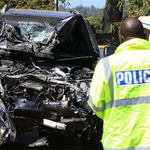
Police officers will not be allowed to hold impounded vehicles for more than 14 days under proposed changes, which have been tabled in the National Assembly, marking a shift from the current situation where law enforcers have the discretion to retain seized units for unlimited periods until investigations are concluded.
The proposed reforms are contained in the Traffic (Amendment) Bill, 2026, which seeks to introduce clear timelines for the detention of vehicles and motorcycles held in connection with traffic offences.
The proposed law, which is sponsored by Yatta Member of Parliament Robert Ngui Basil, aims to curb prolonged impoundment that has often left motorists without their vehicles for indefinite periods.
“The principal object of this Bill is to amend the Traffic Act, Cap 403, to ensure that owners of vehicles and motorcycles are not unreasonably deprived of their property where their vehicles are detained to enforce the provisions of section 107 of the Traffic Act, Cap. 403,” reads the memorandum of the Bill.
Under the new provisions, a vehicle detained for purposes of investigation may only be held for a maximum of 14 days. In cases where the vehicle is required purely as evidence, the detention period will be capped at 48 hours, especially if a photograph or assessment report is deemed sufficient for use in court.
This marks a departure from the current Traffic Act, which allows police officers to detain vehicles “until such inquiries have been made… as they may think necessary,” effectively granting open-ended powers with no fixed timelines.
“It shall be lawful for any police officer to detain at a police station or other place of safety any vehicle which has been removed from a road or other public place under section 106 until such inquiries have been made by the police as they may think necessary in the circumstances of the case,” states the current law.
The provision has left motorists exposed to unnecessary delays, loss of income, and extortion, even when the offences involved are minor. As a result, many police stations across Kenya are clogged with vehicles left to deteriorate in poor and congested conditions.
The proposed amendment introduces a structured framework to balance between law enforcement needs and property rights. Police officers will be required to justify detention, either for investigation or as evidence in a trial.
In addition, the Bill places responsibility on the officer in charge of the police station to ensure the safety and preservation of impounded vehicles.
“A police officer in charge of the police station where a vehicle or motorcycle is detained shall take reasonable care for the preservation of the vehicle or motorcycle,” reads the proposed law.
If passed into law, the provision will address concerns from motorists who have previously complained about damage, vandalism, or loss of parts while their vehicles were in police custody.
The fear of losing income and disrupting livelihoods due to prolonged detention, especially for commercial vehicles such as trucks, taxis, and boda bodas, has always encouraged the issuance of bribes to police officers.
Official data shows that Kenya has witnessed a doubling of registered vehicles, with the number jumping to 4.97 million in 2024 from 2.45 million in 2013. Out of this, the number of cars has grown to 1.46 million from 847, 745.