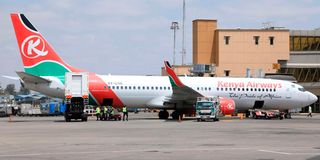
Kenya Airways (KQ) has recorded increased demand and passenger numbers for many of its long-haul flights since the onset of the Middle East war, boosting its revenue and helping its efforts to recover from last year’s losses.
The national flag carrier has disclosed that its planes to major destinations in Europe, the United States and Asia, are now filling up quicker as demand previously captured by large Middle East carriers falls to them.
Its passenger load factor – the percentage of seats in a plane filled up by paying passengers per flight – has improved by about 29 percent, from an average of 70 percent to 90 percent, with many flights having up to 99 percent of seats occupied.
“We’ve achieved in some routes a cabin factor of more than 90 percent, where it used to be 70 percent, because this is normally a low season for us,” said KQ’s acting chief executive officer George Kamal during a press briefing.
“We’re expecting better growth into Africa, because a lot of people are changing the hubs, and this is going to help us. Even after the conflict has ended, we expect to retain between 30 to 40 percent of that traffic growth.”
However, the Iran war has also led to loss of the lucrative Dubai route for KQ, which is its only destination in the Middle East. Before the airspace closure, KQ operated two flights to Dubai daily. Additionally, the close of the Middle East airspace has meant many of its flights to Europe have had to be rerouted, taking up to one hour longer and increasing operational costs by up to $10,000 (Sh1.3 million) per flight.
The war pitting America and Israel against Iran has led to the grounding of operations of major airlines from the Gulf region, due to a closure of the of the airspaces of several countries in the region, including the United Arab Emirates, which is home to Emirates and Etihad.
Dubai, Abu Dhabi, Doha and Riyadh, which are the hubs of Emirates, Etihad, Qatar Airways and Saudia Airlines respectively, are major connection hubs for travellers between the US, Europe, Asia and Africa. With the airspaces of these countries closed, these airlines have been unable to continue operations, shifting traffic to African carriers like KQ, its arch rival Ethiopian Airlines, EgyptAir, among others.
Currently, KQ flies directly to seven destinations in Europe, the US, and Asia. These are London, Amsterdam, Paris, New York, Mumbai, Bangkok, and Guangzhou. In some of these routes, it operates multiple flights per week, and some several daily flights.
Mr Kamal said with the increase in demand, the carrier is seeing an opportunity for increased frequency and capacity to many of these destinations, further boosting its revenues.
The boost is expected to help the carrier bounce back to a profit this year, after a loss last year blamed on constrained capacity due to prolonged grounding of planes.
KQ is expected to release full-year performance for the 12 months to December 2025, but it had projected a major decline in earnings from the Sh5.4 billion net profit reported in 2024.