Kenya Airways swings back to the red with Sh17.2bn loss

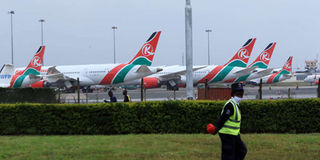
A fleet of Kenya Airways planes at the Jomo Kenyatta International Airport in Nairobi. 

Photo credit: File | Nation Media Group

Kenya Airways made a net loss of Sh17.1 billion in the year ended December 2025, reversing a net profit of Sh5.4 billion the year before as revenue plunged on the grounding of part of its aircraft fleet.

The national carrier’s sales declined by Sh27 billion to Sh161.4 billion, resulting in an operating loss of Sh5.6 billion as operating costs fell by a smaller margin of Sh4.79 billion to Sh167 billion.
“Overall performance and operations in the year 2025 were severely impacted primarily by the temporary grounding of three of the wide body fleet, Boeing 787-8 Dreamliner aircraft. This was driven by the global supply chain constraints and limited engine availability,” the airline said in a statement.

KQ, as the airline is known by its international code, saw its negative asset position worsen to Sh132 billion from Sh118.2 billion. The company however traded at Sh5.2 per share or a market value of Sh30.2 billion yesterday on the Nairobi Securities Exchange as the government tries to get a strategic investor to buy into the airline.

The national carrier’s performance marks a return to losses after a year of profitability, with management attributing the downturn to prolonged grounding of aircraft, which significantly reduced available seat capacity across key routes.

The airline said the reduced fleet availability was driven by longer-than-expected maintenance cycles, occasioned by delays in the supply of critical aircraft components, a challenge that has affected carriers globally.

For most of the year to December 2025, at least three of KQ’s wide body Boeing 787 Dreamliner aircraft were grounded for maintenance at any given time, cutting the airline’s long-haul capacity by about 20 percent and disrupting schedules across its network.

The capacity constraints forced the airline to rationalise some routes and adjust frequencies, limiting its ability to fully capitalise on the recovery in global travel demand.

“We had a number of fleet grounded in 2025, especially our wide body aircraft, and these are the money makers in the industry” said chief financial officer Mary Mwenga, noting that the capacity constraints significantly hit revenues.

Cargo volumes in the review period stood at 64,780 tonnes, down from 70,776 tonnes in the prior year, reflecting weaker demand in freight markets.

Acting chief executive officer George Kamal said the carrier is relying on increased cargo capacity, enabled through the addition of a Boeing 747 cargo plane and capacity share with other carriers, to boost its revenues this year and drive profitability.

Its cargo capacity has already improved from last year’s 70 tonnes per day to 180 tonnes currently, and it seeks to raise that to 250 tonnes daily through capacity share by the mid- year.

A cargo handler labels boxes of flowers for export at JKIA.

Photo credit: FILE

This is expected to raise the revenues raised from cargo and maintenance operations to about 40 percent of the carrier’s total revenues.

The management also said efforts are underway to restore fleet availability and improve operational reliability, including closer collaboration with manufacturers and maintenance providers to secure timely access to spare parts.

“Our outlook remains very optimistic. Our immediate priority is to stabilise operations, rebuild capacity, and to keep a keen eye on cost control,” said Kiprono Kittony, the new KQ chairman.

“We are optimistic that the measures that are being put in place, despite the very complex externalities that we are faced with, are sufficient to allow us to ride through the foreseeable future.”

The airline also indicated that it continues to engage investors as part of its long-term restructuring plan aimed at strengthening the balance sheet and returning to sustained profitability.

KQ’s performance underscores the fragility of the aviation sector’s recovery, where external supply chain constraints continue to pose significant risks even as passenger demand rebounds.

Follow our WhatsApp channel for the latest business and markets updates.

PAYE Tax Calculator

Note: The results are not exact but very close to the actual.