Rural electricity connection cost jumps by Sh165 billion

A Kenya Power technician installs lines during a power supply upgrade at Homa Bay substation.

Photo credit: File | Nation Media Group

The cost of connecting the country’s rural areas and slums to the electric grid is projected to rise by Sh165 billion, following waves of new settlements that will require the installation of new transformers.

As part of its constituency electrification programme, the Rural Electrification and Renewable Energy Corporation (Rerec) expects to spend Sh22 billion on 15,325 new transformers alone between 2017 and 2030.
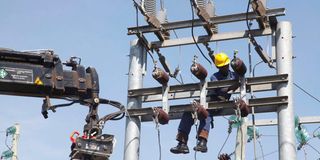
By the end of June last year, the agency had rolled out 3,321 units of the equipment, even as it grappled with rising electricity demand driven by rapid population growth.

“The major challenge has been an increase in the number of new settlements all over the country, leading to an increase in areas requiring transformers to be installed and increased project material costs,” said Rerec in a new report published by the National Treasury.

“Project costs are projected to grow by an additional Sh165 billion. Currently, there is a database of 13,000 unelectrified households, projected to grow to 15,000 in the MTF (Medium Term Framework) period,” added the report, which was published in November last year.

The report did not state the base from which the project cost will rise by Sh165 billion.

While Rerec does not handle electricity metering, it connects households within a 600-metre radius of its infrastructure through service cable drops, with Kenya Power and Lighting Company responsible for metering, billing and maintenance. It extends electricity infrastructure to public facilities such as schools, health centres, markets, and water projects.

Rerec’s mandate was expanded after Kenya Power delegated to it the role of connecting customers in informal settlements, as the power distributor stepped up its focus on customer segments that account for the bulk of its electricity sales.

Rerec is the State agency mandated to connect Kenyans in rural areas at subsidised rates, thereby driving the social objective of improving access to electricity across the country.

Most households in informal settlements use electricity only for lighting, making the sector economically unviable for Kenya Power.

Demand for electricity has risen sharply as Kenya’s population has grown, with official data from the Kenya National Bureau of Statistics showing the number of households climbed to 14.3 million in 2019, a 63 per cent increase from 8.77 million a decade earlier.

Since 2007, Rerec has also been involved in the electrification of public facilities at a total cost of Sh65.26 billion. In Treasury disclosures, Rerec says it has connected 64,395 public facilities to electricity against a target of 115,610 identified public facilities.

“The major challenge has been an increase in the number of new public facilities all over the country and increased project material costs,” says Rerec.

In addition to projects by Rerec, Kenya Power has also been involved in the Last Mile project, which is aimed at connecting households and small businesses located near existing power lines to electricity at subsidised cost.

The Last Mile project was launched by the government in 2015 to speed up the expansion of electricity penetration across the country, particularly in rural areas.

Kenya has expanded electricity penetration across the country, particularly in rural areas, over the past decade under the Last Mile project.

Kenya Power’s customer base grew from 3.61 million in 2015 to 9.66 million in June last year.

The project is, however, not profitable to KPLC, given that remote areas and slums have low consumption levels since power use is largely limited to lighting, charging phones and powering small electronic appliances.

PAYE Tax Calculator

Note: The results are not exact but very close to the actual.