Kenya edges out Tanzania in race for Rwanda fuel imports

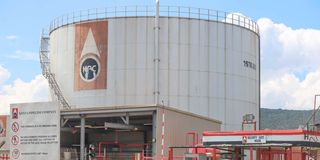
The Nakuru Kenya Pipeline Company (KPA) deport on November 22, 2024.

Photo credit: File | Nation Media Group

Rwanda has chosen Kenya’s transport corridor over Tanzania's for its government-to-government (G-to-G) refined fuel importation programme, underscoring Nairobi’s superior ports and piping infrastructure.

Antoine-Marie Kajangwe, Rwanda’s Minister of Trade and Industry, on Monday disclosed that his country had picked Kenya due to the efficiency of the port of Mombasa and the Kenya Pipeline Company (KPC) network.
“The port infrastructure in Mombasa is extremely efficient, and we are looking forward to utilising the high levels of efficiency to benefit our local private sector and our citizens,” she said on Monday afternoon.

Rwanda has for decades relied on oil marketers that import fuel via the port of Dar es Salaam, with Kenya handling not more than 30 percent of the fuel destined for Kigali.

Kigali’s move to drop Tanzania is a major win for Kenya in the battle to remain the gateway of fuel meant for the East African region, given that it will earn KPC and the port of Mombasa additional revenue besides cementing their reputation as the importation route of the bigger share of fuel consumed in the East African region.

Besides Rwanda, Uganda is also relying on Kenya to fully import its refined fuel under a G-to-G deal that it inked three years ago.

KPC will earn revenue from storing and transporting the fuel that Rwanda will import under its G-to-G deal with OQ Trading, the international energy and commodity trading arm of the Sultanate of Oman.

But Rwanda’s decision to adopt a G-to-G deal for fuel importation will hit the Kenyan oil marketers that have for years sold fuel in Kigali.

Energy and Petroleum Cabinet Secretary Opiyo Wandayi, disclosed that KPC will now handle up to 500,000 cubic metres of refined fuel annually for Rwanda, pointing to KPC’s big win in its revenue drive.

“Kenya will provide a transit environment to guarantee security of supply of bulk petroleum products to Rwanda for the long haul,” Mr Wandayi said on Monday.

“The volumes to Rwanda transiting through this corridor are set to grow more than ten-fold from roughly 50,000 cubic metres to over 500,000 cubic metres annually.”

Kenya has already granted a permit to the Rwanda National Petroleum Corporation (RNPC) to import, export and sell fuel in the wholesale market, paving the way for the government-owned oil marketer of Rwanda to implement the G-to-G deal with OQ Trading.

RNPC becomes the second State-owned oil marketer to rely on KPC’s network for the importation and transport of refined fuel under a G-to-G arrangement.

Uganda National Oil Company (Unoc) has since 2023 been using KPC’s tanks and pipeline to handle and transport the fuel supplied by Vitol Bahrain.

Unoc paid KPC Sh1.2 billion for handling, storing and transporting its fuel in the first year of its deal with Vitol Bahrain.

Rwanda did not disclose the reason behind its G-to-G deal with OQ Trading, only saying that this arrangement will bolster security of supply of fuel in Kigali and other parts of the tiny landlocked country.

Uganda had in 2023 said that costly fuel attributed to middlemen in the Kenyan importation system had led to its decision to shift to a G-to-G deal with Vitol Bahrain.

But Kampala’s deal with Vitol Bahrain has largely failed to lower pump prices, with the country being home to the second costliest fuel in the East African region.

A litre of petrol is retailing at $1.704 in Kampala compared to $1.643 in Nairobi. The fuel is costliest in Kigali, with a litre going for $2.

A litre of diesel is currently going for $1.992 in Kigali compared to $1.712 in Nairobi and $1.665 in Kampala.

Follow our WhatsApp channel for the latest business and markets updates

PAYE Tax Calculator

Note: The results are not exact but very close to the actual.