Time flies with great content! Renew in to keep enjoying all our premium content.
Prime
Public hospitals turn to expensive drugs on lower Kemsa supplies
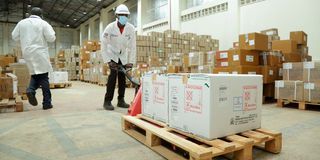
Kenya Medical Supply Authority (Kemsa) transfer cartons containing vaccine doses into a cold storage facility at their warehouse in Kisumu on March 4, 2021.
The Kenya Medical Supplies Authority (Kemsa) delivered only 41 percent of medicines and medical supplies ordered by public health facilities in the financial year ending June 2025, leaving facilities without essential drugs, and forcing some to either turn away patients or opt for expensive sources.
Auditor-General Nancy Gathungu said the 41 percent order fill rate fell far below Kemsa’s internal performance target of 90 percent. The authority’s sales revenue also declined to Sh4.89 billion from Sh5.80 billion the previous year.
The order fill rate measures the proportion of items delivered against those ordered. For instance, a facility that orders 10 units but receives four records has a 40 percent fill rate.
The latest performance marks a continued downward trend that has continued to cripple medical supplies to facilites.
Kemsa’s fill rate stood at 69 percent in 2019/20, dropped to 54 percent in 2020/21, then to 50 percent, before slightly improving to 51 percent and 52 percent in the following years—only to plunge to 41 percent in 2024/25. This is the first time in six years that the rate has fallen below 50 percent.
The decline is largely attributed to a mounting Sh6.28 billion debt owed by county governments and public health facilities, which has significantly constrained Kemsa’s ability to procure stock.
Of this amount, nearly Sh3 billion has been outstanding for over a year without repayment plans. Kemsa now waits an average of 487 days, more than 16 months, to receive payments, far exceeding its 45-day credit policy.
The cash flow strain has in turn affected Kemsa’s ability to pay its own suppliers. During the review period, the authority owed suppliers Sh5.71 billion, including Sh1.73 billion that had remained unpaid for more than 90 days without repayment arrangements.
Operational challenges have also worsened. By June 2025, hospitals were waiting an average of 19.5 days for deliveries, nearly three times the seven-day target.
Dispensaries and smaller facilities faced even longer delays, averaging 24.2 days against a target of ten days.
Even donor-funded programmes for HIV, tuberculosis, malaria, and family planning failed to meet expectations, achieving a fill rate of 79 percent, stilll below the 90 percent benchmark.
Ms Gathungu noted that Kemsa’s performance has been undermined by multiple systemic challenges, including reduced capital investment, limited stock availability, inefficient logistics, and rising operational pressures.
“Between FY 2019/20 and FY 2024/25, Kemsa's capital order fill rates were 69 percent, 54 percent, 50 percent, 51 percent, 52 percent, and 41 percent, consistently falling short of the 90 percent target,” she said.
Meanwhile, a Sh499.7 million integrated computer system intended to link all Kemsa warehouses in real time and enable regional order processing remains incomplete. The system, contracted in November 2023, was only 70 percent complete by May 2025, one year past its deadline, raising concerns over value for money.
Distribution inefficiencies are further compounded by underutilised infrastructure. Of Kemsa’s seven regional warehouses, only the Kisumu facility is partially operational. The remaining depots in Eldoret, Mombasa, Nyeri, Meru, Kakamega, and Nairobi’s commercial street function merely as passive storage sites without distribution capacity.