Time flies with great content! Renew in to keep enjoying all our premium content.
Prime
The Kentwood Address club owner betting against city nightlife
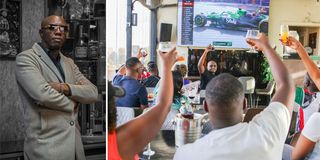
Businessman Alex Ndung’u, director of Kentwood Address, poses at his office in Runda Mall (left), while patrons toast during a Formula One watch party at Kentwood Address Lounge along Kiambu Road on September 21, 2025.
For most entrepreneurs, the decision to close a business comes after losses begin piling up. Two weeks ago, Alex Ndung’u chose to exit while his venture was still raking in profits.
The closure of Kentwood Address Runda, one of the most popular clubs along Kiambu Road, rattled the nightlife sector. Blogs went wild with speculations.
When BDLife finally tracks Alex, the entrepreneur appears at peace with his decision. The club, he says, was still making money, but not enough to justify what he sees as a changing market.
After six years in the nightlife business, Alex believes Nairobi’s entertainment scene has become an increasingly expensive contest driven by celebrity DJs, influencers and paid seat-fillers. Rather than wait for margins to disappear, he chose to exit and place a new bet on what he considers a faster-growing industry: fitness and wellness.
When we meet him at his office in Runda Mall, the 39-year-old steps away from the window overlooking the busy shopping complex, straightens the collar of his grey overcoat and settles into his seat.
Despite building a business portfolio that spans real estate, distribution and entertainment, this is his first-ever media interview.
He says he agreed to speak because of growing speculation surrounding Kentwood’s closure.
“I’ve seen several blogs publish inaccurate reports about why we closed Kentwood. I felt it was only fair to set the record straight,” he says.
Strategic exit
For Alex, the decision was neither emotional nor forced by financial distress. It was a strategic exit.
Born into a family of serial entrepreneurs, he says he was raised to build rather than inherit. “I was taught how to fish, not handed a fish,” he says.
That philosophy has shaped how he approaches business opportunities. In his view, entrepreneurship is not about holding on indefinitely to a venture simply because it is profitable. It is about recognising when a market is changing and deciding whether the effort required to sustain growth still justifies the return.
“Not every business is meant to last forever. Kentwood served its purpose. We had six memorable years, and it felt like the right time to close that chapter and pursue something new.”
The club was not struggling. Customers still walked through its doors. Revenues continued to flow. Yet Alex says the economics that once made the business attractive had shifted.
“Kentwood had become an okay business. It wasn’t making losses, but it wasn’t delivering meaningful margins either. Sometimes you don’t have to wait until a business starts losing money before making the decision to move on.”
He says he learnt that lesson after watching businesses fail, not because they were unprofitable, but because owners remain emotionally attached long after growth has plateaued. He says that the most difficult business decisions are not always about starting ventures but knowing when to exit them.
The battle for attention
When Kentwood opened its doors six years ago, the nightlife landscape looked very different.
According to Alex, customers primarily sought a place to relax after work, enjoy a meal, listen to music and socialise with friends. Success depended largely on creating a welcoming atmosphere and delivering a consistent customer experience.
“When we opened Kentwood, it was a genuine hangout spot. People came to unwind after work, enjoy good food, soak in the ambience and spend time with friends. The business felt very organic.”
Then, over time, however, customer expectations evolved.
As more establishments entered the market, clubs increasingly found themselves competing not only on service and ambience, but also on spectacle. Entertainment, Alex says, became the product.
“Today, nightlife in Nairobi and its environs is less about the hangout experience and more about entertainment. Clubs are constantly competing for attention. Hiring big-name DJs has become the norm, with some charging between Sh75,000 and Sh100,000 a night. That’s what customers seem drawn to now.”
The economics of nightlife
Alex says the pressure to remain visible has transformed the economics of nightlife. For many operators, attracting customers now requires a steady calendar of headline-grabbing events, celebrity appearances, and expensive entertainment packages.
“You have to keep creating big moments. Bring in a popular artiste, pay them a premium fee and give people something to talk about. But eventually the numbers stop making sense. If you're spending between Sh80,000 and Sh100,000 on a DJ for a single Friday night, then you need another attraction on Saturday and something else on Sunday, how long can you sustain that?" Alex poses.
DJs, he says, represent only part of the cost structure.
From organic to 'plastic business'
Alex points to another increasingly common industry practice: the use of seat-fillers.
The strategy is designed to create the impression of a busy venue, particularly during slower days of the week. Clubs provide incentives ranging from complimentary food and drinks to stipends for individuals who help create an atmosphere that attracts paying customers.
“Most nightclubs, especially along Kiambu Road, are not making any meaningful margins. The business has become plastic. Instead of simply opening your doors and waiting for customers, club owners now constantly think about how to keep the club looking full throughout the week.”
The seat-fillers are often attractive and outgoing young women whose presence helps create the perception of popularity.
“We give them free cocktails, food and a stipend just to be there and create an atmosphere. Naturally, high-spending customers are drawn to places that look lively and have attractive people. Most people prefer going where there are already crowds. That’s another cost that eats into your profit margin.”
Combined with entertainment expenses, Alex says the monthly cost of maintaining visibility can run into hundreds of thousands of shillings.
“The cost of hiring DJs and maintaining seat-fillers can range between Sh500,000 and Sh1 million every month,” he says.
Extremely lucrative
In an industry where perception often drives customer behaviour, many club owners have little choice but to participate. “If you don’t hire them, the club next door will.”
For clubs that master this marketing strategy, the returns are worth it.
Businessman Alex Ndung’u, director of Kentwood Address, poses at his office in Runda Mall.
Photo credit: Pool
“The nightclub business can be extremely lucrative. On a good weekend, a club can make more than Sh9 million, and about Sh1.5 million on weekdays. But location is everything.”
Alex believes the physical characteristics of Kiambu Road further intensify competition. The area offers abundant land for large entertainment establishments, making it relatively easy for new entrants to establish themselves.
“Kiambu Road is attractive because there is plenty of land for large entertainment venues. But that’s also its biggest weakness. The moment a club succeeds, competitors can easily find space nearby and set up shop.”
By contrast, neighbourhoods such as Kilimani benefit from natural barriers to entry.
“It’s very different from areas such as Kilimani, where suitable spaces are scarce. That naturally limits competition.”
Yet despite the challenges, he remains candid about the allure of the nightlife business. He still operates another club, which he says continues to perform well.
“There is something about running a nightclub. It has a hold on you. It is an endless cycle of anticipation. You’re always planning for the next weekend, the next holiday, the next big event. There’s always something around the corner. That adrenaline is addictive.”
Reinventing a prime asset
Closing Kentwood did not mean abandoning the property. The location remains one of the most valuable assets in Alex’s portfolio, forcing him to confront a critical entrepreneurial question: what should come next?
Initially, he considered a complete rebrand. “The only way to revive the location and bring it back to full strength would be to relaunch it as a totally different brand.”
The idea, he says, was tempting.
“We debated a lot. Should we reinvent Kentwood? Should we create something completely different from what everyone else on Kiambu Road is doing?”
But the more he analysed the option, the less convinced he became. A rebrand, he concluded, would merely postpone the same challenges.
“I realised a rebrand would only buy a few more years before the same cycle repeated itself. You reinvent, you get another four or five years, and then you’re back to the drawing board.”
Instead, he began paying closer attention to shifts in consumer behaviour. What he observed convinced him that another industry was quietly gathering momentum.
Betting on wellness
For years, nightlife represented one of Nairobi’s most visible lifestyle sectors. Today, Alex believes a different trend is emerging.
“One of the biggest shifts I’ve observed is that people are becoming increasingly health-conscious. They’re drinking less, exercising more and paying closer attention to their overall wellbeing,” he says.
Across Nairobi, gyms are expanding, running clubs are attracting growing participation, padel courts are multiplying and wellness-focused communities are becoming more mainstream.
“More people are joining gyms, attending spin classes, doing yoga and tracking their fitness. In my view, wellness is the next frontier.”
That conviction has informed his next major investment.
Rather than replacing Kentwood with another entertainment venue, he plans to transform the property into a comprehensive fitness and wellness centre.
“I want to build something that serves people every day, not just on weekends.”
The project will include a gym, fitness studios, spin classes, yoga facilities, physiotherapy services, recovery spaces, swimming pools and padel courts.
“We plan to add another level on the rooftop for padel courts and create a walking track around the building. It is an expensive venture.”
Unlike nightlife, where revenues can fluctuate dramatically depending on events, trends and customer sentiment, he believes wellness businesses offer a more predictable growth trajectory.
“A fitness centre grows differently. Membership starts small, then gradually builds over time. It is a steady upward curve.”
Sustainable long-term growth
He also sees a strong demographic fit between the concept and the surrounding neighbourhood.
“There are thousands of residents in this area who fit the profile. They’re professionals, families and health-conscious individuals looking for quality facilities close to home.”
The investment, he says, reflects a broader entrepreneurial principle that has guided his career: follow emerging consumer behaviour rather than past success.
Nightclubs may still generate impressive revenues, he says, but wellness appears better positioned for sustained long-term growth.
“People will always want to be healthier, and that’s a trend I don’t see slowing down.”