In 1979, the founders of Brown’s Food Company decided to go into the dairy industry with two cows. Over four decades later, they have given birth to a venture dominating cheese-making, not only in Kenya but across the East African region.
Originally Brown’s Cheese, the dairy products-making company managed by the second generation, was established by David and Sue Brown as a solar heater manufacturing firm while keeping only a few cows for household milk consumption.
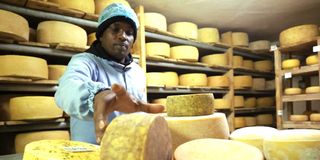
Now, the family-owned company produces cheese wheels, some costing as high as Sh100,000 a piece, with a keen eye on high-end markets, including exports within East Africa.
“When our parents started the business, they were initially focused on solar heaters while keeping a few cows for household milk. During a prolonged drought, cheddar cheese became scarce in the market, forcing the family to experiment with making cheese at home,” Delia Andrew, who co-owns the company with her spouse, tells the BDLife.
The first lesson
That experiment, she says, became the first lesson in entrepreneurship: opportunity often emerges from constraint. What started as a household activity soon attracted interest from friends and early customers.
“They [friends] began asking for more cheese, and that slowly transformed into commercial production,” says Delia.
Cheese served at Brown’s Cheese Farm in Tigoni, Kiambu County, during a World Farmers’ Organization (WFO) General Assembly delegates’ field tour on June 11, 2026.
Photo credit: Evans Habil | Nation Media Group
From the beginning, another guiding principle took centre stage—only produce what the family would confidently consume before scaling it for the market, a philosophy Delia says has helped the company maintain quality discipline even as it expanded.
When she joined the business about 16 years ago, she stepped into a company still rooted in farm-based production but already carrying the ambition of expansion.
The second lesson
That moment, she says, marked a second lesson: growth must be structured, not accidental. “Our involvement marked a shift from informal growth to structured scaling, where systems, quality control and product diversification became central,” she says.
One of the earliest decisions under her leadership was opening up the farm to visitors, a move she describes as a deliberate lesson in transparency and trust-building.
“Consumers are not just buyers. They want to understand how food is made and where it is made from,” she says, noting that openness became part of the company’s competitive advantage.
How family in Kenya built a cheese empire from just two cows
Business resilience
Over time, Brown’s Food Company expanded beyond cheese into other value-added products, including flour milling. Delia says this diversification was driven by another key entrepreneurial lesson—resilience comes from not depending on a single product line.
“We realised we could not just focus on milk. We had to look at the entire farming system, ranging from soil, crops, and livestock to nutrition altogether,” she notes.
Radish-and-cheese appetiser served with a green herb dip at Browns Cheese Farm at Tigoni in Kiambu County on June 11,2026.
Photo credit: Evans Habil | Nation Media Group
Brown’s Food Company now processes more than 20,000 litres of milk per day, sourced from around 6,000 farmers in Molo, Kinangop and Embu. The milk is transformed into multiple products, but cheese remains the most complex and most valuable output.
Capital for expansion remains one of the key challenges for many entrepreneurs, and Delia says that their family business strategy has been to avoid over-borrowing credit. “That discipline has kept us stable,” she says.
Over the years, the business has increased its workforce. When she joined, they had 25 workers, and the company employs about 300. Exports are growing too, accounting for about 25 percent of production within East Africa, mainly to Tanzania, Uganda and Rwanda, with future expansion targeting Dubai and China.
At the centre of the business is cheese-making, which Delia insists is not manufacturing but biological transformation.
“Cheese is alive. It continues to ferment and mature over time. It is not static. It evolves,” she says.
Unlike fresh milk, cheese, just like wine, appreciates in value with time, a reality that has shaped the company’s investment in ageing rooms where temperature and humidity are tightly controlled.
Some wheels are aged for months, others for years, developing richer flavour profiles and higher market prices. In premium cases, a single wheel weighing about 25 kilogrammes can fetch over Sh100,000 depending on its age, quality and type.
Cheese wheels inside an aging room at Brown’s Cheese Farm dairy facility in Tigoni, Kiambu County, on June 11, 2026.
Photo credit: Evans Habil | Nation Media Group
“A kilogramme of an aged cheese wheel, matured for up to six years, sells for not less than Sh4,000,” Delia says.
Brown’s produces a wide range of cheeses, including mozzarella and pizza cheese for hotels and fast-food chains, alongside aged varieties such as parmesan, gouda, camembert, brie and feta for specialty markets. It also produces yogurt, butter and ice cream, often blended with fruits sourced from farmers.
Expansion challenges
Even with the immense growth, expansion has come with challenges. Delia says one of the most persistent is distribution, particularly maintaining the cold chain from production to market.
“Once temperature control is broken, you cannot recover product quality. That is why we invested in our own distribution fleet,” she says
Another major challenge is milk quality consistency, especially for ageing cheeses, where small variations at the farm level can affect flavour months later.
To mitigate these challenges, Phineas David, the company’s quality controller, explains that milk collection systems were developed gradually alongside expansion.
“The company now operates cooling and collection centres in Embu, Molo and Kinangop, working closely with farmers to ensure quality begins at the source,” he says.
He notes that milk intake has grown from about 15,000 to 18,000 litres per day from earlier years to around 35,000 litres currently. They have had to be involved in the milk production process and keep the farmers happy.
Quality Controller Phineas David of Brown’s Food Company explains different types of cheese to World Farmers’ Organization (WFO) delegates during a field visit at Brown’s Cheese Farm in Tigoni, Kiambu County, on June 11, 2026, as part of the WFO General Assembly.
Photo credit: Evans Habil | Nation Media Group
Farmers, he says, are supported with veterinary services, training and inputs to improve productivity, while payments are made twice a month directly to their bank accounts after verification. “Quality starts on the farm. If milk is compromised there, no amount of processing can fix it later,” Phineas says.
The company works with over 6,000 farmers and has built traceability systems that track products from farm to final cheese wheel, ensuring accountability at every stage.
Taxation pressures
However, rising milk prices, taxation pressures and input costs continue to squeeze margins, making efficiency and diversification critical for survival.
Delia says this pressure has reinforced entrepreneurial diversification, noting that it has come with a key lesson: never depend on a single product or market.
The company has since ventured into flour milling under Groven Meadow, incorporating indigenous crops such as sorghum, millet and traditional beans into its product line to promote biodiversity and nutrition.
She says the company is also exploring plant-based cheese, driven by rising lactose intolerance and shifting dietary preferences.
“There are consumers who cannot tolerate lactose, and we are working on plant-based alternatives while maintaining the same philosophy of quality and integrity,” she says.
Running the family-owned company, Delia observes that entrepreneurship has ultimately been about learning to adapt without losing identity—building a business that grows, evolves and matures much like its own cheese: slowly, deliberately, and with increasing value over time.