Time flies with great content! Renew in to keep enjoying all our premium content.
Prime
The AI tool helping flower farms cut pesticide use
A scout at Florensis Kenya horticulture company in Naivasha, Nakuru County Catherine Marofu explaining to a group from Data Science Limited on how sticky monitoring cards work to detect pests on July 16, 2026.
Twice every week at one of the country’s largest flower farms in Naivasha, crop scouts walk through greenhouse rows of flower seedlings, pausing every few metres to key data into tablets as they inspect each bed for signs of pests and diseases.
The software powering the exercise is called Bluleaf, an integrated pest management system built by Kenyan technology firm Data Science Limited. The company is the brainchild of computer scientist Linet Kwamboka Nyang’au.
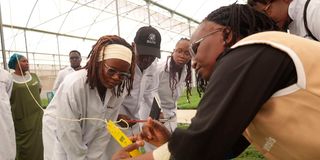
In the flower industry, the software is helping growers reduce pesticide use, improve yields and meet some of the world's toughest export standards. Crop scouts carry android smartphones and tablets loaded with the app as they move through flower beds looking for the earliest signs of aphids, blackflies, mites, moths and other pests or diseases.
They count the exact number of pests spotted in a particular bed, records the severity of infestation in every section and captures the information in the application. The entire exercise takes about three minutes before a scout moves on to the next section.
All the information is uploaded to a central dashboard where the farm generates weekly analytical reports. The software is supplied under a licensing agreement costing $40 (Sh5,200) per month for a single user account.
Beyond simply recording field observations, the platform maps the scale of infestation across the farm, allowing growers to target interventions instead of spraying pesticides across entire greenhouses, which is both costly and environmentally damaging.
"With this data on different flower species going back to different seasons all these years, it is also a good asset for our research operations. It helps when we are testing new pest control mechanisms," Catherine Marufu, a crop scout at the farm, told BDLife.
The historical database also captures how sensitive different flower varieties are to particular pests, helping growers decide which species are best suited for different conditions.
What began as a digital data collection tool has gradually evolved into an artificial intelligence-powered system.
Using more than 10 years of accumulated field data, Bluleaf can assess the health of a flower, identify the pest affecting it, determine the stage of infestation and recommend the most appropriate pesticide.
The AI model also predicts pest patterns based on historical outbreaks, enabling farmers to prepare before infestations spread.
One of the earliest adopters of the technology was Florensis, a multinational flower propagation company that has been using Bluleaf since 2015 at its Naivasha farm.
A scout at Florensis Kenya horticulture company in Naivasha, Nakuru County Catherine Marofu working at the farm when a group from Data Science Limited visited on July 16, 2026.
Photo credit: Evans Habil | Nation Media Group
The 27-year-old company specialises in producing flower cuttings for propagation rather than harvested flowers. It has production and breeding locations in Kenya, Ethiopia, the Netherlands, Germany and Portugal, with Bluleaf deployed across these subsidiaries.
For a business of that scale, timely pest intelligence is critical. Florensis grows more than 480 flower species, and on a typical harvesting day, the farm produces about 900,000 flower cuttings. Peak periods such as January can see production rise to six million cuttings daily, according to scouts at the farm.
The company's main clientele is in the European Union (EU), where compliance with pesticide regulations is among the strictest globally. Kenya is the world's fourth-largest exporter of cut flowers and the leading supplier to the EU, accounting for roughly 40 percent of the lucrative bloc's flower imports. The industry remains one of the country's leading foreign exchange earners.
But to access the EU market, exporters must comply with strict pesticide maximum residue limits (MRLs), plant health regulations and detailed traceability requirements covering every chemical application.
The bloc also tightly regulates pests such as False Codling Moth and thrips, while rose exporters are required to comply with the Rose Systems Approach, which prescribes pest reduction and chemical management protocols.
Every pesticide application must be documented, including what chemical was used, when it was applied, where it was applied and the dosage.
As such, Bluleaf's detailed records help simplify that compliance process while reducing the need for chemical spraying.
"We can go up to a month without using sprays. By the time we consider a chemical spray, we have already tried cleaner options such as bioextracts, light insecticide sprays like natural pyrethrin and predatory mites that naturally consume common plant pests," said Monicah Ingaji, an agronomy assistant at Florensis.
She adds that the platform has made the twice-weekly health scouting exercise faster than the manual data collection methods previously used, which were tedious and offered little value for decision-making.
The financial impact of such data-led decision-making is substantial for these large commercial flower farms.
Industry estimates suggest that reducing pesticide use by about 80 per cent, for instance, could save a large grower roughly Sh3 million every month.
But for Ms Nyang'au, the technology's biggest impact extends beyond operational savings.
"I look at our impact beyond the monetary costs the flower firms are cutting by using the tool," she told BDLife.
"There is the human impact with the workers and neighbouring communities, health-wise. Heavy chemical use affects the air quality, waterways and water systems, and ends up in our food systems as well," she says.
Unlike many technology start-ups chasing venture capital, Data Science has been bootstrapped since its founding.
"It was a choice I made,” Ms Nyang'au says of funding the company with her personal savings. “Of course, when you look around, and your peers are raising millions of dollars to fund their businesses, it looks very lucrative. But when you are funded, even by grants or venture capital, especially at the beginning, that would have denied me what I wanted to do."
A green sticky insect trap which is used for monitoring and controlling flying insect pests in a greenhouse is placed at Florensis Kenya horticulture company floral greenhouse in Naivasha, Nakuru County on July 16, 2026.
Photo credit: Evans Habil | Nation Media Group
The University of Nairobi alumnus says she wanted to build a sustainable company while balancing family life.
"I also wanted to start a family and have children. So there was that balance. If I'm reporting to someone else and I have financial targets, that changes things,” she says.
“I just kept a small team working towards profitability. For me, it has always been clients before chasing funders. Thankfully, it worked out. We are fully customer dependent."
That approach, she says, proved valuable during the Covid-19 pandemic when many start-ups struggled of folded up.
“We lost a lot of business as some of our clients closed down and others stopped on-boarding new businesses. But as directors, we were able to sustain the company and maintain our team. At no point has anyone gone unpaid, and the only salary delay we have ever had was 10 days."
"I like keeping it lean and allowing ourselves to grow organically. We might not be making millions every month, but we also don't owe anyone anything. It's a healthy, sustainable operation."
Ms Nyang’au says her advice to entrepreneurs is to have a separate income for the family, especially at the early stages when their companies are not generating much revenue yet.
“You still have to pay your people, and it is why I keep my consultancy work," she says. She has consulted for the World Bank, the United Nations and international development organisations.
She also believes founders need to remain adaptable. "Structures are great, but sometimes structures are also limiting. If I didn't occasionally mix my money and the company's money, that would limit me. I've learned to be very dynamic and agile."