Edible and crypto are words that rarely share a sentence, but in Nairobi’s satellite town of Kitengela, an unlikely innovation is marrying them, with the promise of easing a long-standing headache for Kenyan farmers.
When 28-year-old Mara Maroa ventured into dragon fruit farming, he wasn’t trying to invent an edible cryptocurrency, but his passion for both agriculture and digital assets pushed him to try to combine the two.
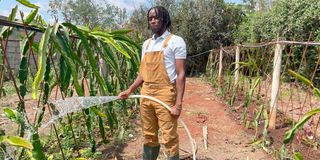
That experiment became Pitaya, a crypto coin named after the fruit itself. Two years later, it has grown into a project attracting digital asset enthusiasts from around the world.
“It all started with a $300 (Sh38,760) airdrop (free gift) I received in December 2022,” Mr Maroa recalls.
“The crypto market was crashing, and I thought I should get something tangible out of it. So, I used the money to buy 120 dragon fruit seedlings and materials for my first farm.”
Unlike many cryptos, which often thrive on popularity, Pitaya – built on the Solana blockchain – is backed by a real commodity. Holders of the coin can redeem it for an actual dragon fruit grown on Mr Maroa’s farm, which is then shipped directly to them.
“A lot of cryptocurrencies are just attention-based. So I thought, if people can trade attention, why not trade a commodity?” he says. “That’s why I decided to tokenise my farm.”
Tokenisation involves turning a real-world asset into a digital version that can be traded in smaller units online. Pitaya is not strictly a tokenised asset: it works as a crypto coin, but what makes it unique is the redemption option for the fruit itself.
The idea is simple: create a ready market for dragon fruit while eliminating middlemen, who often take a large share of farmers’ earnings.
“With Pitaya, the farmer has direct access to the buyer, and the buyer has direct access to fresh fruit,” Mr Maroa explains.
Mr Maroa currently runs three farms with about 2,600 dragon fruit trees. He is still fine-tuning the redemption system and has yet to deliver fruit to an overseas buyer, but he is confident it will work.
While this business model is not yet regulated in Kenya or anywhere in the world, he reckons it should work just like an ordinary horticulture export business, as Kenya still works towards enacting virtual asset regulation laws.
“We intend to start with the United Arab Emirates because it has the highest number of Pitaya holders, and exporting there is relatively affordable,” he says.
So far, the Pitaya coin has reached a market capitalisation of $237,000 (Sh30.6 million), the equivalent to about 23,700 kilogrammes of dragon fruit at $10 per kilo.
With an average fruit weighing half a kilo, it would take six million fruits, or roughly two million plants per harvesting season, to meet current demand.
By 2028, Mr Maroa hopes to scale to at least a million plants. He has created a Pitaya Decentralised Autonomous Organisation to rally farmers into a community of growers for the network. But convincing them has been an uphill task.
“Kenyan farmers are very conservative. The moment someone hears crypto, they think it’s a scam. They don’t understand how the network could help them tap unreachable markets,” he says.
Dennis Mariara, the only other farmer who has been onboarded on the network, believes the platform could be a game-changer for both farmers and investors seeking to invest in agriculture.
“The Pitaya coin could empower us as farmers with financing, fair trade, and global exposure while also giving investors a unique agricultural-backed crypto asset,” he said.
For farmers who do sign up, the process would be digital. Each farmer would update the network with the value of fruits available for redemption. Once coins are redeemed, the farmer converts them into USDC (a crypto stable coin pegged to the US dollar), then into local currency. Redeemers pay shipping fees in coins, which are passed to logistics providers, removing that burden from farmers.
Pitaya aims to bypass middlemen, giving farmers more and buyers lower prices. But one might wonder: why would someone in Dubai, or even Nairobi, buy the fruit through a crypto platform instead of a supermarket or a grocery store?
“It has been shown that Kenyan dragon fruit is among the best quality in the world,” Mr Maroa argues. “We’re also building a transparent community where buyers can monitor progress from planting to harvesting, and be assured of top-quality fruit.”
Dragon fruit is also climate-resilient, thriving in Kenya’s hot and dry regions. Researchers highlight its nutritional value too: rich in antioxidants, fibre and minerals like magnesium. So far, buyers seem interested less in the fruit and more in the culture and novelty of the project, though.
Eric Michubu, a crypto trader and Pitaya token holder, says he invested because of the idea itself: “The fact that I can participate in farming remotely is noble. Pitaya is a pioneering innovation in crypto.”
As he builds the project step by step, Mr Maroa hopes Pitaya will not only bring more young Kenyans into fruit farming but also draw them to its health benefits. But first, he will have to overcome the traditional skepticism holding back crypto, not just in Kenya, but across the globe.