Time flies with great content! Renew in to keep enjoying all our premium content.
Prime
The Achilles’ heel in Kenya’s real estate sector
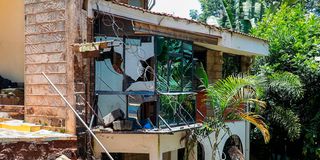
A general view shows destruction at a residential compound along Likoni Lane off Dennis Pritt Road in Nairobi on March 15, 2026 after heavy overnight rains caused a perimeter wall to collapse.
After hours of heavy rain in Nairobi earlier this year, residents of one apartment suddenly lost water for two days after the estate’s borehole pump failed under pressure.
The replacement motor had only been installed a few months earlier because it was cheaper than the recommended option. It failed again during the downpour, forcing the management to organise emergency water bowser deliveries while technicians searched for spares.
The rains exposed a common problem afflicting Kenya’s real estate sector: Lack of maintenance. Most property crises begin long before flooding, water shortages, or equipment breakdowns occur.
They begin with delayed maintenance, weak governance, poor planning, and the growing culture of prioritising short-term savings over long-term sustainability.
Kenya’s National Building Maintenance Policy acknowledges that maintenance in the country is often treated as a peripheral activity, leading to deteriorating buildings, delayed repairs, and weak maintenance culture. The policy further warns that many structures suffer because maintenance is approached reactively rather than preventively.
Heavy rains, flooding, power outages, and business disruptions in Nairobi and several other parts of Kenya have exposed how vulnerable many developments remain whenever infrastructure is tested under pressure.
The conversation around real estate in Kenya often focuses on construction, occupancy rates, rental income, and sales. Yet little attention is paid to what happens after occupation.
Every property depends on functioning drainage systems, pumps, roofing, electrical infrastructure, and preventive maintenance.
When those systems fail, the consequences quickly become financial and, in some cases, dangerous.
The challenge is especially visible in apartments where owners and tenants share the same infrastructure but often approach maintenance differently. Some owners rarely participate in operational matters, while tenants still expect uninterrupted services. In many estates, service charge collection becomes difficult because some residents view it as optional rather than essential.
The consequences are now visible across residential and commercial properties in Nairobi. Gutters remain clogged for months, especially in leafy suburbs where falling leaves block pipes and flat-roof drainage outlets. Water accumulates on rooftops, causing leakages into apartments, offices, parking areas, and electrical rooms.
During rainy seasons, frequent power outages and surges also damage pumps, lifts, CCTV systems, generators, and electrical panels in developments that lack proper protection systems or timely servicing.
A University of Nairobi research warned that poor maintenance culture continues to contribute to deterioration in many urban residential buildings. From my experience in managing high-end apartment developments, I have seen how poor maintenance decisions quickly become expensive operational crises.
One of the biggest misconceptions in property management is the belief that maintenance costs are unnecessary expenses rather than investments in preserving assets.
Residents often question why service charges increase, yet the cost of labour, electricity, spares, fuel, water, and technical maintenance continue to rise every year. Infrastructure does not maintain itself. Delaying maintenance only postpones failure until it becomes larger, more disruptive, and more expensive.
Yet, maintenance failures directly affect daily life. Elderly residents become stranded when lifts fail. Families go for days without water after pump breakdowns.
Businesses lose customers because flooded entrances cut off access. Roof leakages damage offices, electronics, ceilings, and stock. Most of these situations are preventable through proper planning, realistic budgeting, and timely maintenance decisions.
The true measure of a successful property is not how impressive it looks during launch day, but how well it functions years later during heavy rains, flooding, water shortages, or power failures. Nairobi’s skyline continues to grow rapidly every year.
The question is whether we are building sustainable properties for the future or creating tomorrow’s maintenance disasters hidden behind modern finishes and glossy brochures.
Jacob Otieno is a properties and facilities manager in Kenya
Unlock a world of exclusive content today!Unlock a world of exclusive content today!