One of the most important moments in China’s political calendar concluded on March 11. Delegates from the National People’s Congress, numbering over 2,900, and representatives of the Chinese People’s Political Consultative Conference, a political advisory body of 2,170 members, convened in Beijing for the annual ‘Two Sessions’.
This year was significant, as the government announced its annual economic targets and released the 15th Five-Year Plan, which set out key policy priorities and development goals for 2026-30. This document will function less as a forecast and more as a blueprint.
In China’s political architecture, five-year plans are not aspirational pamphlets, but they are operational roadmaps. They signal priority sectors, resource allocation, and the ideological direction of the state.
The plans and policies that emerge from the two annual sessions provide the domestic foundation and resources for China’s global engagements. The question is no longer whether China will influence global development discourse —it already does — but how it intends to do so.
At the centre of this evolution lies the Global Development Initiative (GDI), introduced by President Xi Jinping in 2021 as a framework for reshaping development cooperation around infrastructure, industrial capacity, food security, digital transformation and policy coordination.
While global reactions differ across regions, its resonance in Africa deserves particular attention. This is not accidental geography; it is structural alignment.
The defining feature of the GDI is not simply the scale of financing attached to it, but rather the philosophy beneath it. For decades, Western development finance largely operated like a well-meaning but strict relative: “Here’s the loan, and here’s the list of reforms you need to implement before dessert”.
Institutions such as the World Bank and the International Monetary Fund anchored that model.
Funding came tied to governance benchmarks, policy conditions, and macroeconomic checklists. China’s GDI shifts the tone.
Under this framework, state-led development isn’t frowned upon; it’s legitimate. Infrastructure and industrialisation aren’t side dishes; they’re the entrée. And policy sovereignty isn’t something to negotiate away in the fine print. Subtle? Yes. Significant? Absolutely.
The GDI doesn’t announce, “we’re replacing Western aid.” It says something quieter: “What if development were structured more like partnership than supervision?” That’s a different conversation.
At its core, what makes the GDI extra special is its focus on human dignity, well-being, and shared prosperity. People and purpose are equally important. It also mirrors the guiding ethos of the UN Sustainable Development Goals.
This alignment allows the GDI to present itself not simply as a foreign policy instrument, but as a human development platform connected to globally recognised values. Development should be a human aspiration, not just an economic metric, fundamentally about improving the lived experiences of ordinary people.
The GDI frames development as responding to the universal human aspiration for a better life. This includes access to reliable energy, modern infrastructure, quality healthcare, education, and economic opportunity. Development cooperation should thus benefit humanity broadly rather than serve narrow strategic interests.
An equally important aspect is that for many developing countries, sovereignty is not just a political principle; it is closely tied to their dignity. A development model that allows countries to design their own policy pathways is perceived as more respectful of local contexts and priorities, and the GDI perfectly aligns with that.
They also emphasise country-specific solutions and acknowledge that development challenges are deeply contextual. A rural agricultural economy in Africa, for example, may require different policy tools than a rapidly industrialising Asian economy. Development cooperation essentially becomes a collaborative partnership rather than a prescription of solutions.
Many GDI-related programmes also emphasise smaller initiatives with immediate social benefits, for example, agricultural training programmes improving crop productivity—the hybrid rice training and technology transfer in Madagascar and Mozambique.
In a world of multipolar development models, the GDI highlights that the future of international cooperation lies in responsiveness to national needs, inclusivity, and long-term human-centered transformation.
A major shift in development strategies translates into meaningful improvements in the daily lives of people, or rural solar power projects expanding energy access (the solar mini-grid and household solar systems in rural Nigerian communities). Such projects show how development cooperation can directly influence household-level day to day well-being.
For many African governments, this framing speaks directly to long-standing priorities. The African Union’s development blueprint, Agenda 2063, emphasizes industrialization, infrastructure integration, regional value chains, economic diversification, and policy autonomy.
These are not abstract goals, they respond to real structural constraints: energy shortages, high transport costs, limited manufacturing capacity, and vulnerability to commodity cycles.
An additional aspect is that the appeal of the GDI is practical more than ideological, with Infrastructure-heavy cooperation addressing visible bottlenecks. Kenya illustrates this dynamic clearly.
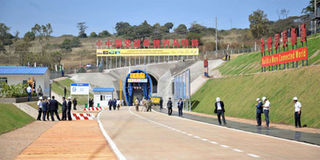
The Standard Gauge Railway linking Mombasa and Nairobi represents a financing and delivery model that differs from traditional grant-based aid. Debate over debt sustainability is real and necessary, yet the project itself reflects a longer-term ambition: building logistics capacity to support industrial growth.
At the same time, Kenya continues to work closely with multilateral institutions and Western partners. There has been no abrupt pivot away from existing relationships, instead there is diversification. African states are broadening their options, not abandoning one camp for another. Coexistence, not substitution, defines the landscape.
Recent policy discussions emerging from the 2026 ‘Two Sessions’ further clarify how Africa fits within China’s evolving development framework, particularly under the Global Development Initiative.
Based on the government work reports emerging from the meetings, several key areas of focus for Africa have become clear, particularly across five major priority sectors. The major areas are in Infrastructure & industrialization, green energy & climate cooperation, Digital economy & technology partnerships,
Trade expansion & market access, Poverty reduction & agricultural modernization. Still, one of the most consistent priorities remain in infrastructure-led development and industrial capacity building, with China’s policy discussions emphasizing on high-quality development.
This highlights China’s increasing view of Africa not simply as a destination for development projects, but as a long-term collaborator in shaping a more multipolar global development landscape.
The 15th Five-Year Plan will deepen the connection between China’s domestic modernization and its external development initiatives like the GDI. The strategic insight here is subtle but significant: China is internationalizing its domestic development playbook.
One concrete policy development highlighted in connection with the ‘Two Sessions’ is China’s decision to eliminate tariffs on all imports from African countries with which it maintains diplomatic relations, beginning in 2026.
This measure aims to increase Africa’s exports to China, support value-added production and deepen trade integration between China and African economies. Improved market access to the world’s second-largest economy could significantly benefit agriculture, minerals, and manufactured exports from Africa.
Is the world witnessing a structural shift in global development governance? Possibly, but not in the simplistic sense of East replacing West. The more accurate description is pluralization. Financing ecosystems are becoming more multipolar.
There is growing resistance to rigid policy conditionality. Infrastructure-led growth is returning to the center of development thinking. Western institutions themselves are adapting, incorporating blended finance, climate-linked investment, and greater flexibility around industrial policy.
The GDI functions as competitive pressure. It forces debate at the level of model, not rhetoric. The most important analytical correction is this: Africa is not the object of global development competition. It is the arena in which competing development approaches are tested, negotiated and refined.
African governments are actively shaping outcomes: balancing lenders, renegotiating terms, aligning external financing with national strategies. The erosion of a single dominant model reflects not only China’s rise, but Africa’s growing strategic agency.
With the conclusion of the 2026 ‘Two Sessions,’ the significance of the Global Development Initiative extends well beyond bilateral projects.
By placing human dignity, shared prosperity, and people-centered development at its core, the initiative underscores that development should not be viewed merely as a geopolitical tool, but rather as a collaborative effort that respects sovereignty and local priorities.
For African nations, the GDI continues to resonate highly not because it eliminates Western aid, but because it offers that additional pathway.
One that places sovereignty, infrastructure, and long-term structural transformation at the center of cooperation. It enables governments to diversify partnerships, align external financing with national development strategies, and exercise greater agency in shaping their development outcomes.
Susan Mukami is the project coordinator, China Media Group Africa
Unlock a world of exclusive content today!Unlock a world of exclusive content today!