Combating banditry through soft security

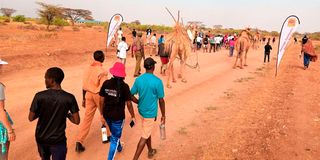
Some of the participant's of this year's camel caravan for sensitizing communities on need to conserve River Ewaso Nyiro and championing for peace within Gafarsa in Garbatulla, Isiolo South on August 4, 2023.

Photo credit: File | Nation Media Group

Soft security strategy compliments hard security operations to weed out bandits.

In this approach, governments and communities work on the push-and-pull factors that fuel banditry. By cultivating trust among communities, stakeholders and partners, the strategy secures mutual respect and acceptance, reducing threats.
Education, economic activity, and pro-active, non-coercive measures such as pasture regeneration, serve to prevent and mitigate against insecurity.

Building on this idea, 200 Maa elders of ilmeoli age-set [45-55 years], whose children are the current morans met at Ewaso in Laikipia last Friday.

Their purpose was to use traditional, culture-based sanctions to defuse rising tensions, broker return of stolen livestock, and stem rising banditry.

This was the third instalment in a series of engagements, conducted away from the tired-act, chest thumping of politicians. Community dialogue has proven effective in combating insecurity and was the basis of the very successful peace caravan movement covering 32 districts in 2009-12.

Laikipia, Isiolo, Samburu and Baringo (collectively, Amaya Triangle) have had more than their fair share of banditry, fueled in part, by very low access to economic opportunities. A history of development neglect and conflict has left many areas in the landscape with very low commercial activity and poor educational attainment. This in turn fuels insecurity, furthering the cycle.

Data from the 2019 census shows that a full 75 percent of the residents of Tiaty Constituency aged three and above have never been to school of any kind. Samburu County and Laikipia North Constituency are only marginally better at 54 percent and 48 percent respectively. Adding to this cocktail is the easy availability of small arms.

The hamlets, markets and trading centres in the region remain unplanned, and with no utilities such as water. This lack of public investments means that they can only attract very low levels of basic commercial activity, leading to widespread unemployment.

Cooperation for Peace and Development is the security and economic development block by the four counties. Dubbed Amaya Triangle Initiative (ATI), it emphasises the role of economic development in creating sustainable peace.

Leaders and technocrats alike need to gain a deeper understanding of the underlying causes of insecurity in the region, so that they are not just treating symptoms. Stimulating economic activity is at the heart of any sustainable security solution.

Such efforts must include physical planning of various markets and trading centres, provision of water and basic infrastructure, creating conditions necessary for increased commercial activity.

Further, increased development of water storage infrastructure in the region, including the proposed Rumuruti dam, Amaya dam, Crocodile Jaws dam, Pesi dam, and Nanyuki Bulk Water is crucial.

In addition, the protection of key wetlands such as the one at Rumuruti, is critical for ground water recharge. This should be complimented by development of smaller water storage facilities (water pans), and a legal regime promoting and incentivising privately developed water dams.

The soft security strategy agreed between the Ministry of Interior and the Amaya Triangle counties in 2022 contains these measures.

Intended as a three-year, Sh6.5 billion conditional grant, it involves investments to invigorate the trading centres, livestock incentives for teenagers and young adults to join literacy classes and skills training, and targeted investments into local value chains to create jobs. The strategy should be implemented.

Incentives can influence change of behaviour. For instance, a maternal health initiative in Laikipia North incentivised clinic attendance and delivery at health facilities by expectant mothers.

Traditional birth attendants, who encouraged their clients to go for clinics and deliver at health facilities were rewarded with a goat for each child. The results were amazing and heart-warming. Births at health facilities jumped from 48 percent to 94 percent, leading to a significant improvement in maternal health.

Learning from others leads to success.

Kitui and Makueni counties have been building sand dams for a while.

The Laikipia Permiculture introduced them in Laikipia in 2021. You build a concrete dam wall, much like you are building a water dam, but to hold back the sand. The gullies soon fill up, restoring the landscape. The sand acts as a reservoir of water which can be collected and drawn from an underground tank.

The economic activity by women groups alongside the sand dams speaks to sustainability and transforming lives.

At Chui Mamas in Ewaso, bee keeping, a vegetable farm, a cultural manyatta, and an events hall, all generate income, creating a small monthly stipend for the members. An ICT centre would be a great addition. Any takers?

The writer is an economist, is partner at Ecocapp Capital, the advisory firm.

PAYE Tax Calculator

Note: The results are not exact but very close to the actual.