Why the world is looking to Africa for business answers

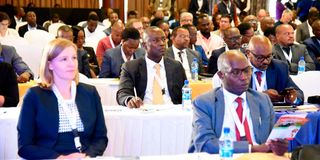
Stakeholders during the inaugural E-mobility conference at the Safari Park Hotel on February 7, 2023.

Photo credit: File | Nation Media Group

For decades, the discussion around Africa has largely been on the language of infrastructure gaps, financial exclusion, energy shortages, governance constraints, and digital divides.

Africa has often been portrayed as a recipient of global business models rather than a contributor to them. That narrative does not reflect reality.
Today, at a moment of profound geopolitical, economic, and technological disruption, Africa’s experience is becoming relevant to the rest of the world.

From the ongoing conflicts in the Middle East and the resulting pressures on energy markets and global supply chains, to rising protectionism, climate shocks, and the disruptive impact of artificial intelligence (AI), uncertainty is no longer uniquely African but a global concern.

African businesses have long operated in environments where complexity is not the exception, but the norm. They have learned how to innovate amid volatility, adapt under constraint, and build resilience with fewer buffers. In many ways, Africa has been preparing for the future the world is now entering and ironically, this is precisely why Africa matters more than ever before.

One of the things that illustrated this clearly is the Covid-19 pandemic. While the crisis exposed vulnerabilities everywhere, it also revealed Africa’s remarkable adaptability. Informal systems once viewed as weaknesses became engines of resilience. Digital payments accelerated. Mobile first solutions expanded rapidly. Businesses and communities adapted with remarkable speed.

This ability to innovate through uncertainty is a competitive advantage. Africa’s innovation story is perhaps best illustrated by the rise of mobile money, the case of M-Pesa.

What began as a solution to everyday financial access challenges evolved into one of the world’s most studied examples of digital financial inclusion. But its success was never simply about technology. It was about ecosystem thinking, progressive regulation, customer trust, partnerships, agent networks, and collaboration across sectors.

The lesson extends beyond financial services. Africa is demonstrating that innovation succeeds not through isolated platforms, but through ecosystems built on adaptability, inclusion, and shared value creation. This shift from competition alone to co-creation may prove to be one of the continent’s most transferable lessons to the global economy.

The same confidence is now shaping African investment patterns. Across the continent, businesses are expanding across borders, deploying capital and operational expertise into neighbouring markets despite uncertainty. As the African Continental Free Trade Area evolves, intra-African investment and trade could become one of the defining economic stories of the coming decades.

At the same time, Africa’s digital transformation is being accelerated by demographics. Africa has the world’s youngest population digitally native, entrepreneurial, and connected. Unlike many developed markets, Africa is not retrofitting digital infrastructure onto legacy systems. In many sectors, digital is the default foundation from the outset.

This creates a historic leapfrog opportunity. AI may amplify this advantage further. Africa has fewer entrenched analogue systems to unwind, potentially enabling faster AI adoption across healthcare, agriculture, finance, education, and public service delivery.

AI-powered weather forecasting, disease surveillance, fraud prevention, and predictive service delivery are no longer theoretical possibilities; they are emerging realities.

Technology must improve livelihoods, deepen inclusion, create dignity, and expand opportunity. Its value should be measured not simply by scale or profitability, but by its societal impact. And this is perhaps where Africa offers the world its most important lesson because it is not simply catching up to global business but helping redefine it.

By 2050, one in four people on earth will be African. That demographic reality alone means Africa will shape the future of labour markets, consumption, investment, climate strategy, and the future of work.

The resilience models, platform ecosystems, AI leapfrog strategies, and digital public infrastructure lessons emerging across African markets are no longer peripheral to global business conversations. They are central to them.

The world is beginning to look to Africa not only for markets, but for insight and Africa must be ready for this.

The Writer is the Group Chief Executive Officer, Safaricom PLC

PAYE Tax Calculator

Note: The results are not exact but very close to the actual.