22m passengers by 2045? Why JKIA plan is already behind the curve

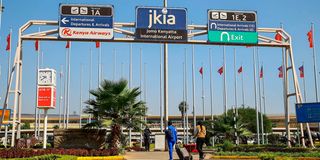
Travelers push their belongings at JKIA awaiting clearance on September 11, 2024.

Photo credit: File | Nation Media Group

A new tender promises a larger JKIA. However, the figures suggest reduced ambition and a runway decision that could haunt Kenya for decades.

The tender is live. The minister has briefed the press.

The master plan, which has been in development for years, runs to over 400 pages.

However, if you read it carefully, beyond the vision statements and organisational charts, a rather deflating truth emerges: Kenya has just published a 20-year blueprint for its main international airport, and the headline figure it is celebrating has already been exceeded by its regional rivals years ago.

The Ministry of Roads and Transport’s media brief, on March 3, anchors the entire JKIA modernisation project to a single forecast: 22.31 million passengers by 2045. Cabinet Secretary Davis Chirchir frames it as the airport’s future.

The data, however, frames it as something considerably more modest. Consider the regional context. Addis Ababa Bole International Airport processed 12.1 million passengers in 2024.

Cairo handled 18.7 million the same year. South Africa’s OR Tambo was already past 21 million by 2017. Elsewhere, Singapore’s Changi Airport handled 67.7 million passengers in 2024, with Terminal 5 already under construction to handle tens of millions more
Kenya, through the same tender documents and master plan, aspires to reach 22.31 million passengers two decades from now, in 2045.

The ambition, in other words, is to arrive in the 2040s at a destination that Africa’s top hubs reached before the pandemic.

The shrinkage in ambition becomes starker when you trace the paper trail.

Kenya Vision 2030’s second medium-term plan, published in 2013, projected 45 million passengers through JKIA by 2030. In 2015, the African Development Bank’s appraisal of a new terminal projected 18.5 million passengers and 901,295 tonnes of cargo by that same year.

Then, in June 2024 barely 21 months ago, Cabinet Dispatch Issue 8/2024 approved an investment plan for JKIA that projected 42.1 million passengers by 2050.

The current final master plan, published last month, now project 22.31 million passengers by 2045. Not only has the passenger forecast been halved compared to the Cabinet’s own dispatch from less than two years prior, but the cargo projection of 860,400 tonnes for 2045 is lower than what the African Development Bank had already projected for 2030.

The numbers matter, but the runway matters more. JKIA currently operates on a single runway, a configuration that imposes a hard ceiling on aircraft movements regardless of how many new terminals you bolt on. The master plan itself acknowledges the constraints: limited runway capacity, lack of operational redundancy, and insufficient aircraft stands.

The solution the tender proposes for Phase 1 is upgrading the existing runway, including the construction of two rapid exit taxiways and a partial parallel taxiway, measures the plan says will shave about 5.9 seconds off runway occupancy time per aircraft.

A new second runway, which every major planning document including the February 2026 master plan itself acknowledges is necessary, has been deferred to Phase 2. Given that large airport infrastructure projects of this scale routinely take a decade or more from tender to operation, that deferral is not a scheduling footnote. It is a structural decision with consequences.

At the current growth rate of 4.6 percent annually, JKIA’s single runway approaches saturation well before Phase 2 runway construction could realistically be completed.

The African Development Bank had already committed to financing a second runway as far back as 2017, approving a $160 million loan for a 4.9km parallel runway that would have nearly doubled aircraft movements from 25 to 45 per hour. The project was shelved. Now, nine years later, it has been shelved again, this time in plain sight, buried in a phasing table.

There is also the conspicuous absence of any mention of an Instrument Landing System upgrade in the published master plan summary. ILS capability determines an airport’s ability to operate safely in low-visibility conditions: fog, heavy rain, the kind of weather Nairobi’s altitude and microclimate can produce.

A hub that cannot guarantee reliable all-weather operations cannot reliably claim hub status. Ethiopia understood this. It is building an entirely new airport near Bishoftu, designed from scratch to handle up to 110 million passengers per year, with dual parallel runways, targeting its first phase of completion in 2029.

Singapore’s Changi Airport handled 67.7 million passengers in 2024, with Terminal 5 already under construction to handle tens of millions more. That is a country with no meaningful hinterland, no agricultural cargo base, no region of 400 million people to anchor its hub economics.

Kenya has all of those. JKIA sits at the gateway of East Africa, already Africa’s leading cargo airport, already carrying 8.93 million passengers past an infrastructure designed for 7.5 million. It is bursting. And the response, formalized in a March 2026 tender, is to upgrade the taxiways and promise a second runway sometime later.

This is not an argument against upgrading the existing terminal or improving landside access. Those interventions are overdue and genuinely necessary.

The congestion at JKIA is real: peak-hour bottlenecks, apron crowding, and road access constraints that greet arriving passengers before they even reach the terminal. Near-term improvements will make a difference to passengers today. The problem is the missing commitment to the infrastructure that determines what JKIA can become, not just what it can patch.

A hub that cannot guarantee reliable all-weather operations and is capped by a single runway cannot credibly compete for the title of East Africa’s premier aviation gateway.

Kenya’s government has stated, repeatedly and at the highest levels, that it wants to position Nairobi as a Singapore of Africa. That framing is not modest. It implies a city that wins because of its connective infrastructure, its logistics sophistication, its ability to move people and goods faster and more reliably than its neighbors. Singapore did not achieve that by upgrading its existing runway.

It built Changi, then expanded it, then built Terminal 5.

The JKIA tender is not nothing. It is a real commitment of capital and political will to a facility that genuinely needs investment. But a plan whose headline passenger target for 2045 is already within reach of where Cairo and OR Tambo stood before COVID is a plan that has confused renovation with transformation.

Kenya does not need to merely survive the next 20 years of aviation growth. It needs to lead them. That starts with a second runway, now, not in Phase 2.

Henry K Nyakundi is a professional engineer and a member of EBK

PAYE Tax Calculator

Note: The results are not exact but very close to the actual.