Why calls to stop G-to-G fuel deal are reckless

DNCOASTFUELSHIP1304E

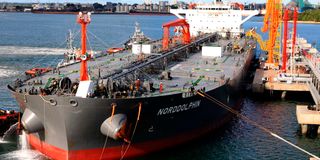
A Fuel Vessel MV Norddolphin of 250m Long which is loaded with 85000 tonnes of Petrol from UAE offloading the precious commodity at the new Kipevu Oil Terminal in Mombasa in this photo taken on April 13, 2023. PHOTO | KEVIN ODIT | NMG
 

The transporters lobby, emboldened by a government that increasingly looks cornered and desperate, has escalated to the highest demands. They want a Sh46 reduction in the price of diesel, scrapping of the market regulator Epra, and dismantling of the government to government (G-to-G) oil purchase deal.

To back these demands, they have issued an ultimatum: cut fuel taxes or face mayhem and paralysis in the capital city. This is the new normal. Any form of public protest today carries the credible threat of shutting down Nairobi, destroying private property, and costing lives. The government is being held hostage.
Yet in the noise of these negotiations, neither side is paying serious attention to what is happening in the international oil market — and that is a dangerous oversight. The global oil crisis will not resolve itself quickly, even if the Strait of Hormuz reopened tomorrow.

The dominant driver of high international prices right now is not a shortage of crude, but a shortage of refining capacity.

At least eight significant Gulf refineries are fully or partially out of action, and repairing them will take many months. This crisis is not winding down — it is just beginning. We are debating short-term concessions against a problem that is structural and long-term.

On the domestic fiscal side, the hard truth is that Kenya has little room to absorb a global commodity shock through subsidies or tax cuts. The budget deficit already exceeds Sh1.1 trillion. Debt service consistently consumes roughly 70 percent of revenue, according to the National Treasury's own monthly outturns.

There is simply no fiscal space. We cannot borrow our way out of a global supply crisis. Consider the fuel maintenance levy, which at 25 percent is the single-largest impost on the pump price.

How much of it is actually available to fund subsidies? Very little — nearly 50 percent of its receivables are already pledged to bondholders under the securitisation programme. What remains is the primary funding source for road maintenance. Cut it deeply, and we revert to the potholes and degraded highways of a decade ago.

The arithmetic is brutal and unambiguous. Excise duty, at 21 percent, is the second largest impost. The conversation within the policy elite right now is apparently to reduce excise duty on diesel and close the gap by raising petrol prices by the same margin — a politically risky proposition.

VAT has already been half-consumed by the first round of subsidies. The stabilisation fund has been depleted.

The loudest demand, however, is the clamour to dismantle the G-to-G arrangement. This is reckless. To understand why, one must recall the economic abyss Kenya stood over in late 2022. The country was in the grip of a severe dollar liquidity crisis. The domestic interbank market had effectively seized up.

Because Kenya imports 100 percent of its petroleum, local oil marketing companies were scrambling collectively for nearly $500 million every month to settle invoices within a rigid five-day window upon cargo arrival.

That relentless, concentrated demand for hard currency broke the back of the Kenyan shilling, sent the exchange rate into freefall, and brought the economy to the brink of product stock-outs and an outright shutdown.

The G-to-G framework — negotiated with Saudi Aramco, ADNOC, and ENOC — was an emergency structural intervention.

Its most consequential feature was not price, but time: a 180-day deferred payment credit facility that redistributed that compressed $500 million monthly demand across six months, taking acute pressure off the forex market.

Dismantling the arrangement today would instantly reconcentrate that demand, dumping it back onto a fragile currency market already under pressure from a weak current account and declining export performance. The result would not be cheaper fuel — it would be a catastrophic devaluation of the shilling overnight.

Critics also conveniently ignore the G2G deal's role as a hedge against supply chain volatility. The arrangement locks in fixed rates for freight and premium components.

Globally, maritime freight costs and war-risk insurance premiums have hit historic highs. Because Kenya's costs are contractually anchored under the G2G framework, our landed cost of product is materially lower than what a fragmented, spot-market system could secure today.

To dismantle G-to-G in the name of short-sighted populism would not reduce the price of fuel by a single cent. It would simply ensure that we pay for our fuel with a broken currency and a bankrupted economy.

The most likely outcome is that the government, out of political expedience, will bite the bullet and cut fuel taxes. Perhaps the more useful conversation to be having is around soft regulation of commuter fares.

Some transport operators appear to be exploiting the crisis to hike prices well beyond what the actual margins of fuel cost increases justify, extracting unfair premiums from stranded citizens. That is a problem a government with backbone could address.

The writer is a former managing editor of The EastAfrican.

PAYE Tax Calculator

Note: The results are not exact but very close to the actual.