Time flies with great content! Renew in to keep enjoying all our premium content.
When world comes to Olkaria: It’s time to lead the geothermal century
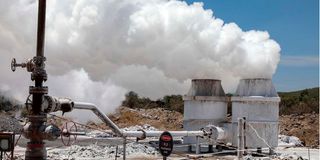
Kenya Electricity Generating Company PLC (KenGen) Olkaria Geothermal well undergoing tests through discharging in preparations for electricity in this picture taken on February 21, 2025.
There is a particular kind of validation that arrives not through applause, but through an invitation.
When the international geothermal community decided that the 2029 World Geothermal Congress, the most prestigious gathering in the global geothermal calendar, held once every five years, would convene in Kenya, it was not simply a scheduling decision. It was a verdict.
The world looked at what this country has built beneath the surface of the Great Rift Valley and said, "You have earned the right to lead this conversation".
Kenya should sit with that for a moment before rushing to logistics.
The World Geothermal Congress brings together thousands of scientists, engineers, policymakers, investors, and energy professionals from more than 100 countries.
It is the forum where the direction of geothermal energy is debated and decided, where breakthroughs are announced, partnerships forged, and investment flows redirected. Previous hosts include Reykjavik, Bali, Melbourne, and Melbourne again. In 2029, they come to Nairobi. That sentence alone rewrites something fundamental about how Africa is perceived in the global clean energy order.
Kenya ranks seventh in installed geothermal capacity worldwide.
More significantly, it stands first in Africa, not by a narrow margin, but by a wide and growing one. This achievement has been built over decades of deliberate, technically demanding work at Olkaria, in the heart of Hell's Gate, where steam has been converted into electricity since the early 1980s.
The Kenya Electricity Generating Company has been the engine of that transformation, drilling wells, building plants, training engineers, and steadily expanding its geothermal fleet, which today powers millions of Kenyan homes and businesses.
Olkaria has become something of a geothermal pilgrimage site, a place that government delegations, development finance institutions, regional energy ministries, and international researchers visit not out of curiosity, but out of the desire to replicate what works.
Ethiopia, Djibouti, Tanzania, Rwanda, and others across the Rift Valley have looked eastward to Kenya for a model.
That positioning gives Kenya a profound responsibility as 2029 approaches, one that goes beyond organising a successful conference. The Congress is a once-in-a-generation opportunity to convert technical credibility into geopolitical influence.
For policymakers and energy regulators across East and Central Africa, it offers a chance to compress years of learning into a single week of high-density exchange with the world's foremost practitioners.
The Rift Valley system that runs through Kenya extends into Ethiopia, Eritrea, Djibouti, Uganda, Tanzania, and Zambia, a subterranean endowment that could, if properly developed, dramatically alter the energy security calculus of an entire region.
Kenya's experience navigating everything from geothermal exploration risk to steam field management to community relations around geothermal sites could form the foundation of a regional knowledge-sharing architecture. The 2029 Congress is the ideal moment to plant that institutional seed.
For investors and development finance institutions, the Congress will shine a spotlight on the African geothermal frontier with an intensity that no bilateral meeting or project prospectus can replicate.
The challenge for Kenya and its neighbours has never been a lack of geothermal resource; the Rift is extraordinarily well-endowed, but rather the perception of risk that attaches to early-stage exploration drilling. Hosting WGC 2029 gives Kenya the platform to make the case, with four decades of operational data behind it, that African geothermal is a proven, investable, and scalable asset class.
The conversations that begin in Nairobi's conference rooms could translate into exploration commitments across the region within years.
For the Kenyan government, the implications extend further still. Energy transition commitments under the Paris Agreement and the African Union's Agenda 2063 both demand a dramatic scaling of clean baseload power. Geothermal, unlike solar and wind, produces electricity around the clock regardless of weather, a characteristic that makes it foundational, not supplementary, to any serious decarbonisation strategy.
Kenya's WGC hosting rights arrive at precisely the moment when the global conversation about energy transition is shifting from aspiration to implementation, from nationally determined contributions to nationally delivered outcomes.
The Congress offers Kenya's leadership a moment to articulate a national geothermal vision that is not merely reactive to international pressure, but genuinely ahead of it.
None of this happens automatically. The period between now and 2029 is not a waiting room; it is a preparation ground.
Kenya must use these years to deepen the scientific and policy thinking it will present to the world, to expand its geothermal capacity so that the story told in Nairobi is one of forward momentum rather than past achievement, and to build the regional convening infrastructure that makes the Congress a catalyst rather than a celebration.
The steam rising from Olkaria has long told a quiet story about what African ingenuity, patience, and technical rigour can produce. In 2029, that story will be told loudly, in one of the world's most consequential energy forums, to an audience that will carry it home to every geothermal frontier on earth.
Kenya did not stumble into this moment. It was built, well by well, megawatt by megawatt. The task now is to be worthy of it.
The writer is the Managing Director and CEO of Kenya Electricity Generating Company PLC. Email: md&[email protected] Twitter: @kenGenMDandCEO