When things fall apart: will AfCFTA hold Africa?

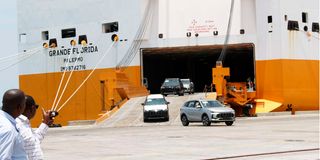
Some of the High End Vehicles whcih are part of the 3800 Cars which were destined for Dubai Port are discharged from Grande Florida Palermo Ship at the Lamu Port Yard following the ongoing Middle East Conflict in this photo taken on March 19, 2026.

Photo credit: Kevin Odit | Nation Media Group

Long layovers often send me wandering through airport malls searching for new perfumes or scanning shelves for the elusive “Made-in-Africa” labels. On February 28, at Singapore’s Changi Airport, after a week of International Law training at the National University of Singapore, I was admiring the Jewel Rain Vortex when breaking news cut through the calm.

The UAE had just closed its airspace following overnight missile and drone exchanges between the US-Israel coalition and Iran. Flights were halted, operations were suspended, and stranded passengers were moved to hotels while awaiting updates.
Amid that uncertainty, my thoughts drifted toward the fragility of the global order and the visible cracks in the international legal system designed to uphold peace. The UN Charter’s commitment to “save succeeding generations from the scourge of war” felt increasingly tested.

In moments like these, Kwame Nkrumah’s warning resonated strongly: “Divided we are weak; united, Africa could become one of the greatest forces for good in the world.”

The geopolitical crisis was, and still is, a reminder that Africa cannot afford fragmentation in an era where global disruptions travel quickly across borders.

The world is still recovering from the Covid‑19 supply chain collapse and the volatility triggered by the Russia-Ukraine war. During that conflict, African airlines, including Ethiopian Airlines, rerouted critical cargo when European freight corridors buckled, demonstrating resilience often overlooked by global observers. Today, as geopolitical tensions disrupt major trade routes, Africa faces a similar inflexion point.

In this instance, the African Continental Free Trade Area (AfCFTA), designed to merge 55 markets into a single $3.4 trillion bloc serving 1.4 billion people, offers the continent its strongest shield against global shocks. Rather than relying on external routes, AfCFTA provides a framework for integrated trade corridors that enhance Africa’s autonomy and economic resilience.

The Strait of Hormuz crisis and Iran’s blockade have slowed the world’s most critical shipping route, forcing vessels to delay or divert.

Amidst the disruption lies an unexpected African advantage. Bloomberg reports that the Hormuz shutdown has transformed Kenya’s Lamu Port into a refuge for vessels unable to access the Gulf or safely transit the Red Sea.

Lamu has handled 74 vessels since January, a third of its total traffic since 2021, compared to just two container ships in the same period last year.

This surge includes major vehicle shipments from Japan redirected from Jebel Ali, with shipping agents now scrambling for additional docking space.

At the same time, the fragility of Africa’s external dependencies is evident in decisions such as Hapag‑Lloyd’s suspension of all cargo bookings between Africa and the Upper Gulf, triggered by escalating security risks following the global disruptions.

This suspension disrupted shipments destined for the UAE, Qatar, Iraq, Kuwait and Saudi Arabia, affecting flows of minerals, agricultural goods, petroleum derivatives, and manufactured items.

The Lamu Port surge and the Hapag‑Lloyd suspension expose both the vulnerabilities and the opportunities embedded in global disruption. With AfCFTA as an enabling framework, such opportunities could accelerate the continent’s transformation into a central trade corridor when traditional routes falter.

Global firms are increasingly drawn to Africa’s relative stability and the policy alignment provided by the AfCFTA to minimise geopolitical risk. Volkswagen’s expansions in Ghana and Rwanda highlight this shift toward regional production.

However, to sustain this momentum, the continent must prioritise removing non-tariff barriers, streamlining customs, and strengthening cross-border value chains.

The same logic applies to energy. Middle East instability continues to rattle global oil markets, yet Africa now possesses the tools to coordinate regional energy planning, expand refining capacity, and advance integrated power corridors.

The Dangote Refinery and the promise of the Grand Inga Dam show how regional infrastructure can reduce external dependence. Financial innovations like the Pan‑African Payment and Settlement System (PAPSS) further insulate African economies from dollar‑linked volatility.

Despite isolated challenges, Africa is emerging as one of the more stable macro‑regions at a time when traditional manufacturing hubs face escalating geopolitical risks. The world is searching for new anchor points in global supply chains. Africa can be that anchor if it acts urgently and decisively.

The AfCFTA is more than a policy document; it is Africa’s shield against global volatility and its platform for economic self‑determination. But its promise depends entirely on implementation. The global economic map is shifting swiftly. Trade routes are being re‑drawn. Shipping patterns are being re‑engineered. Africa cannot afford to stand by merely as an observer.

This is the moment for African governments to deepen integration, modernise infrastructure, and build the continental trade arteries needed to withstand global shocks.

With disruptions to major trade corridors reshaping global trade in ways that are both challenging and unexpectedly advantageous, the continent stands before a historic opportunity. Africa must not waste it.

Faith Chelangat is an International Trade Lawyer and an Associate with ALN Kenya

PAYE Tax Calculator

Note: The results are not exact but very close to the actual.